
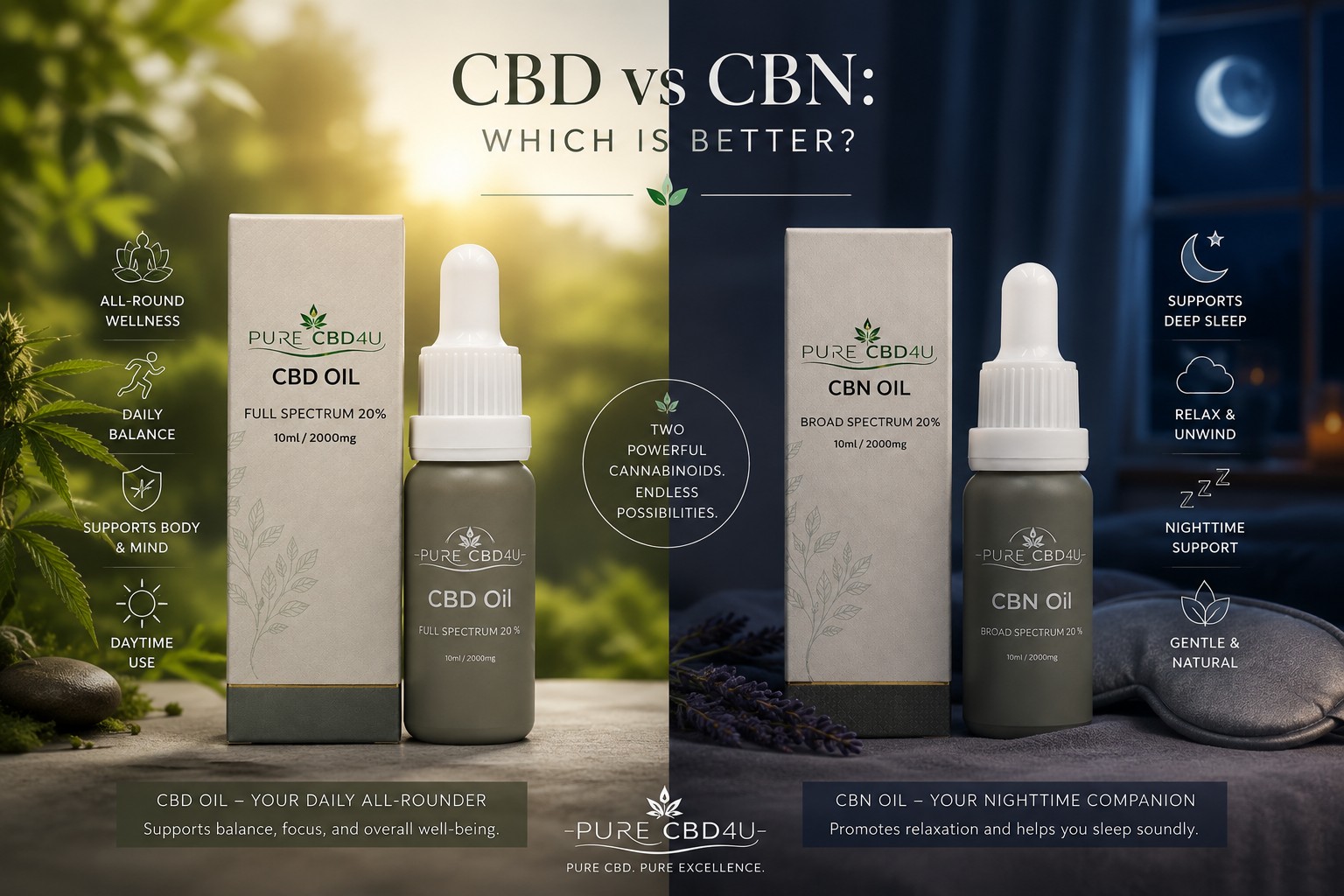
CBD and CBN both come from the same plant, yet they behave quite differently once they reach the body. One has years of research behind it and a reputation for everyday balance. The other is newer to the spotlight, best known for its evening-time appeal. Neither one wins outright — the better cannabinoid depends entirely on what you’re trying to achieve.
| Quick Answer CBD is the more researched, all-purpose cannabinoid, useful for daily wellness, stress, and relaxation.CBN is mainly associated with evening use and sleep-focused formulas, though human evidence is still limited.Many people use both together, since they’re often described as complementary rather than competing. |
What Is CBD?
Cannabidiol, or CBD, is a naturally occurring compound found in hemp and cannabis plants. It doesn’t produce a high, which is part of why it became so widely adopted in the first place. Among all non-intoxicating cannabinoids, CBD remains the most studied after THC itself, with a research base that spans everything from general wellness to specific physiological processes.
Its popularity isn’t limited to one country or one type of user. People reach for CBD oils, gummies, and capsules for a wide variety of reasons:
- Supporting everyday wellness and balance
- Encouraging relaxation after a demanding day
- Managing everyday stress
- Supporting recovery after physical activity
- Maintaining a general sense of equilibrium
Even with this track record, scientists are still uncovering exactly how CBD interacts with the body’s various systems. What’s already known is substantial — but the field keeps evolving, and new studies continue to refine the picture.
What Is CBN?
Cannabinol, or CBN, tells a different story. Rather than being abundant in the fresh plant, it mostly forms as THC ages and oxidizes over time. Fresh cannabis contains only trace amounts of CBN naturally, so most CBN found in products today has been concentrated through extraction and processing rather than harvested directly.
Interestingly, CBN’s popularity has grown almost entirely around one use case: nighttime routines. Brands frequently position CBN oils and capsules as sleep aids, and consumer chatter around the cannabinoid tends to focus squarely on winding down before bed.
That said, the scientific record for CBN is still thin. Most of what circulates online comes from anecdotal reports and early lab research rather than large-scale human trials, so it’s worth treating CBN’s sleep reputation as promising but unproven rather than settled fact.
CBD vs CBN: Key Differences
Seeing the two cannabinoids side by side makes the contrast easier to grasp:
| Factor | CBD | CBN |
| Origin | Occurs naturally in fresh cannabis and hemp plants | Forms as THC breaks down through age and oxidation |
| How it’s produced | Extracted directly from the plant | Usually concentrated from aged hemp or created through controlled oxidation |
| Typical uses | Everyday wellness, relaxation, stress support, recovery | Evening wind-down, sleep-focused routines |
| Research available | Extensive and still growing | Early-stage, considerably smaller body of evidence |
| Popularity | Widely known and used worldwide | Growing niche interest, especially in sleep products |
| Best time of day | Any time, morning or evening | Most often used at night |
| Product availability | Very wide range of formats and strengths | More limited, usually oils or sleep blends |
| Typical combinations | Full spectrum, broad spectrum, isolate | Often paired with CBD or melatonin in sleep formulas |
| Psychoactive effects | None | None, though it forms from a psychoactive cannabinoid |
| Legal status | Legal in most regions when derived from hemp with low THC | Generally follows the same hemp-derived rules as CBD |
CBD vs CBN for Sleep
CBD
CBD doesn’t act as a sedative in the traditional sense. Instead, it tends to help some people relax, which can indirectly support sleep when stress or a racing mind is what’s keeping them awake. For someone whose sleep trouble stems from tension rather than a physical issue, that calming quality can make a real difference.
CBN
CBN has built its name almost entirely around nighttime use. It’s a frequent ingredient in sleep-specific formulas, often blended with other calming compounds. Here’s the part many marketing pages skip over: human evidence for CBN’s sleep benefits remains limited, and much of its reputation is built on consumer experience rather than controlled clinical studies.
In practice, plenty of sleep products combine CBD and CBN in the same formula, on the theory that the two work better as a pair than either does alone.
CBD vs CBN for Anxiety
This is where the research gap becomes most obvious. CBD has a considerably larger body of scientific literature behind it, particularly around stress, calmness, and general relaxation. CBN, by comparison, has very limited evidence specific to anxiety — most of what’s discussed about CBN centers on sleep rather than mood or stress regulation. If anxiety support is the primary goal, CBD is currently the better-documented option.
CBD vs CBN for Pain
CBD is far more commonly used for pain-related wellness goals, and the research supporting it is proportionately larger. CBN’s role here is still in its early stages — there’s growing interest among researchers, but the studies needed to draw firm conclusions simply haven’t been done yet. Anyone considering CBN specifically for physical discomfort should treat it as an area to watch rather than a proven solution.
Which One Is Better?
Here’s the honest answer: it depends on what you’re solving for.
- Daily wellness → CBD
- Everyday stress → CBD
- General relaxation → CBD
- Sleep support → CBN, or a CBD + CBN combination
- Evening wind-down routine → CBN
- Just starting out → CBD
Rather than searching for a universal winner, it helps to match the cannabinoid to the specific goal at hand.
Can You Take CBD and CBN Together?
Yes — and many people already do. CBD and CBN are frequently described as complementary rather than competing, which is why full-spectrum products and dedicated combination formulas pair them so often. This overlapping, whole-plant effect is sometimes referred to as the entourage effect. If you’d like a deeper look at how cannabinoids interact with one another, our guide on What Is the Entourage Effect? covers it in full.
Possible Side Effects
Both cannabinoids are generally well tolerated, but neither is entirely free of side effects. With CBD, some people report mild drowsiness, a dry mouth, or occasional digestive discomfort. CBN carries a similar side-effect profile, and because it’s frequently used at night, drowsiness is arguably more expected — even desired — with this cannabinoid.
Both CBD and CBN can potentially interact with certain prescription medications. If you’re taking any medication regularly, it’s worth checking with a healthcare professional before adding either cannabinoid to your routine.
How to Choose
A good CBD or CBN product should make it easy to verify what’s actually inside the bottle. Before buying, look for:
- Independent third-party lab testing
- A published Certificate of Analysis (COA)
- Clear, specific cannabinoid content on the label
- A brand with an established, trustworthy track record
- A strength that matches your experience level and goals
On the flip side, be cautious of listings that make sweeping health claims or that can’t produce a lab report on request. Missing documentation is one of the clearest warning signs in this market.
Frequently Asked Questions
Is CBN stronger than CBD?
Not in a straightforward sense. They affect the body differently, so “stronger” depends on what you’re measuring — CBN isn’t simply a more powerful version of CBD.
Is CBD or CBN better for sleep?
CBN has the stronger reputation for sleep, but CBD can help indirectly by easing the stress that often keeps people awake. Many sleep formulas combine both.
Can I take CBD and CBN together?
Yes. They’re commonly combined in full-spectrum products and dedicated sleep or relaxation blends.
Does CBN make you high?
No. CBN is non-intoxicating, even though it forms from THC as it ages.
Which is better for beginners?
CBD is generally the easier starting point, thanks to its wider research base and broader range of everyday uses.
Can I take CBD during the day and CBN at night?
Yes, this is a common approach — CBD for daytime balance, CBN as part of an evening routine.
Are CBD and CBN legal?
In most regions, both follow the same hemp-derived legal framework, provided THC content stays within local limits.
Should I choose CBD or CBN first?
If you’re new to cannabinoids, starting with CBD gives you a well-documented baseline before experimenting with CBN.
Final Thoughts
CBD and CBN each bring something different to the table. CBD remains the stronger all-round choice, largely because of how much more research supports its wide range of everyday uses. CBN, meanwhile, has carved out a genuine niche in evening and sleep-focused routines, even though the science behind it is still catching up to its popularity.
Rather than asking which cannabinoid is objectively better, it’s more useful to ask which one fits your goals, your routine, and your lifestyle. For many people, the real answer isn’t CBD or CBN — it’s CBD and CBN, used at the right time for the right purpose.
Written by Carmen Dos Anjos Germano, Founder of Pure CBD4U
Carmen founded Pure CBD4U after her own search for reliable, high-quality CBD oil, starting with full spectrum CBD oil 5% as part of her personal wellness routine. That experience shaped the company’s focus on transparency, quality and independent testing. Pure CBD4U works with EU-grown hemp, uses third-party laboratory testing, and makes batch results accessible through QR codes on its products. Carmen remains closely involved in product selection, quality standards and the development of the Pure CBD4U range.

Leave a Reply