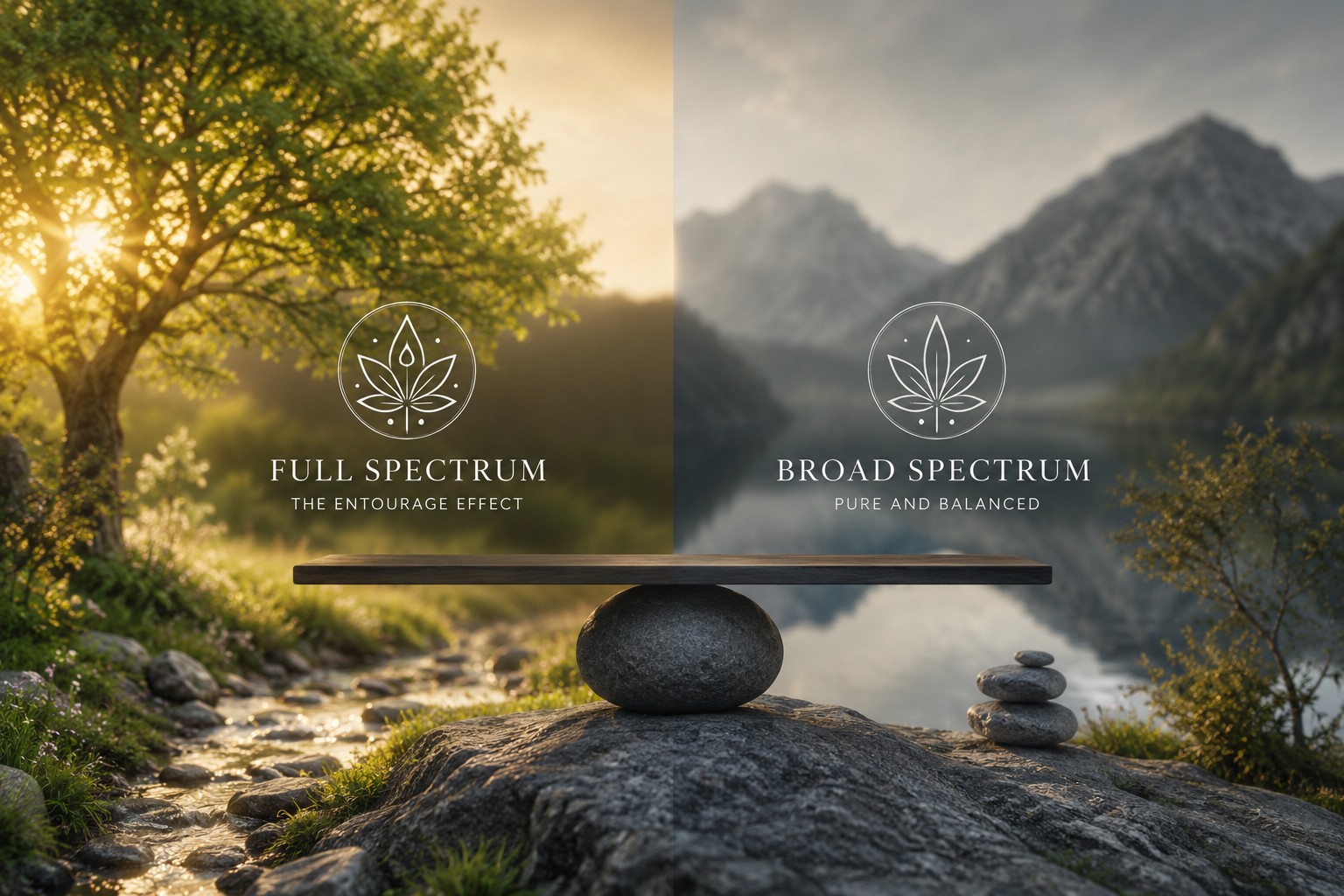
Two bottles, same shelf, same eye level. Same brand, same 10% strength, same 10ml size, same price down to the cent. Pick either one up and you’d struggle to tell them apart by weight or feel. The only real difference sits in a few small words on the label: one says Full Spectrum. The other says Broad Spectrum. And there you are, holding one in each hand, trying to figure out which belongs in your evening routine.
It’s a more interesting moment than it looks. Not because the decision is complicated in some technical sense, but because almost everything that should make it easier — the price, the strength, the branding — has been deliberately equalized. What’s left is the actual question: what do these two words mean for someone specifically trying to manage anxiety, and why does an industry insider’s answer sound less like “pick this one” and more like “it depends on you”?
What’s Actually Sitting Inside Each Bottle
Set the marketing aside for a second and look at what’s chemically true. Both products start from the same place: hemp extract containing dozens of naturally occurring cannabinoids, terpenes, and plant compounds, not just isolated CBD. Full Spectrum keeps that whole profile intact, including trace THC — legally capped, in properly compliant EU products, at under 0.2%. Broad Spectrum starts from that same full profile and then removes the THC specifically, through an additional filtration step, while keeping the rest of the cannabinoid and terpene range largely intact.
That’s the entire structural difference. Not strength, not effectiveness by default, not quality — just whether THC has been filtered out. Everything else about why someone might choose one over the other flows from that single fact.
Why a Few Trace Molecules of THC Change the Decision for Some People
For plenty of buyers, 0.2% THC is a non-issue — a legal technicality with no practical bearing on their day. For others, it’s the entire deciding factor, and for reasons that have nothing to do with wanting or not wanting a high, since a properly dosed bottle at that concentration isn’t intoxicating either way.
Drug testing is the most concrete version of this concern. Workplace tests, particularly in safety-sensitive roles or in industries with zero-tolerance policies, can in rare cases detect trace THC after heavy or prolonged Full Spectrum use, even at legal concentrations. Broad Spectrum removes that risk almost entirely, which is exactly why people in regulated professions — aviation, transportation, certain government roles — tend to reach for it specifically, regardless of what they’ve read about entourage effects.
International travel raises a related but distinct concern. THC limits and legal thresholds vary considerably between countries, and even trace amounts that are perfectly legal in the Netherlands may complicate matters elsewhere. Someone who travels frequently for work has a genuinely practical reason to prefer a THC-free product that removes that variable entirely, independent of anything to do with anxiety relief specifically.
| Questions worth asking yourself at the shelf Do I face workplace drug testing, even occasionally? Do I travel internationally with my CBD? Am I personally comfortable with any trace THC, however legal? Am I curious about the entourage effect, or would I rather remove that variable? |
The Entourage Effect: What’s Genuinely Known, and What’s Still a Theory
This is where a lot of Full Spectrum marketing gets ahead of the science, so it’s worth being precise. The entourage effect refers to the theory that cannabinoids and terpenes work more effectively together than any single compound does in isolation — that THC, even at trace levels, might enhance how CBD interacts with the body’s endocannabinoid system. The theoretical mechanism is plausible and grounded in real pharmacology: these compounds do interact with overlapping receptor systems, and some laboratory research supports synergistic effects between specific cannabinoid combinations.
What doesn’t exist yet is robust clinical evidence specifically proving that Full Spectrum products outperform Broad Spectrum ones for anxiety in humans. Most of what circulates as confirmation of the entourage effect is preclinical research, anecdotal comparison, or reasoning by analogy rather than head-to-head human trials isolating spectrum type as the only variable. Someone choosing Full Spectrum for the entourage effect is making a reasonable bet based on a credible theory — not acting on settled science, whatever a product page might imply.
Back to the Shelf: What Actually Tips the Decision
For a buyer with no drug testing concerns, no imminent international travel, and general comfort with trace THC, the decision often comes down to something closer to intuition — an interest in the fuller plant profile and a willingness to test whether the entourage effect makes a personal difference, weighed against equally reasonable comfort with a THC-free product that removes one variable from an already complex wellness routine.
Taste and routine matter more here than most people expect going in. Full Spectrum tends to carry a slightly earthier, more herbaceous flavor from the fuller compound profile; Broad Spectrum is often marginally milder, though the difference is subtle rather than dramatic. Neither should be the deciding factor on its own, but for someone already hesitant about the taste of CBD oil generally, it’s a legitimate tiebreaker between two otherwise equally reasonable choices.
What Neither Bottle Promises
It’s worth being direct about something that applies to both products equally: neither Full Spectrum nor Broad Spectrum CBD is a guaranteed or clinically proven treatment for anxiety. Research into CBD’s interaction with serotonin receptors and stress-regulation pathways is genuine and growing, and consumer reports of reduced anxiety are common across users of both formulations — but that evidence supports cannabidiol broadly, not one spectrum type specifically over the other. Anyone choosing between these two bottles primarily to treat a diagnosed anxiety condition should be doing so alongside guidance from a healthcare provider, not instead of it.
Leaving the Shelf
The two bottles are exactly where they were when this all started — same brand, same strength, same price, same two words on the label. Nothing about the products themselves has changed in the time it took to work through the decision. What’s changed is which question actually matters: not “which one works better,” because the honest answer is that neither has been proven superior for anxiety specifically, but “which one fits my job, my travel schedule, my comfort with trace THC, and my own curiosity about whether the fuller compound profile makes a difference for me personally.”
Someone flying for work next month, or facing an annual drug screen, has a clear, practical answer sitting right there in that question. Someone with neither concern, genuinely curious about the entourage effect and comfortable with legal trace THC, has an equally clear answer — just a different one. Both people can walk away from that shelf with confidence, not because one bottle beat the other, but because the choice was finally being made on the right grounds. Understanding CBD dosage and how oil, gummies and capsules interact with either spectrum type rounds out the rest of that decision, but the spectrum question itself was never about which is objectively better. It was always about which one is better for you.
This article is intended for general educational purposes and is not medical advice. CBD is not a treatment or cure for anxiety disorders. Anyone considering CBD to manage anxiety, particularly if it is persistent or severe, should speak with a healthcare provider, and should check local regulations before travelling internationally with any CBD product.
Written by Carmen Dos Anjos Germano, Founder of Pure CBD4U
Carmen founded Pure CBD4U after her own search for reliable, high-quality CBD oil, starting with full spectrum CBD oil 5% as part of her personal wellness routine. That experience shaped the company’s focus on transparency, quality and independent testing. Pure CBD4U works with EU-grown hemp, uses third-party laboratory testing, and makes batch results accessible through QR codes on its products. Carmen remains closely involved in product selection, quality standards and the development of the Pure CBD4U range.

Leave a Reply