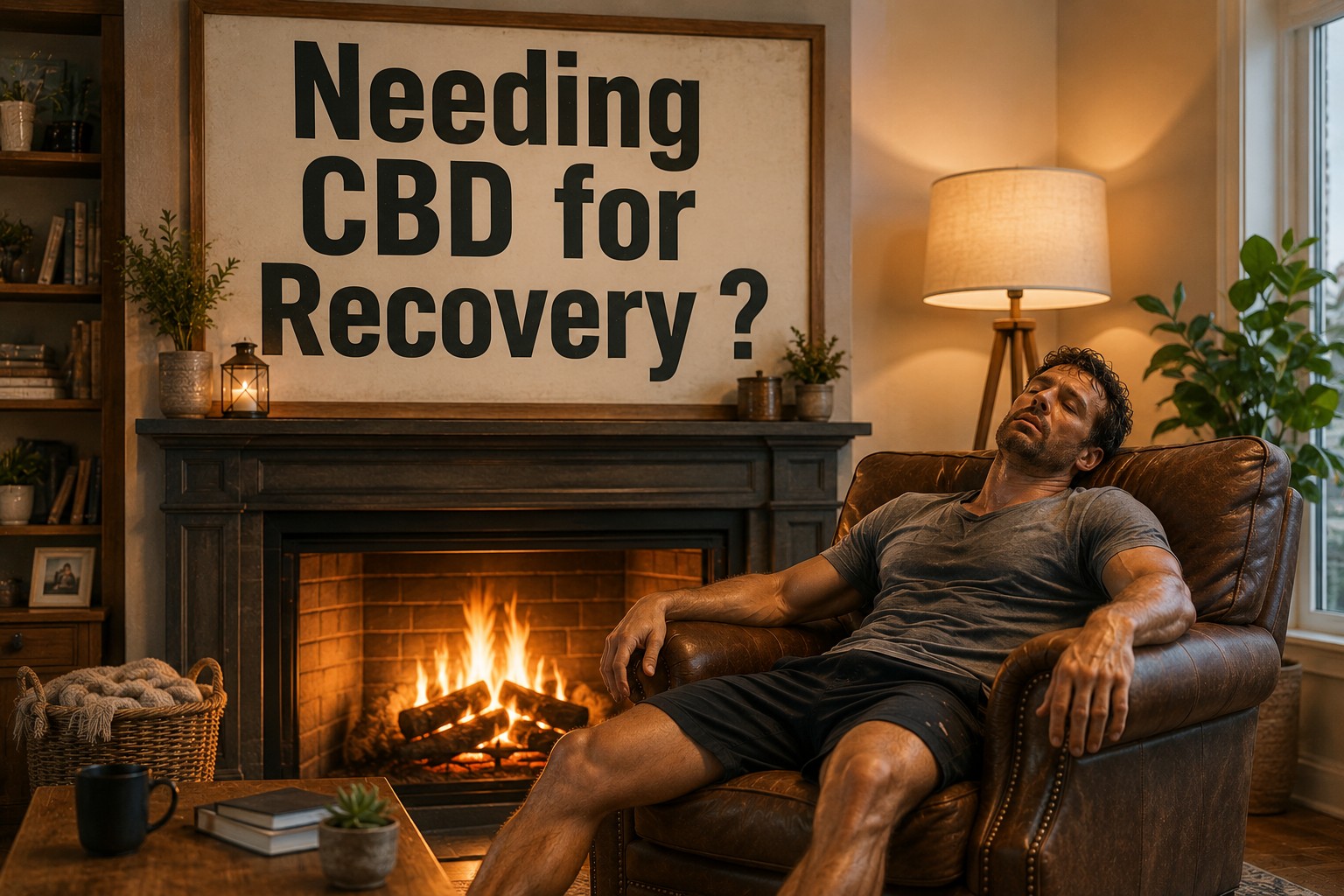
You trained hard yesterday. Today you can feel it — the deep muscle fatigue that sets in a day after a tough session, the stiffness when you swing your legs out of bed, the particular reluctance of your legs on the stairs. This is DOMS: delayed onset muscle soreness. It’s the tax your body charges for adaptation, and most serious trainers know it well.
The question isn’t how to avoid it. It’s how to move through it efficiently — recover properly between sessions, protect your sleep, and get back to training without carrying yesterday’s session into tomorrow’s.
That’s the context in which CBD oil for recovery and cannabidiol recovery support make sense. Not as a quick fix or a performance enhancer, but as a practical support tool in a routine that takes recovery seriously.
What Recovery Actually Is (And Why It Matters More Than Training)
Recovery isn’t passive. It’s not simply the absence of exercise — it’s an active biological process during which your body does the work that training initiates. When you stress muscle tissue through lifting, running or any sustained physical effort, you create micro-damage. The inflammatory response that follows isn’t a problem to suppress; it’s the signal that triggers repair, protein synthesis, and ultimately adaptation.
This is why obsessing over training volume while underinvesting in recovery is one of the most common mistakes active people make. The adaptations you want — strength, endurance, speed — happen during recovery, not during the session itself. Sleep is where growth hormone peaks. Nutrition provides the raw materials for tissue repair. Rest creates the conditions for the body to act on the stimulus you’ve applied.
Recovery support CBD works best when it fits into this framework — supporting the processes that enable recovery rather than trying to shortcut them.
The Four Pillars of Post-Exercise Recovery
Before CBD enters the picture at all, it’s worth being clear about what post workout recovery actually depends on.
Sleep is the biggest lever. Growth hormone release, muscle repair, protein synthesis, and inflammatory regulation all concentrate in deep sleep. If recovery is suffering, sleep quality is usually where the diagnosis starts.
Nutrition — particularly adequate protein and carbohydrate replenishment in the post-workout window — provides the substrate for repair. Hydration affects almost every physiological process involved in recovery, including the removal of metabolic waste products generated during intense exercise.
Movement and mobility — gentle active recovery, stretching, light walks — maintain circulation and prevent the stiffness that comes from complete immobilisation after hard sessions.
Time. DOMS typically peaks 24-48 hours after training and resolves in 3-5 days with appropriate support. There are no shortcuts that meaningfully compress this timeline, only strategies that support it.
CBD for physical recovery fits into this picture as an additional layer of support. CBD muscle soreness support specifically is one of the better-researched active applications., not a replacement for any of the above.
Where CBD Fits Into a Recovery Routine
So where does post workout CBD actually add value? Three areas are supported by both research and consistent user experience.
Recovery-related inflammation support. Exercise generates an acute inflammatory response. Some degree of inflammation is necessary and beneficial — it’s part of the adaptation signal. But when inflammation runs hotter than needed, or when athletes are training at high frequency without adequate recovery windows, the result is excess soreness, fatigue, and reduced performance. Current research suggests CBD may interact with inflammatory pathways in ways that help moderate — rather than suppress — the inflammatory response. This is meaningfully different from using anti-inflammatory drugs, which can blunt the adaptation signal if used too aggressively. Our CBD oil for inflammation article covers the underlying mechanisms.
Sleep quality support. Recovery happens in sleep, and training loads that challenge the body significantly can paradoxically disrupt it — elevated cortisol, physical discomfort, and nervous system activation can all interfere with sleep quality. Many athletes using CBD after exercise report improvements in sleep quality on hard training days specifically, which matters for recovery in a direct, downstream way.
Reducing perceived soreness and tension. Several studies have investigated CBD’s effects on muscle soreness and physical discomfort in active populations. Results have been consistently promising rather than conclusive — effect sizes vary, sample sizes are modest — but the direction of evidence supports CBD’s role in reducing the severity of muscle soreness during recovery periods. Many active CBD users describe less resistance getting back to training after hard sessions, which has practical implications for training consistency.
Building a Practical Recovery Routine
Here’s what CBD oil for recovery looks like integrated into a realistic post-session routine:
Immediately post-workout: hydration, protein, and carbohydrate replenishment. This is non-negotiable and CBD doesn’t replace it.
Evening: CBD sports recovery fits naturally into an evening wind-down — taken alongside a meal, 60-90 minutes before sleep. The timing supports both the relaxation aspect (particularly useful on days when physical effort has left the nervous system activated) and the sleep quality dimension. Our best time to take CBD oil article goes deeper on timing strategies.
Before sleep: light stretching or mobility work combined with CBD can support the physical and mental transition into restorative sleep — the period when recovery does most of its heavy lifting.
Between sessions: on rest days, consistent daily CBD use maintains a stable baseline that may support ongoing inflammatory balance rather than leaving it to spike and crash between sessions. Our CBD oil for daily wellness guide covers this longer-term routine perspective.
For spectrum choice, many athletes prefer full spectrum CBD for recovery applications, with the reasoning that the full cannabinoid and terpene profile may provide more comprehensive support than isolate. Our full spectrum vs broad spectrum CBD guide explains the practical differences. And if you’re curious whether CBG or CBN might complement your recovery stack alongside CBD, the CBD vs CBG vs CBN comparison is worth reading — CBN in particular has attracted interest for sleep-focused recovery support.
Realistic Expectations
CBD oil for recovery isn’t a performance enhancer. It won’t increase your one-rep max, improve your VO2 max, or help you train harder. What it may do is support the biological processes that let you recover better between the sessions you’re already doing — and for athletes and regular trainers, recovery capacity is a genuine limiter of long-term progress.
The difference between an athlete who recovers well and one who doesn’t isn’t just comfort — it’s training frequency, training quality, and ultimately adaptation over time. Anything that supports recovery in a safe, well-tolerated way has real value in that context, even if it’s not dramatic.
CBD oil for recovery — natural recovery support at its most practical — is best understood as one tool in a serious recovery toolkit — alongside the sleep hygiene, nutrition, hydration, and mobility work that it complements rather than replaces.
Before starting a daily CBD routine, our CBD dosage guide helps with appropriate amounts for active users, and the CBD side effects guide is worth reading to understand the full picture.
Frequently Asked Questions
Does CBD help with muscle recovery?
Current evidence suggests CBD may support muscle recovery by interacting with inflammatory pathways, improving sleep quality on hard training days, and reducing perceived soreness. Results from human studies are promising but still limited in scale. Most active CBD users report improvements in recovery quality rather than speed.
When should I take CBD after a workout?
Most people find CBD after exercise most useful in the evening — taken with a meal 60-90 minutes before sleep. This aligns CBD timing with the peak recovery window and supports sleep quality, which is when most physical repair occurs.
Can CBD reduce muscle soreness?
Early research suggests CBD may reduce the severity of DOMS for some users, though effect sizes vary between individuals. It doesn’t eliminate soreness entirely — which wouldn’t necessarily be desirable — but many active users describe less resistance returning to training after hard sessions.
Should I take CBD before or after exercise?
Both are used. Pre-workout CBD may help with focus and reducing pre-session nervous tension; post-workout CBD is more commonly used for recovery and sleep support. Most recovery-focused users prioritise the post-workout window.
How long does CBD take to help with recovery?
Some effects — particularly on sleep quality — may be noticeable within days of consistent use. For cumulative benefits like reduced training-related soreness over time, a more accurate evaluation period is two to four weeks of daily use.
Is CBD good for athletes and serious trainers?
CBD is generally well tolerated and is not a prohibited substance under WADA guidelines at typical wellness doses. For serious athletes in tested sports, verifying the specific product through third-party testing is important to avoid contamination risks. Our guide on how to choose high-quality CBD oil covers this.
Related reading: CBD Oil for Joint Support
Written by Carmen Dos Anjos Germano, Founder of Pure CBD4U
Carmen founded Pure CBD4U after her own search for reliable, high-quality CBD oil, starting with full spectrum CBD oil 5% as part of her personal wellness routine. That experience shaped the company’s focus on transparency, quality and independent testing. Pure CBD4U works with EU-grown hemp, uses third-party laboratory testing, and makes batch results accessible through QR codes on its products. Carmen remains closely involved in product selection, quality standards and the development of the Pure CBD4U range.

Leave a Reply