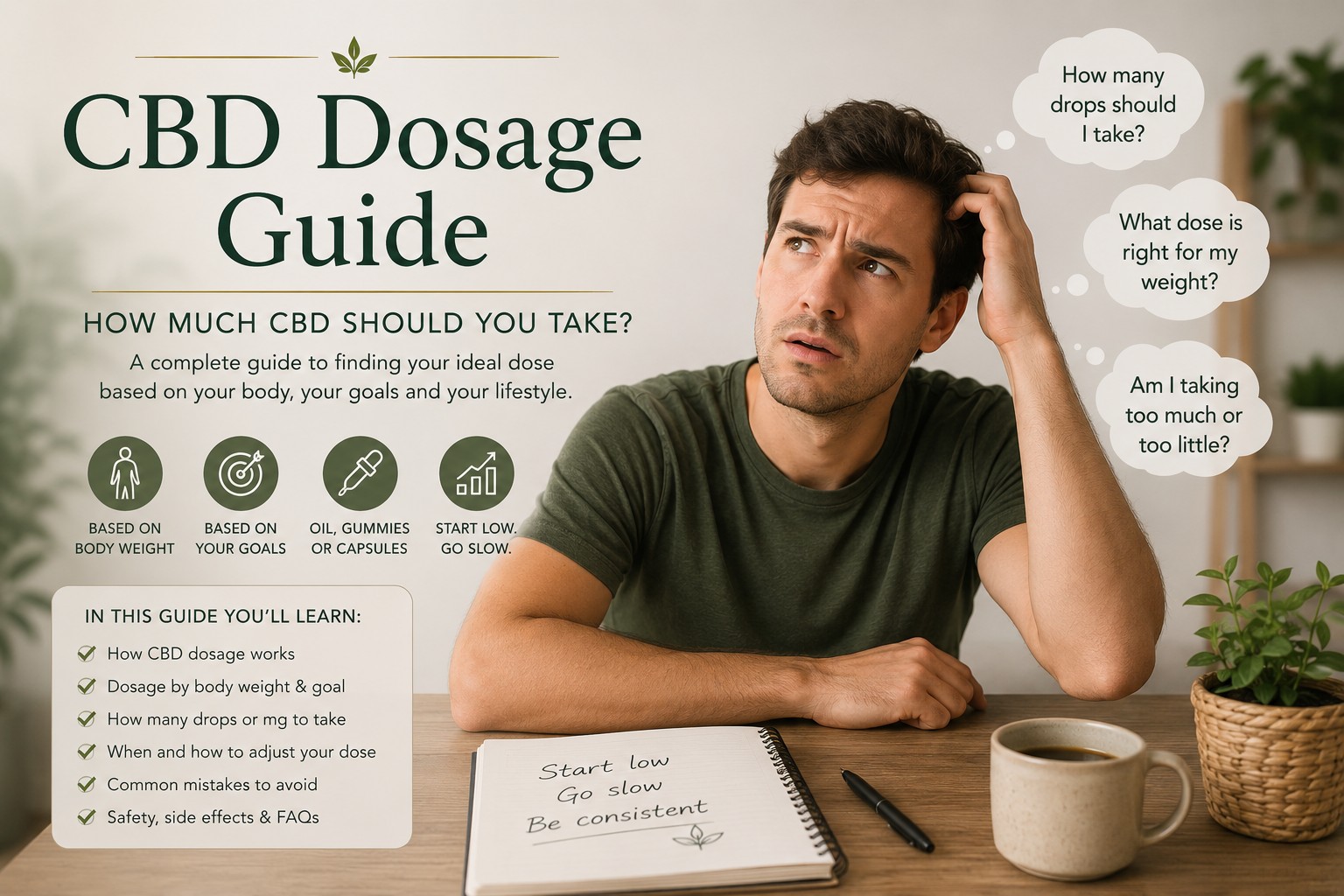
How much CBD should I take? It’s the single most common question anyone new to cannabidiol ends up asking, usually right after buying their first bottle and staring at a dropper with no idea where to start, and the honest answer is that there is no universal CBD dose that works the same way for every person, every product, and every goal. This CBD dosage guide exists specifically to replace that uncertainty with a clear, workable framework: what determines your ideal amount, how body weight and metabolism and experience level shift that number, how strength and delivery method change the math, and how to adjust safely over time without guessing. There’s no single milligram figure because CBD doesn’t behave like a standardized over-the-counter drug with one approved dose for everyone; it behaves more like caffeine or even food, where a reasonable amount for one person can be noticeably too much, or too little, for another person of a different size, tolerance, and goal entirely.
This guide is written for two overlapping audiences: people taking their very first dose of CBD oil, gummies, or capsules who need a sensible, low-risk starting point, and existing users who’ve been taking CBD for a while but never actually worked out whether their dose is well-matched to their body weight, their goal, and the strength of their specific product. By the end of this CBD dosage guide, you’ll understand how to read a bottle’s strength, translate that into actual milligrams per drop, adjust your starting dose based on body weight and your reason for taking CBD in the first place, recognize the signs that your dose is too low or too high, and know when and how to safely increase it. We’ll also walk through what a CBD dosage calculator actually does under the hood, so that if you do use one, whether through a dedicated CBD app, a CBD drops calculator, or a simple CBD bottle calculator, you understand the math behind the number it gives you rather than treating it as a black box.
What Is CBD Dosage?
Answering how much CBD should I take starts with understanding what a CBD dose actually is: the amount of cannabidiol, measured in milligrams, that a person takes in a single serving or across a day. That sounds straightforward until you realize that the same bottle of CBD oil can deliver wildly different milligram amounts depending on the strength printed on the label, the size of the dropper, and how many drops someone actually counts out, which is exactly why so many people feel lost the first time they try to dose CBD oil correctly. Unlike a tablet of ibuprofen, where the milligram content is fixed and identical in every pill, your CBD intake is something you actively control and calculate yourself, drop by drop or gummy by gummy, which is empowering once you understand the math and confusing before you do.
A useful way to answer how much CBD should I take is to think of it as a combination of two numbers: the concentration of the product, which tells you how many milligrams are packed into each milliliter or each drop, and the amount you choose to take, measured in drops, milliliters, or whole gummies and capsules. Get comfortable with that relationship and the question of how much CBD should I take stops being mysterious; the rest of this CBD dosage guide becomes mostly a matter of plugging your own body weight, goal, and product strength into a framework you already understand, rather than memorizing a single number that’s supposed to apply to everyone.
Why There Is No Universal CBD Dose
If you’ve searched for a single authoritative CBD dosage chart with one correct number, you’ve probably noticed that no two sources agree, and that’s not because the people writing them disagree about the science; it’s because no universal CBD dose exists in the first place. The FDA has not established an official recommended daily dose for CBD the way it has for vitamins or many over-the-counter medications, largely because CBD is sold as a dietary supplement rather than an approved drug for general use, with one narrow prescription exception used for specific severe seizure disorders. Without that kind of regulatory standard-setting, dosage guidance has been built instead from a patchwork of human studies, animal research, and real-world reporting from millions of regular users, which is genuinely useful but inherently more variable than a single fixed number.
Clinical evidence indicates that effective doses across published research range enormously, from a few milligrams in studies on everyday anxiety to several hundred milligrams daily in trials involving severe, treatment-resistant epilepsy under direct medical supervision. That spread alone should tell you that “how much CBD should I take” doesn’t have one right answer; it has a right answer for your specific body, your specific goal, and the specific product strength sitting in front of you, which this CBD dosage guide is built to help you work out for yourself rather than copying a number from someone else’s bottle.
How CBD Works in the Body
To understand why how much CBD works best varies so much from person to person, it helps to understand a little about how CBD actually works once it’s in your system. CBD interacts with the endocannabinoid system, a network of receptors found throughout the brain, nervous system, and immune cells that plays a role in regulating mood, sleep, pain perception, and stress response. Because each person’s individual endocannabinoid system varies somewhat from person to person, partly due to genetics and partly due to lifestyle factors, the same milligram amount of CBD can produce a noticeably different effect in two different people, even when their body weight is similar.
Beyond how the endocannabinoid system itself processes cannabinoids, CBD is also fat-soluble, dissolving more readily in fat than in water, which affects both how it’s absorbed and how long it lingers in the body depending on someone’s individual body composition. Existing research shows that bioavailability, the percentage of a dose that actually reaches your bloodstream in active form, varies significantly by delivery method: CBD oil taken sublingually tends to have meaningfully better bioavailability than CBD gummies or capsules that must first pass through digestion, which is one of the more practical reasons dosage recommendations differ across delivery methods covered later in this guide.
Why Everyone Responds Differently
Two people of identical body weight, taking the exact same milligram dose of the exact same CBD oil, can report genuinely different experiences, and that variability isn’t a flaw in the product; it’s a normal feature of how cannabinoids interact with a system that differs meaningfully from person to person. Published literature on CBD pharmacology points to several underlying reasons: differences in liver enzyme activity that affect how quickly CBD is metabolized, differences in the density and sensitivity of endocannabinoid receptors, and simply differences in prior exposure to cannabinoids, since regular users sometimes report needing a higher dose to notice the same effect a first-time user gets from a smaller amount.
This is exactly why this CBD dosage guide leans so heavily on the principle of starting low and adjusting gradually rather than handing you one fixed number and calling it done. Available evidence suggests that individual response is genuinely one of the biggest variables in how CBD behaves, more so than with many other supplements, which makes a personalized, gradual approach far more reliable than copying a friend’s dose simply because you weigh roughly the same amount.
Factors That Affect CBD Dosage
Several concrete, identifiable factors shift what counts as an appropriate dose for any given person, and understanding each one individually makes the overall calculation far less mysterious.
Body Weight
Body weight is one of the most consistently cited factors in dosing guidance, on the logic that a larger body generally requires more of a substance to achieve the same relative concentration in the bloodstream. A commonly referenced starting framework suggests roughly 1 to 6 milligrams of CBD per 10 pounds of body weight, depending on the intensity of the effect someone is seeking, which means a 150-pound adult and a 220-pound adult starting at the same intended intensity would reasonably end up with two different starting doses. We’ll return to specific CBD dosage by body weight numbers shortly, since this is genuinely one of the most useful calculations in this entire guide.
Metabolism
Metabolism affects how quickly CBD is processed and cleared from the body, which influences both how soon you’ll notice an effect and how long that effect lasts. People with a faster metabolism often report needing slightly more frequent dosing, or a marginally higher single dose, to maintain a consistent effect throughout the day, while people with a slower metabolism may find that a lower dose lasts noticeably longer, sometimes requiring less frequent dosing than the standard once or twice daily pattern.
Age
Age plays a more nuanced role than body weight or metabolism alone. Older adults sometimes process medications and supplements more slowly due to changes in liver function over time, which can mean a comparatively lower starting dose is appropriate even at a similar body weight to a younger adult. This is one of several reasons a healthcare professional should be part of the conversation for older adults managing multiple existing health conditions or medications, rather than relying solely on a generic CBD dosage chart built around a general adult population.
Experience Level
Whether you’re brand new to CBD or have been taking it consistently for months changes the appropriate starting point considerably. CBD dosage for beginners should almost always start lower than what an experienced user has worked their way up to over time, since tolerance and familiarity with how your own body responds both build gradually. Jumping straight to an experienced user’s dose as a first-time user skips the most important part of this entire process: learning how your own body responds before assuming you need more.
Symptoms and Goal
What you’re actually trying to address shapes dosage as much as any other factor on this list. Dosing for general daily wellness tends to sit lower than dosing for more specific, intense goals like significant pain or sleep disruption, partly because milder goals often respond to milder, more consistent doses while more disruptive symptoms sometimes require a higher dose to produce a noticeable effect. We’ll cover dosing by goal in detail in its own dedicated section below.
CBD Strength
The strength of the product you’ve bought, typically expressed as a percentage on CBD oil bottles, such as 5%, 10%, 20%, or 30%, directly determines how many milligrams you’re getting per drop or per milliliter. This is arguably the single most overlooked factor by beginners, who often focus entirely on number of drops without realizing that a drop from a 5% bottle and a drop from a 30% bottle contain wildly different amounts of actual CBD. We’ll walk through the exact milligram math for each common strength later in this guide.
Delivery Method
Whether you’re taking CBD oil, CBD gummies, or CBD capsules changes both the speed of onset and, to some degree, the effective dose, since oil taken sublingually tends to have somewhat better bioavailability than products that must be digested first. This doesn’t necessarily mean you need a higher milligram dose in gummy or capsule form to get an equivalent effect, but it’s a meaningful enough difference that switching delivery methods is a reasonable moment to revisit your dose rather than assuming the same number works identically across formats.
CBD Dosage for Beginners
If you’re taking CBD for the first time, the single most important piece of advice in this entire CBD dosage guide is to start low and increase gradually rather than guessing at a number that sounds reasonable. A sensible CBD dosage for beginners typically falls between 5 and 15 milligrams per dose, taken once or twice daily, with at least a few days at that starting amount before considering any increase. This range isn’t arbitrary; it reflects the lower end of doses studied across published human research for general wellness use, low enough to minimize the chance of side effects while still being high enough that most beginners notice some effect within the first one to two weeks of consistent use.
Translating that milligram target into an actual number of drops depends entirely on your product’s strength, which is exactly why a CBD dosage calculator, CBD drops calculator, or simple CBD bottle calculator becomes genuinely useful rather than an unnecessary extra step. A beginner using a 5% CBD oil and a beginner using a 20% CBD oil need very different numbers of drops to land on the same 10-milligram starting dose, and conflating “a few drops” with “the right dose” is one of the most common mistakes new users make. We’ll walk through the specific milligram-per-drop math for every common strength shortly.
CBD Dosage by Body Weight
Body weight-based dosing gives you a more personalized starting point than a flat, one-size-fits-all number, and it’s one of the more practical tools in this CBD dosage guide for narrowing down where to begin. A commonly used framework suggests:
- Low intensity (general wellness): approximately 1 milligram of CBD per 10 pounds of body weight
- Medium intensity (moderate symptoms): approximately 3 milligrams of CBD per 10 pounds of body weight
- High intensity (significant symptoms, under guidance): approximately 6 milligrams of CBD per 10 pounds of body weight
Using this CBD dosage by body weight framework, also sometimes called CBD dosage by weight for short, a 130-pound adult starting at low intensity would land around 13 milligrams, while a 200-pound adult at the same low intensity would land closer to 20 milligrams. A 130-pound adult exploring medium intensity might reasonably take around 39 milligrams, while a 200-pound adult at that same medium intensity might take closer to 60 milligrams. These numbers are starting estimates rather than fixed prescriptions, and they work best as a sensible range to begin within rather than an exact target to hit precisely on day one.
It’s worth being clear that dosing by body weight is a useful heuristic, not a clinically validated formula the way dosing is calculated for many prescription medications. Existing research hasn’t settled on one definitive body weight equation, partly because body weight is only one of several factors discussed earlier in this guide, but it remains one of the most practical, repeatable starting points available to a beginner trying to translate general advice into an actual number.
CBD Dosage by Goal
Why you’re taking CBD matters just as much as your body weight when it comes to choosing an appropriate starting dose, since different goals tend to cluster around somewhat different ranges in both published research and real-world reporting from regular users.
CBD Dosage for Anxiety
Dosing CBD for anxiety is one of the more heavily studied use cases, with several human studies using doses in the range of 25 to 75 milligrams for situational anxiety, sometimes considerably higher in controlled clinical settings using purified, pharmaceutical-grade CBD rather than an over-the-counter oil. For everyday anxiety management with standard wellness products, many users start lower, often in the 10 to 30 milligram range, and adjust upward gradually based on how they respond rather than starting at the higher end seen in clinical trials, which often involved doses and oversight not directly comparable to typical at-home use.
CBD Dosage for Stress
Dosing for stress overlaps considerably with anxiety dosing, since the two are closely related physiologically, though everyday stress management often responds to a more modest, consistent daily dose in the 10 to 25 milligram range rather than the higher amounts sometimes used in clinical anxiety research. Many users managing routine daily stress prefer a steady, predictable dose taken at the same time each day rather than varying the amount based on how stressful any particular day happens to be.
CBD Dosage for Sleep
Dosing for sleep tends to run somewhat higher than dosing for general daytime stress, with many users settling between 20 and 40 milligrams taken thirty to sixty minutes before bed. Early findings indicate that higher doses may have more sedating effects than lower doses, which is part of why sleep-focused dosing skews toward the higher end of typical beginner ranges, though starting lower and increasing gradually still applies even when sleep is the specific goal.
CBD Dosage for Pain
Dosing for pain varies considerably depending on the type and severity of discomfort involved, with general everyday aches often responding to doses in the 15 to 30 milligram range, while more significant, chronic pain has been studied at higher doses, sometimes 40 milligrams or more daily, in research settings. As with every other goal-based category in this guide, working upward gradually from a lower starting dose remains the safer approach than beginning at the higher end of any published range.
CBD Dosage for Recovery
Dosing for recovery, meaning post-exercise or general physical recovery use, tends to mirror pain-focused dosing fairly closely, often in the 15 to 30 milligram range, sometimes timed specifically after physical activity rather than as a steady daily baseline. Some users prefer combining a daily baseline dose with an additional dose specifically after particularly demanding physical activity, though this kind of layered approach works best once you already have a clear sense of how your body responds to a single daily dose first.
CBD Dosage for Daily Wellness
Dosing for daily wellness, for people without one specific symptom they’re targeting, generally sits at the lower end of the overall spectrum, often 10 to 20 milligrams taken once daily as a consistent baseline. This is frequently the most appropriate starting category for true beginners, since it doesn’t require estimating the severity of a specific symptom and simply establishes a steady, low-risk foundation that can be adjusted later if a more specific goal emerges.
CBD Oil Dosage
CBD oil dosage is calculated by drops or milliliters rather than a fixed unit, which gives it more flexibility than gummies or capsules but also means you need to understand your specific bottle’s concentration before you can dose it accurately. Most standard droppers deliver approximately 20 drops per milliliter, though this can vary slightly by manufacturer, which is part of why checking your specific product’s labeling matters more than relying on a single universal drops-to-milliliters conversion.
If you’re still wondering how much CBD oil dosage actually means in practice, think of it as one specific way of answering how much CBD should I take, and separately, how many mg of CBD should I take, just in the specific context of drops rather than gummies or capsules. CBD drops are simply the delivery unit; the milligram content behind each drop is what actually answers how much CBD you’re taking, which is why this CBD oil dosage guide keeps returning to strength percentage as the variable that matters most once you’ve settled on a target milligram amount.
A typical 10-milliliter bottle contains 200 total drops using that standard assumption, and the milligram content of each drop depends entirely on the bottle’s overall strength. Your CBD oil dosage, and your CBD oil dosage chart for future reference, becomes far easier to manage once you’ve worked out your own product’s milligram-per-drop figure, which we’ll calculate explicitly in the bottle strength section just ahead.
CBD Gummies Dosage
CBD gummies dosage is considerably simpler to manage than oil, since each gummy contains a fixed, pre-measured amount, commonly 10, 25, or 50 milligrams per piece depending on the brand and product line. This fixed-dose format removes the drop-counting and strength-percentage math entirely, which makes CBD gummies dosage especially appealing to beginners who find the oil-based calculations intimidating at first.
The tradeoff is precision in the other direction: if your ideal dose falls between two gummies’ worth of CBD, you’re stuck rounding up or cutting a gummy in half, which isn’t always practical depending on the product. Many users handle this by combining CBD gummies with a smaller CBD oil dose on days when they want a more precise total, or by simply choosing a gummy strength that divides evenly into their established target dose.
CBD Capsules Dosage
CBD capsules dosage, much like CBD gummies dosage, works similarly in that each capsule typically contains a fixed amount, often 25 milligrams, making the math straightforward once you know your target. CBD capsules dosage has the added benefit of no flavor or texture considerations, which some users prefer, along with a delivery method that some people find easier to incorporate into an existing daily supplement or vitamin routine rather than treating CBD as a separate, distinct ritual.
Because capsules and gummies are both digested rather than absorbed sublingually, onset tends to take longer, generally thirty minutes to two hours, compared with the fifteen to forty-five minutes typical of sublingual CBD oil. This doesn’t make capsule or gummy dosing less effective; it simply means timing your dose with that slower onset in mind matters more than it does with oil, particularly for goals like sleep where taking a capsule too close to bedtime might mean the effect peaks later than intended.
How Many Drops Should I Take?
How many drops of CBD should I take is one of the most frequently asked questions in any CBD dosage guide, and the honest answer always depends on your bottle’s specific strength rather than a single universal drop count. A reasonable beginner starting point is 2 to 4 drops, once or twice daily, but that range only makes sense once you know how many milligrams those drops actually contain, since 3 drops from a 5% bottle and 3 drops from a 30% bottle deliver dramatically different amounts of CBD.
How Many Milligrams Are in One Drop?
How many mg of CBD should I take, translated into a per-drop figure, depends directly on your bottle’s percentage strength. Using the standard assumption of roughly 20 drops per milliliter, here’s the CBD mg per drop math across common strengths, assuming a typical 10-milliliter bottle:
- 5% CBD oil: 500 total milligrams in the bottle, roughly 2.5 milligrams per drop
- 10% CBD oil: 1,000 total milligrams in the bottle, roughly 5 milligrams per drop
- 20% CBD oil: 2,000 total milligrams in the bottle, roughly 10 milligrams per drop
- 30% CBD oil: 3,000 total milligrams in the bottle, roughly 15 milligrams per drop
This is precisely the kind of calculation a CBD dosage calculator or CBD drops calculator automates for you, but understanding the underlying math means you’re never genuinely dependent on having one handy. If you know your target milligram dose and your bottle’s strength, you can work out the right number of drops with simple division every time, regardless of which specific bottle you’re holding.
Understanding CBD Bottle Strengths
CBD oil is typically sold in a handful of standard strengths, most commonly 5%, 10%, 20%, and 30%, and understanding what these numbers actually represent is essential to using any CBD dosage chart correctly.
5% CBD Oil
A 5% CBD oil is generally the most appropriate strength for true beginners or anyone particularly sensitive to new supplements, since it allows for a comfortable number of drops without needing an impractically small fraction of a drop to hit a low starting dose. The tradeoff is that higher daily targets require a larger number of drops, which becomes less convenient once someone has worked their way up to a more substantial daily amount.
10% CBD Oil
A 10% CBD oil suits people who already have some experience or want a more efficient daily routine without needing an unwieldy number of drops, while still sitting comfortably within a moderate, beginner-friendly range. This strength is often the most popular middle-ground choice precisely because it balances dosing precision against day-to-day convenience.
20% CBD Oil
A 20% CBD oil is generally better suited to people who have already established that they need a higher daily dose, commonly for more persistent discomfort or sleep support, and who want to reach that target efficiently without counting out an excessive number of drops each time.
30% CBD Oil
A 30% CBD oil is typically considered a maximum-strength option, most appropriate for experienced users who already know their effective dose and want to reach it in the fewest possible drops. It is not the ideal starting strength for a true beginner, since the higher concentration per drop makes it considerably harder to dial in a small, precise starting dose without either overshooting comfortably or wasting product trying to measure out a fraction of a single drop.
When Should You Increase Your Dose?
How long before increasing CBD dosage is appropriate is a question with a fairly consistent answer across most practical guidance: give any new dose at least three to seven days of consistent use before deciding it isn’t enough, since CBD’s effects, particularly for less acute goals, often build gradually rather than announcing themselves immediately. Increasing too quickly, before a starting dose has had a fair chance to work, is one of the most common mistakes covered later in this guide, and it tends to produce more side effects without necessarily producing more benefit.
When you do decide to increase, doing so gradually, often by adding just a few milligrams or one to two additional drops at a time, gives you a much clearer picture of where your effective dose actually sits than jumping straight to a significantly higher amount. This step-by-step approach is part of what’s sometimes called finding your CBD sweet spot.
Finding Your CBD Sweet Spot
Finding your sweet spot means identifying the lowest dose that reliably produces the effect you’re looking for, rather than the highest dose you’re comfortable taking. Many users mistakenly assume that more CBD automatically means a stronger or better effect, but available evidence suggests cannabinoid effects don’t necessarily scale in a simple, linear way, and significantly overshooting your effective dose mainly increases the likelihood of mild side effects rather than delivering proportionally greater benefit.
A practical approach to finding your sweet spot involves keeping a simple daily log, even just a quick note on your phone, tracking your dose, the time you took it, and how you felt over the following hours. Over one to two weeks, clear patterns usually emerge, making it much easier to settle into a stable, personal dose that works reliably rather than constantly second-guessing whether you should be taking more or less.
Morning vs Evening: When Should You Take CBD?
CBD morning or evening dosing depends almost entirely on why you’re taking it in the first place. People using CBD for daytime stress, focus, or general wellness often prefer morning dosing, since it avoids any potential mild drowsiness interfering with the day ahead. People using CBD specifically for sleep typically find evening dosing, generally thirty to sixty minutes before bed, makes more practical sense, particularly given that higher, sleep-focused doses tend to be somewhat more sedating.
The best time to take CBD ultimately comes down to consistency as much as the specific hour you choose. Taking your dose at roughly the same time each day helps maintain a steadier baseline level in your system, which many regular users find produces more reliable results than dosing sporadically at different times depending on the day.
Taking CBD With Food
Taking CBD with food is generally recommended for better absorption, since cannabinoids are fat-soluble compounds and a meal containing some dietary fat can meaningfully improve how much of a given dose actually reaches your bloodstream. That said, plenty of people take CBD on an empty stomach without issue, particularly when using sublingual oil rather than a digested format like gummies or capsules, where the digestive process itself is more directly tied to food intake and timing.
If you’re taking a higher dose specifically for a more significant goal like persistent pain or sleep, pairing it with a small, fat-containing snack may meaningfully improve CBD absorption compared with taking the same dose on a completely empty stomach. For lower, daily-wellness doses, the difference is less likely to be noticeable enough to worry about, and consistency in your overall routine matters more than precisely timing each dose around meals.
Can You Take Too Much CBD?
Can you take too much CBD, in the sense of a dangerous overdose, is a different question from whether you can take an unnecessarily large, wasteful dose, and it’s worth answering both directly. Can you overdose on CBD in a life-threatening sense appears very unlikely based on current safety research; there’s no established lethal dose in humans the way there is for many substances, and significant CBD toxicity has not been demonstrated even at doses far higher than typical wellness use. That doesn’t mean unlimited amounts are advisable or that more is automatically better.
Taking far more CBD than your body actually needs mainly increases the likelihood of mild side effects, covered in detail shortly, without providing additional benefit beyond your actual effective dose. Staying within a reasonable, gradually adjusted range, rather than taking an excessive amount in the hope of a stronger result, remains both the safer and the more cost-effective approach.
Signs Your Dose Is Too Low
Recognizing that your current dose may be too low is usually a process of noticing an absence rather than a specific negative symptom. If you’ve been taking a consistent dose for one to two weeks and genuinely haven’t noticed any change in the symptom or goal you started CBD for, that’s a reasonable signal to consider a modest increase rather than assuming CBD simply doesn’t work for you. It’s worth ruling out other factors first, including whether you’ve been consistent with timing and whether your product’s actual CBD content matches its label, before concluding the dose itself is the issue.
Signs Your Dose Is Too High
Signs that your dose is too high tend to show up as the mild side effects covered next: noticeable drowsiness when you didn’t intend to feel sedated, digestive upset, or a sense of grogginess that lingers longer than expected. If you notice any of these patterns consistently, scaling back to your previous, lower dose for a few days before considering any further adjustment is generally the more sensible response than pushing through discomfort in the hope that your body will simply adjust.
Possible Side Effects
CBD side effects are generally described as mild in published literature, though “generally mild” doesn’t mean entirely without exception. Commonly reported CBD side effects, and CBD oil side effects specifically, include drowsiness or fatigue, dry mouth, changes in appetite, and occasional digestive upset such as diarrhea, with most of these effects being dose-dependent, meaning they show up more frequently and more noticeably at higher doses rather than at the lower end of a typical starting range.
As part of the broader picture of CBD side effects, existing research has also found that CBD use at higher doses has, in some studies, been associated with changes in liver enzyme levels, which is part of why people with existing liver conditions are generally advised to discuss their intake specifically with a healthcare professional before starting, rather than assuming standard guidance applies equally to every individual health situation.
CBD Safety
CBD safety, broadly speaking, is one of the more reassuring aspects of the current research landscape, though it comes with real, specific caveats that any honest CBD dosage guide needs to include rather than gloss over. The World Health Organization’s review of cannabidiol concluded that it is generally well tolerated in humans and does not appear to carry the abuse potential or dependence-forming properties associated with many other substances, a conclusion that specifically addressed pure CBD rather than every commercial product currently sold under that label.
The FDA has not approved nonprescription CBD products for treating any condition, and inconsistent labeling across the broader CBD products market remains a genuine concern the FDA has raised directly, which is exactly why dosage guidance only works as well as the accuracy of the product you’re actually using. A CBD oil that contains meaningfully less, or more, CBD than its label claims makes every calculation in this guide unreliable, regardless of how carefully you’ve worked out your intended milligram target.
Drug Interactions
CBD drug interactions are a genuinely important dosage consideration, not a minor footnote. CBD is metabolized by the liver through the same enzyme system responsible for processing a wide range of prescription medications, including blood thinners and certain antidepressants, which means CBD can change how much of another medication remains active in your bloodstream. This shared metabolic pathway is precisely why dosage guidance changes for anyone taking other medications regularly: the safe starting point isn’t just about your body weight and goal, it’s also about what else is already in your system.
Speaking with a healthcare professional before combining CBD with any prescription medication isn’t a generic disclaimer included to cover legal bases; it’s a genuinely practical step that can catch a specific interaction risk no amount of general dosage guidance can anticipate on your behalf. A pharmacist or doctor reviewing your actual medication list is more reliable than any chart, calculator, or guide, including this one.
Using a CBD Dosage Calculator
A CBD dosage calculator takes everything covered in this guide, body weight, goal, product strength, and delivery method, and turns it into a specific number of drops, milliliters, or milligrams without requiring you to do the arithmetic by hand each time. Whether you’re using a dedicated CBD app, a standalone CBD drops calculator, or a simple CBD bottle calculator built specifically around a particular product line, the underlying logic is the same: strength tells you milligrams per drop, your target milligram dose divided by that figure tells you how many drops to take.
A CBD cost calculator serves a related but slightly different purpose, helping you compare the actual price per milligram across different strengths and bottle sizes rather than comparing sticker prices alone, since a higher-percentage bottle is frequently more economical per dose even though its upfront price looks higher on the shelf. Used together, a CBD dosage calculator and a CBD cost calculator take most of the guesswork out of both how much to take and which specific product or strength makes the most practical sense for your situation.
It’s worth remembering that any calculator, including the most sophisticated CBD dosage calculator, is only as accurate as the inputs you give it and the actual CBD content of the product you’re using. Treat the output as a well-reasoned, evidence-informed starting estimate rather than a precise medical prescription, and continue adjusting gradually based on your own observed response exactly as this guide has described throughout.
Does Spectrum Type Affect Your Dosage?
Full spectrum CBD, broad spectrum CBD, and CBD isolate are all dosed using the same basic milligram math covered throughout this guide, but it’s worth understanding why people sometimes assume otherwise. Full spectrum CBD retains trace THC alongside the full range of naturally occurring cannabinoids and terpenes, while broad spectrum CBD keeps most of that same profile with THC removed, and isolate strips everything down to CBD alone. None of these distinctions change the underlying dose-by-weight or dose-by-goal calculations in this guide; they change the THC content and, for some users, the subjective character of the effect through what’s sometimes called the entourage effect, the theory that cannabinoids and terpenes work better together than any single compound in isolation.
This is also where realistic expectations about CBD benefits matter most. The CBD benefits people most consistently report, including support for everyday stress, occasional anxiety, and sleep quality, tend to depend more on consistent, correctly calculated dosing than on which specific spectrum type sits in the bottle. Choosing full spectrum CBD over broad spectrum CBD, or assuming full spectrum CBD products are inherently “more effective” without adjusting your actual dose, misses the point; the CBD benefits you experience are driven primarily by getting the milligram amount right for your body weight and goal, not by the spectrum label on the front of the bottle. THC content matters far more for legal and drug-testing considerations than it does for the core dosing math itself, which is precisely why broad spectrum CBD and CBD isolate exist as lower-THC or THC-free alternatives for people who want the same dosing approach without that specific compound.
Common Dosage Mistakes to Avoid
A handful of avoidable mistakes account for most of the frustration beginners report when dosing CBD. Starting at too high a strength, such as buying a 30% CBD oil as a first purchase, makes it unnecessarily difficult to land on a small, precise starting dose. Increasing your dose too quickly, before giving a starting amount a fair one-to-two-week trial, tends to produce more side effects without proportionally more benefit. Confusing “a few drops” with an actual milligram target, without checking your bottle’s specific strength, is one of the most common and easily corrected errors covered throughout this guide. Ignoring a product’s Certificate of Analysis, commonly abbreviated COA, and never actually checking that COA against the label, means you’re calculating an exact dose based on a number you haven’t actually verified, which undermines the precision of every other step. Finally, assuming full spectrum CBD and broad spectrum CBD require meaningfully different dosing is generally a myth; both are dosed by their CBD content the same way, with the main practical difference being THC content rather than the underlying milligram math itself.
Final Thoughts
Dosing CBD doesn’t have to remain a guessing game, even though the marketplace surrounding CBD products sometimes makes it feel that way. The fundamentals covered throughout this CBD dosage guide are genuinely consistent: start low, typically 5 to 15 milligrams for most beginners, understand your specific product’s strength so you know exactly how many milligrams each drop, gummy, or capsule actually delivers, adjust based on body weight and your specific goal, and give any new dose at least several days before deciding whether to increase it.
It’s worth closing with a few honest caveats that any trustworthy CBD dosage guide should carry. The FDA, and equivalent regulators elsewhere, has not evaluated nonprescription CBD products for safety or effectiveness in the way the FDA evaluates approved medications, and the World Health Organization’s generally favorable safety conclusions about pure CBD don’t automatically extend to every commercial product on the market. CBD side effects, while generally mild, are real, and CBD drug interactions through shared liver enzyme pathways mean this guide can inform your starting point but can’t replace an actual conversation with a healthcare professional if you’re managing other medications or health conditions. Current evidence on optimal dosing continues to evolve, and treating any single number, including the ranges in this guide, as a final answer rather than a well-reasoned starting estimate would overstate what current research actually supports.
Whether you ultimately use a CBD dosage calculator, a CBD drops calculator, or simply the milligram math walked through in this CBD oil dosage guide, the underlying principle stays the same: your dose is something you calculate and adjust deliberately, not something you guess at once and never revisit. Pair that approach with a third-party tested product backed by a verifiable Certificate of Analysis, and you’ll have both the right answer to how much CBD you should take and a product you can actually trust to deliver it.
If you’re still working out the fundamentals, our companion CBD for beginners guide covers the broader basics this dosage-focused article assumes you already know, while goal-specific resources on CBD oil for anxiety, CBD oil for stress, CBD oil for sleep, CBD oil for pain, and CBD oil for depression go deeper into the research behind each individual use case than the brief, dosage-focused summaries here. The same dosing principles apply whether you’re working with full spectrum CBD, broad spectrum CBD, CBD gummies, or CBD softgels, and if you’re curious about related cannabinoids, our guides to CBG oil and CBN oil cover dosing considerations specific to those compounds. Whatever product you choose, take a moment to actually open the lab report tied to your bottle’s batch verification number before your first dose, since every calculation in this guide depends on that label being accurate in the first place.
Frequently Asked Questions
How much CBD should I take?
There’s no single universal answer to how much CBD you should take, since the right amount depends on your body weight, your specific goal, your experience level, and the strength of your particular product. A sensible starting point for most beginners is 5 to 15 milligrams once or twice daily, increasing gradually over one to two weeks based on how you respond. A CBD dosage calculator can help translate that general guidance into an exact number of drops for your specific bottle, but the core principle, start low and adjust slowly, applies regardless of which specific product or strength you’re using.
What is the best CBD dosage for beginners?
Determining the right CBD dosage for beginners, sometimes summarized on a CBD dosage chart for beginners, typically starts in the 5 to 15 milligram range, taken once or twice daily, ideally with a lower-strength product like a 5% or 10% CBD oil that makes it easier to dose a small, precise amount. Starting at a higher strength or a larger milligram amount doesn’t make CBD work faster or better; it mainly increases the likelihood of mild side effects without necessarily improving the outcome you’re hoping for as a first-time user.
How many drops of CBD should I take?
The right number of drops depends entirely on your bottle’s strength, since drops alone don’t tell you the actual milligram amount you’re consuming. Using the common assumption of about 20 drops per milliliter, a 10% CBD oil delivers roughly 5 milligrams per drop, meaning 2 to 3 drops would land close to a typical beginner starting dose. Always check your specific product’s labeling rather than assuming a universal drop count applies across every strength and brand.
How many mg of CBD should I take?
Most beginners considering how much CBD they should take do well starting around 5 to 15 milligrams per dose, while more experienced users managing specific goals like sleep or persistent discomfort sometimes take 25 to 50 milligrams or more, based on gradual increases over time. The right milligram amount for you depends on body weight, goal, and how your body responds, which is why this guide emphasizes a personalized, gradual approach over a single fixed recommendation.
How do I calculate my CBD dosage?
Calculating your dose involves combining your target milligram amount with your product’s specific strength. Divide your target dose by the milligrams per drop, milliliter, gummy, or capsule to find out exactly how much of the product to take. A CBD dosage calculator or CBD drops calculator automates this division for you, but understanding the underlying math means you can work it out manually for any product, strength, or format you encounter.
Does body weight matter for CBD dosage?
Yes, body weight is one of the most commonly used factors in dosing guidance, on the general logic that a larger body typically requires a somewhat larger amount to achieve a comparable effect. A commonly referenced framework suggests roughly 1 to 6 milligrams per 10 pounds of body weight depending on desired intensity. Body weight isn’t the only relevant factor, but it provides a genuinely useful, personalized starting point compared with a single flat dose recommended for every adult regardless of size.
Can I take CBD every day?
Yes, many people take CBD daily, and consistent daily use is actually how most reported benefits tend to build over time rather than appearing after a single isolated dose. Daily use at an appropriate, gradually established dose is generally considered safe for healthy adults, though it’s still worth periodically reassessing your dose and checking in with a healthcare professional, particularly if you’re taking other medications or notice any new effects developing over weeks or months of regular use.
Can I take CBD twice a day?
Yes, splitting a daily total into two smaller doses, often morning and evening, is a common approach that can help maintain a steadier level of CBD in your system throughout the day rather than experiencing a single peak followed by a longer gap with no effect. If you’re currently taking one larger dose and considering splitting it, simply divide your existing milligram amount in half rather than taking two full doses, unless you’ve specifically decided to increase your overall daily total.
Can I take too much CBD?
You can take more than your body actually needs, which mainly increases the likelihood of mild side effects like drowsiness or digestive upset without providing additional benefit beyond your actual effective dose. This is different from a dangerous overdose, which current safety research suggests is very unlikely with CBD specifically. Staying within a reasonable, gradually adjusted range remains both safer and more cost-effective than taking an excessive amount in hopes of a stronger result.
Can you overdose on CBD?
Significant CBD toxicity severe enough to be life-threatening is considered very unlikely based on current research, and there’s no established lethal dose in humans the way there is for many other substances. That said, taking far more than necessary can still produce uncomfortable side effects, including pronounced drowsiness or digestive upset, even if it isn’t dangerous in the way an overdose of many other substances would be. Staying within a sensible, gradually increased range is still the better approach.
When should I increase my dose?
A reasonable rule of thumb is to give any new dose at least three to seven days, and ideally up to two weeks, before deciding it isn’t sufficient. If you genuinely haven’t noticed any change in your target symptom or goal after that period of consistent use, a modest increase, often just a few additional milligrams or one extra drop, is a reasonable next step rather than jumping to a significantly higher amount all at once.
How long before CBD starts working?
CBD oil taken sublingually typically produces noticeable effects within fifteen to forty-five minutes, since some of it absorbs directly through tissue under the tongue. CBD gummies and capsules generally take longer, often thirty minutes to two hours, since they must be digested first. For goals like general mood or sleep quality, the fuller benefit of consistent use sometimes takes days to weeks to become clearly noticeable, rather than appearing after a single dose.
How long do the effects last?
Most users report CBD effects lasting somewhere between four and six hours per dose, though this varies based on individual metabolism, body composition, and the size of the dose taken. This variability is part of why many regular users settle into a consistent once or twice daily routine rather than redosing continuously throughout the day, since a steady baseline tends to produce more reliable results than chasing the tail end of a single dose.
Should I take CBD in the morning or evening?
This depends on your goal. CBD in the morning is often preferred for daytime stress, focus, or general wellness use, since it avoids any potential drowsiness interfering with your day. CBD in the evening, typically thirty to sixty minutes before bed, is more commonly recommended for sleep-focused use, since higher, sleep-oriented doses tend to be somewhat more sedating. Consistency in timing matters more than the specific hour you ultimately choose.
Should I take CBD with food?
Taking CBD with a meal containing some dietary fat can improve absorption, since cannabinoids are fat-soluble compounds. That said, plenty of people take CBD on an empty stomach successfully, particularly with sublingual oil. If you’re taking a higher dose for a more significant goal, pairing it with a small, fat-containing snack may noticeably improve how much of your dose is actually absorbed compared with a completely empty stomach.
Should I take CBD on an empty stomach?
Yes, you can take CBD on an empty stomach, and many people do so without any issue, particularly with sublingual oil rather than digested formats like gummies or capsules. Absorption may be somewhat lower compared with taking CBD alongside a meal containing dietary fat, but for lower, daily-wellness doses, this difference is unlikely to be significant enough to require strict meal timing around every single dose.
Does Full Spectrum CBD require a different dosage?
No, full spectrum CBD is dosed based on its CBD content the same way any other type is, following the same body weight and goal-based guidance covered throughout this guide. The main practical difference between full spectrum CBD and other types is the presence of trace THC and a fuller cannabinoid profile, not a fundamentally different dosing approach or a need for a higher or lower milligram target purely because of the spectrum type.
Does Broad Spectrum CBD require a different dosage?
No, broad spectrum CBD follows the same CBD-content-based dosing logic as full spectrum or isolate products. Since broad spectrum CBD has had THC removed while keeping most other cannabinoids and terpenes, some users report a marginally different subjective experience, but the underlying milligram calculation for your target dose remains the same regardless of which spectrum type you’ve chosen.
Does CBD oil work faster than gummies?
Generally yes. CBD oil taken sublingually tends to act within fifteen to forty-five minutes, since some of it absorbs directly through tissue under the tongue rather than passing entirely through digestion. CBD gummies must be digested first, typically taking thirty minutes to two hours to take full effect. Neither format is more or less effective overall; oil simply tends to act faster, while gummies offer a fixed, pre-measured, more convenient dose.
What strength should beginners buy?
Most beginners do best starting with a 5% or 10% CBD oil, since both make it easier to measure out a small, precise starting dose without needing either an impractically tiny fraction of a drop or an excessive number of drops. Higher strengths like 20% or 30% are generally better suited to experienced users who already know their effective dose and want to reach it more efficiently in fewer drops.
Is 5% CBD oil enough?
For many beginners and for general daily wellness use, yes, 5% CBD oil provides enough flexibility to reach a reasonable starting dose, typically in the 5 to 15 milligram range, within a manageable number of drops. If you’re specifically targeting a more demanding goal like significant pain or sleep disruption, you may eventually need either more drops from a 5% bottle or a higher-strength product to reach an appropriate target dose efficiently.
What CBD benefits should I expect at a typical starting dose?
At a typical beginner dose of 5 to 15 milligrams, the most commonly reported CBD benefits, and the CBD benefits people ask about most, include a steadier mood, easier relaxation, and modest improvements in everyday stress, rather than a dramatic, immediate shift. Reported CBD benefits, and the CBD benefits described throughout this CBD dosage guide, tend to scale somewhat with dose and consistency, which is why a properly calculated starting amount, taken consistently via a CBD dosage chart or CBD dosage calculator, tends to outperform a single oversized dose taken inconsistently. CBD side effects and CBD oil side effects, by contrast, also scale with dose, which is exactly why working from the lower end upward remains the safer strategy for capturing the benefits without unnecessary side effects.
Does it matter whether I use CBD capsules, CBD drops, or gummies for the same dose?
Not for the underlying milligram target itself, but it does affect onset and convenience. CBD capsules and CBD drops dosage both ultimately deliver the same kind of cannabinoid content; capsules and gummies must be digested first, generally taking longer to act than CBD drops taken sublingually. Many users choose CBD drops when they want flexibility to fine-tune an exact milligram amount, and switch to capsules or gummies for convenience once they’ve already settled on a reliable daily dose using a CBD bottle calculator or similar tool.
Should I buy 10%, 20%, or 30% CBD oil?
This depends on your experience level and goal. A 10% CBD oil suits most people who want a moderate, beginner-friendly strength without an excessive number of drops. A 20% CBD oil suits people who’ve already established they need a higher daily dose, often for more persistent discomfort. A 30% CBD oil is best reserved for experienced users who already know their effective dose and want to reach it as efficiently as possible.
Can I combine CBD gummies with CBD oil?
Yes, many users combine formats, for example using CBD oil for faster-acting relief at one point in the day and CBD gummies for a convenient, pre-measured dose at another. If you do combine formats, simply add up the total milligrams from both sources to make sure your combined daily total still falls within your intended overall range, rather than treating each format as a separate, unrelated dose.
Can I change my dosage every day?
You can, but it’s generally not the most effective approach for understanding how CBD actually works for you. Sticking with a consistent dose for at least several days to a week before making any adjustment gives you a much clearer picture of your true effective dose than changing the amount daily based on how any single day happens to feel, which makes it harder to identify genuine patterns.
Should I speak with my doctor before starting CBD?
Yes, particularly if you’re taking any prescription medications, managing an existing health condition, or are pregnant or breastfeeding. CBD can interact with certain medications through shared liver metabolism pathways, and a healthcare professional can check your specific situation against known interaction risks, including the kind of CBD side effects already discussed in this CBD dosage guide, in a way that no general CBD dosage for beginners chart can fully replicate. This single conversation, alongside understanding your own endocannabinoid system’s likely sensitivity and double-checking your CBD oil dosage math, is one of the most valuable steps you can take before starting CBD seriously, regardless of how much CBD you ultimately decide to take, since how much CBD should I take is a question worth revisiting periodically rather than answering only once.
What’s the difference between a CBD dosage chart and a CBD dosage calculator?
A CBD dosage chart typically shows general starting ranges based on factors like body weight or goal, useful as a quick reference point. A CBD dosage calculator goes a step further, taking your specific inputs, body weight, target milligrams, and your exact product’s strength, and converting that directly into a precise number of drops or milliliters for your particular bottle, making it more personalized than a general chart alone.
Do I need a Certificate of Analysis to dose CBD accurately?
Effectively, yes. Every calculation in this guide assumes the CBD content listed on your product’s label is accurate, and a Certificate of Analysis, or COA, from an independent third-party lab is the only reliable way to confirm that’s actually true. Without it, you’re calculating a precise dose based on a number you haven’t actually verified, which undermines the accuracy of even the most careful dosage math.
Written by Carmen Dos Anjos Germano, Founder of Pure CBD4U
Carmen founded Pure CBD4U after her own search for reliable, high-quality CBD oil, starting with full spectrum CBD oil 5% as part of her personal wellness routine. That experience shaped the company’s focus on transparency, quality and independent testing. Pure CBD4U works with EU-grown hemp, uses third-party laboratory testing, and makes batch results accessible through QR codes on its products. Carmen remains closely involved in product selection, quality standards and the development of the Pure CBD4U range.

Leave a Reply