
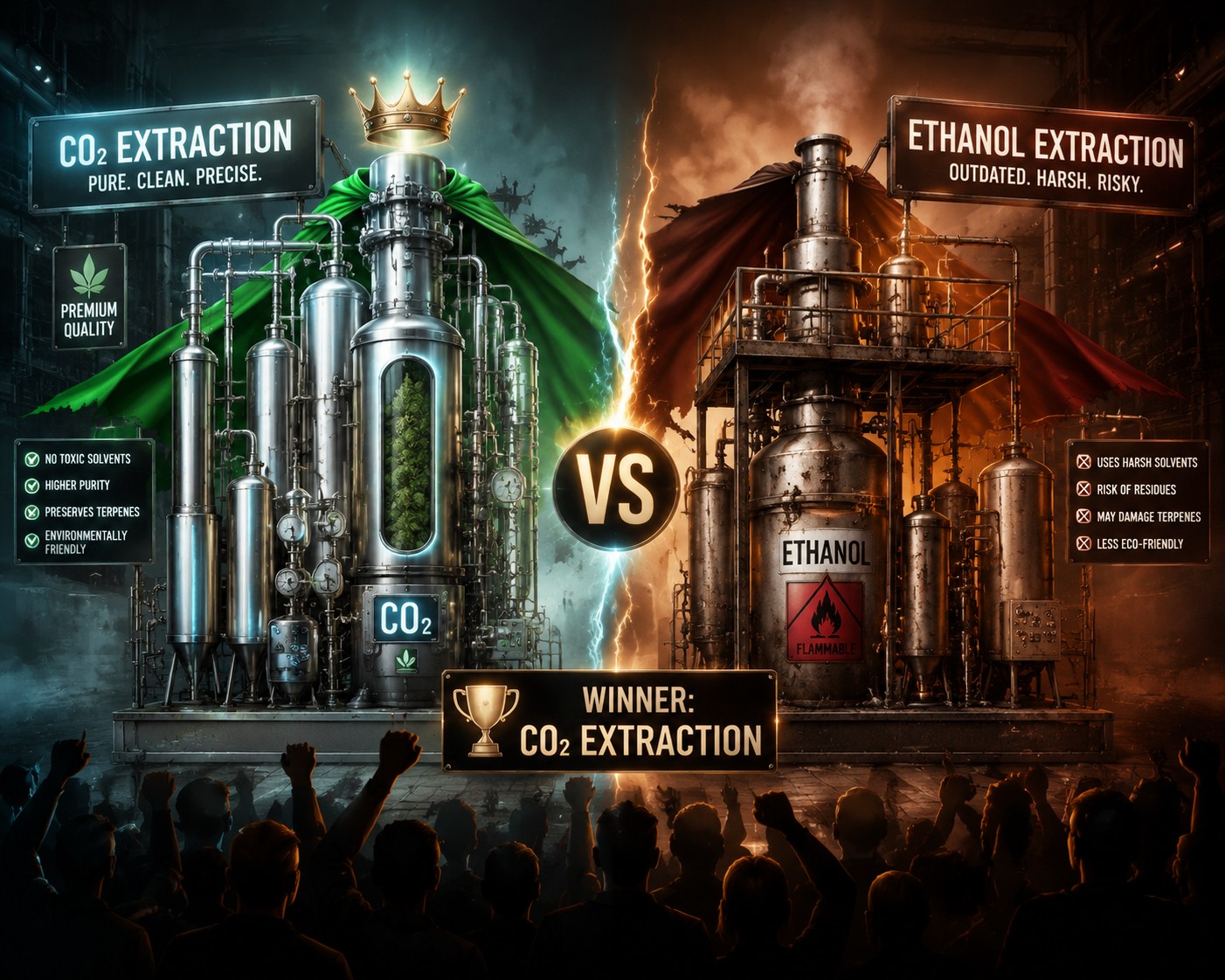
“Supercritical CO2 Extraction,” one label announces, in the confident all-caps typically reserved for genuine breakthroughs. “Ethanol Extracted,” says the other, almost matter-of-factly, as if daring you to think it’s the lesser choice. Both brands are certain they’ve made the smarter decision. Both can’t be right — or can they? That question is worth actually chasing down, rather than accepting either label at face value.
How Extraction Became a Marketing Word
Somewhere along the way, “CO2 extraction” stopped being a manufacturing detail and became a selling point, printed on the front of the label rather than buried in fine print. That shift makes sense from a marketing standpoint — “supercritical” sounds clinical and impressive, evoking precision and science. Ethanol, by comparison, carries a faint whiff of the industrial, even though it’s used to make everything from food flavoring extracts to pharmaceuticals. The two methods didn’t earn their reputations through a public vote on effectiveness. They earned them through branding.
What’s Actually Happening Inside a CO2 Extraction Tank
Strip away the marketing language and CO2 extraction is a fairly elegant piece of chemistry. Carbon dioxide is pressurized and cooled until it enters a “supercritical” state — behaving like both a liquid and a gas at once — which allows it to pull cannabinoids and other compounds out of plant material without the use of a chemical solvent. Once the pressure is released, the CO2 simply returns to gas and evaporates away, leaving a concentrated extract behind. It’s precise, it’s controllable, and it leaves essentially nothing behind that shouldn’t be there. It’s also expensive: the equipment required is specialized and costly, which is part of why CO2-extracted products often carry a higher price tag.
Why Some Manufacturers Choose Ethanol on Purpose — Not as a Compromise
Here’s where the investigation gets more interesting than the marketing suggests. Ethanol extraction isn’t simply the budget alternative to a superior technology — it’s a deliberate choice for plenty of experienced producers. Ethanol is an efficient solvent, capable of processing larger volumes of plant material relatively quickly, and food-grade ethanol is a well-established, food-safe substance with a long history of use in extraction across multiple industries. Done properly, with full solvent evaporation and testing to confirm no meaningful residue remains, ethanol extraction produces a clean, high-quality result. The idea that ethanol is inherently inferior says more about branding momentum than about the chemistry itself.
The Strengths Neither Label Fully Admits to Sharing
CO2 extraction is prized for its precision and its reputation for leaving no solvent residue, which makes for straightforward, reassuring lab reports. Ethanol extraction is prized for its efficiency, scalability, and its long, well-documented safety record in food and pharmaceutical production. Both are capable, industrially proven methods — the CBD industry didn’t invent either of them, and both were solving extraction problems long before hemp products existed.
The Compromises Neither Label Mentions
CO2 systems are costly to install and operate, and if not properly tuned, can under-extract certain compounds, requiring multiple passes to achieve full potency. Ethanol extraction, if rushed or poorly executed, can also pull unwanted plant compounds like chlorophyll into the extract, affecting taste and requiring additional filtration. Neither method is flawless in the hands of a careless or under-resourced producer — the label alone doesn’t guarantee a clean execution of either process.
Does Either Method Actually Preserve More of the Plant?
This is the question both labels seem to imply an answer to, without quite saying it outright. In practice, both methods are capable of preserving cannabinoids and terpenes effectively when properly executed — the difference in outcome tends to come down to the skill and equipment of the specific facility rather than an inherent advantage of the method itself. A well-run ethanol extraction can outperform a poorly run CO2 extraction, and vice versa. Method sets the ceiling; execution determines whether a product actually gets close to it.
The Uncomfortable Question: Does Extraction Even Determine Final Quality?
Here’s the part that undercuts a lot of front-label marketing: extraction method is one stage in a much longer chain, and it’s not even the stage most likely to make or break a finished product’s quality. Hemp genetics and cultivation practices, post-extraction purification, formulation accuracy, and manufacturing consistency all shape the final bottle just as much — arguably more, in cases where extraction itself was handled competently either way. A brand’s insistence on printing its extraction method in bold letters says very little about whether the rest of that chain was handled with the same care.
Can Excellent CBD Oil Come From Either Method?
Yes, without much argument. Plenty of well-regarded, thoroughly tested CBD oils on the market today use ethanol extraction, just as plenty use CO2. The deciding factor in each case isn’t which acronym appears on the label — it’s whether the finished product’s Certificate of Analysis confirms accurate cannabinoid content and clean contaminant results. Extraction method is a process detail. A COA is proof. Our guides What Is a CBD Certificate of Analysis? and How to Read a CBD Lab Report explain exactly what that proof should look like.
So What Actually Separates a Good Bottle From a Mediocre One?
Having traced the process this far, the honest answer has little to do with the extraction method itself. It comes down to sourcing and cultivation quality, whether the extraction — regardless of type — was executed with care and proper post-processing, and whether independent testing backs up what the label claims. Our feature What Makes Premium CBD Oil? explores this fuller picture, and it reaches a similar conclusion from a different angle: no single production detail defines quality on its own.
When Extraction Method Actually Deserves Your Attention
There is one legitimate scenario where the method genuinely matters to a buyer directly: sensitivity to residual solvents, however rare, or personal preference for a specific manufacturing philosophy. In that specific case, checking the Certificate of Analysis for solvent residue results — not just glancing at the extraction method printed on the label — is the only way to actually know whether either process left something behind. Beyond that narrow case, the method itself is far less informative than the testing that follows it.
The Real Answer to the Real Question
So — are these two companies selling an extraction method, or are they selling a better CBD oil? Based on this investigation, mostly the former. Both CO2 and ethanol are legitimate, well-established extraction technologies capable of producing excellent results in capable hands. The label announcing one over the other is telling you something about the brand’s marketing priorities, not necessarily something conclusive about the bottle’s actual quality. The more useful question was never CO2 versus ethanol. It’s whether the finished product, however it was made, can prove what it claims — through transparent, batch-specific, independently verified testing. That’s the label that actually matters.
Written by Carmen Dos Anjos Germano, Founder of Pure CBD4U
Carmen founded Pure CBD4U after her own search for reliable, high-quality CBD oil, starting with full spectrum CBD oil 5% as part of her personal wellness routine. That experience shaped the company’s focus on transparency, quality and independent testing. Pure CBD4U works with EU-grown hemp, uses third-party laboratory testing, and makes batch results accessible through QR codes on its products. Carmen remains closely involved in product selection, quality standards and the development of the Pure CBD4U range.

Leave a Reply