Picture yourself about to buy something that actually costs real money — a car, a house, a piece of jewellery, a used watch from a private seller. The seller looks you in the eye and says, “Everything is perfect.” Do you hand over the payment on that basis alone? Or do you quietly want a mechanic, a surveyor, an appraiser, someone with no stake in the sale, to check first?
Almost everyone picks the second option, usually without even thinking about it. That instinct is the entire subject of this article — and it turns out to explain more about buying CBD than most people realize.
We Already Live Surrounded by This Exact System
Look closely and independent verification is quietly built into most of the purchases that actually matter. A used car gets inspected by a mechanic who has no commission riding on the sale. Restaurants operate under hygiene ratings issued by inspectors who don’t work for the kitchen. Food producers are subject to safety inspections separate from their own internal quality teams. Public companies have their financial statements checked by outside auditors rather than trusting their own bookkeeping. Even a product review carries more weight when it comes from someone who wasn’t paid to write it.
None of these systems were built on the assumption that everyone involved is lying. Most sellers, most restaurants, most companies are probably being entirely honest. These checks exist anyway, for a much simpler reason: honesty isn’t something you can verify just by hearing it stated confidently. Someone independent has to actually look. That’s what turns a claim into something you can actually rely on.
CBD Labels Make a Lot of the Same Kinds of Promises
Walk down a shelf of CBD products and you’ll see the same handful of assurances repeated everywhere: Premium quality. Pure CBD. THC compliant. Laboratory tested. Every one of those phrases is easy to print and costs a brand absolutely nothing to claim. The real question — the one almost nobody stops to ask while standing in front of the shelf — is who actually verified any of it?
Because here’s the uncomfortable part: in most places, a CBD company can write “laboratory tested” on a label without any outside party ever confirming a single number. The claim and the proof are not the same thing, and nothing on the packaging forces them to be.
This Is Exactly the Gap Independent Testing Was Built to Close
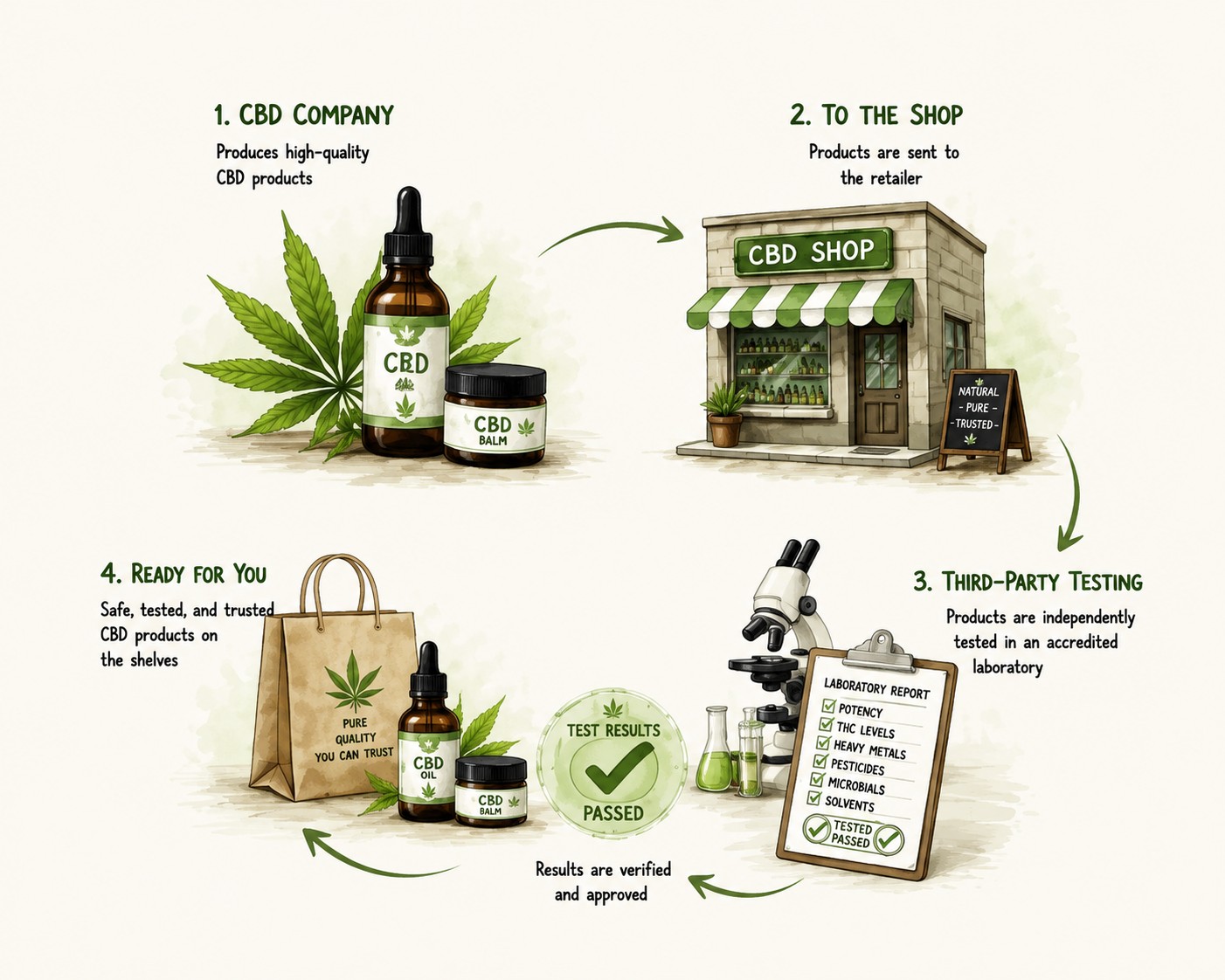
Third-party laboratory testing plays the same role in CBD that a mechanic plays for a used car, or an auditor plays for a company’s balance sheet. An outside lab, with no financial interest in whether the results look flattering, checks the product and reports what it actually finds — separate from whatever the brand hoped that answer would be.
Without getting lost in chemistry, here’s roughly what that check is looking at: whether the cannabinoid content actually matches what’s printed on the label, whether THC stays within the legal threshold, and whether the product is free from things nobody wants in a bottle they’re consuming regularly — pesticide residue, heavy metals, leftover processing solvents, or microbial contamination. None of that requires a science background to appreciate. It’s the same basic due diligence you’d want from any product making a health-adjacent claim.
It’s worth pausing on why this particular product category needs that check more than most. Hemp absorbs whatever is present in the soil and water around it, which means contaminant testing isn’t a bureaucratic formality — it’s addressing a real, plant-specific risk. Combine that with a market where oversight varies enormously from one region to the next, and independent testing stops looking like an optional extra and starts looking like the one consistent safeguard a buyer can actually count on, regardless of where a product was made.
One Report Isn’t Automatically the Same as One Test
A detail that’s easy to miss: not every lab report actually applies to the bottle sitting in front of you. Products vary somewhat between manufacturing runs, so a report belongs to a specific batch, not to a brand’s entire product line indefinitely. A brand reusing one old report across every batch it produces isn’t offering the same level of assurance as a brand testing consistently, batch by batch. Consistency, in other words, matters just as much as the fact that testing happened at all once.
Why This System Ends Up Helping Almost Everyone Involved
Independent testing isn’t a hurdle imposed on an unwilling industry — it quietly benefits nearly every party involved. Consumers get a way to check a claim instead of simply hoping it holds up. Responsible brands, the ones actually doing things properly, get a way to prove it and stand apart from competitors cutting corners. Retailers get a defensible reason to stock a product with confidence. And the CBD industry as a whole borrows credibility it hasn’t fully earned yet through regulation, gaining some of that trust through independent verification instead.
A brand that publishes its batch-specific Certificates of Analysis openly is demonstrating something a marketing slogan never can: a willingness to be checked. That’s a meaningfully higher form of transparency than simply asserting quality and hoping the buyer takes it on faith.
What Testing Doesn’t Promise
It’s worth being honest about the limits here, too. Independent testing doesn’t guarantee a flawless product, and it isn’t a blanket promise that everything about a brand is trustworthy forever. It confirms specific things — potency accuracy, the absence of certain contaminants — at a specific point in time, for a specific batch. That’s still meaningful. It’s just not the same as a guarantee, and treating it as one oversells what the document is actually telling you.
Where the Paper Trail Leads
The tangible output of all this is the Certificate of Analysis — the document an independent lab produces once the testing is complete. If you want to understand exactly what that document contains and why it matters, our guide What Is a CBD Certificate of Analysis? covers that directly. And if you already have one in hand and want to know how to actually interpret the numbers on it, How to Read a CBD Lab Report walks through that step by step. This article isn’t the place to repeat either — just to explain why that document exists in the first place.
Coming Back to the Question We Started With
Think back to that car, that house, that watch from a stranger. The question was never really whether the seller seemed trustworthy in the moment — plenty of dishonest sellers are perfectly convincing, and plenty of honest ones simply can’t prove what they’re saying without help. The question that actually protected you was who checked.
CBD works exactly the same way. The issue was never really “do I trust this CBD company?” Trust, on its own, isn’t something a stranger’s label can earn from you no matter how confidently it’s worded. The better question — the one worth asking every time — is who verified what this company is claiming. Once that question becomes a habit, buying CBD stops being a matter of hoping the label is honest, and starts being a matter of checking whether it’s been proven.
Written by Carmen Dos Anjos Germano, Founder of Pure CBD4U
Carmen founded Pure CBD4U after her own search for reliable, high-quality CBD oil, starting with full spectrum CBD oil 5% as part of her personal wellness routine. That experience shaped the company’s focus on transparency, quality and independent testing. Pure CBD4U works with EU-grown hemp, uses third-party laboratory testing, and makes batch results accessible through QR codes on its products. Carmen remains closely involved in product selection, quality standards and the development of the Pure CBD4U range.

Leave a Reply