
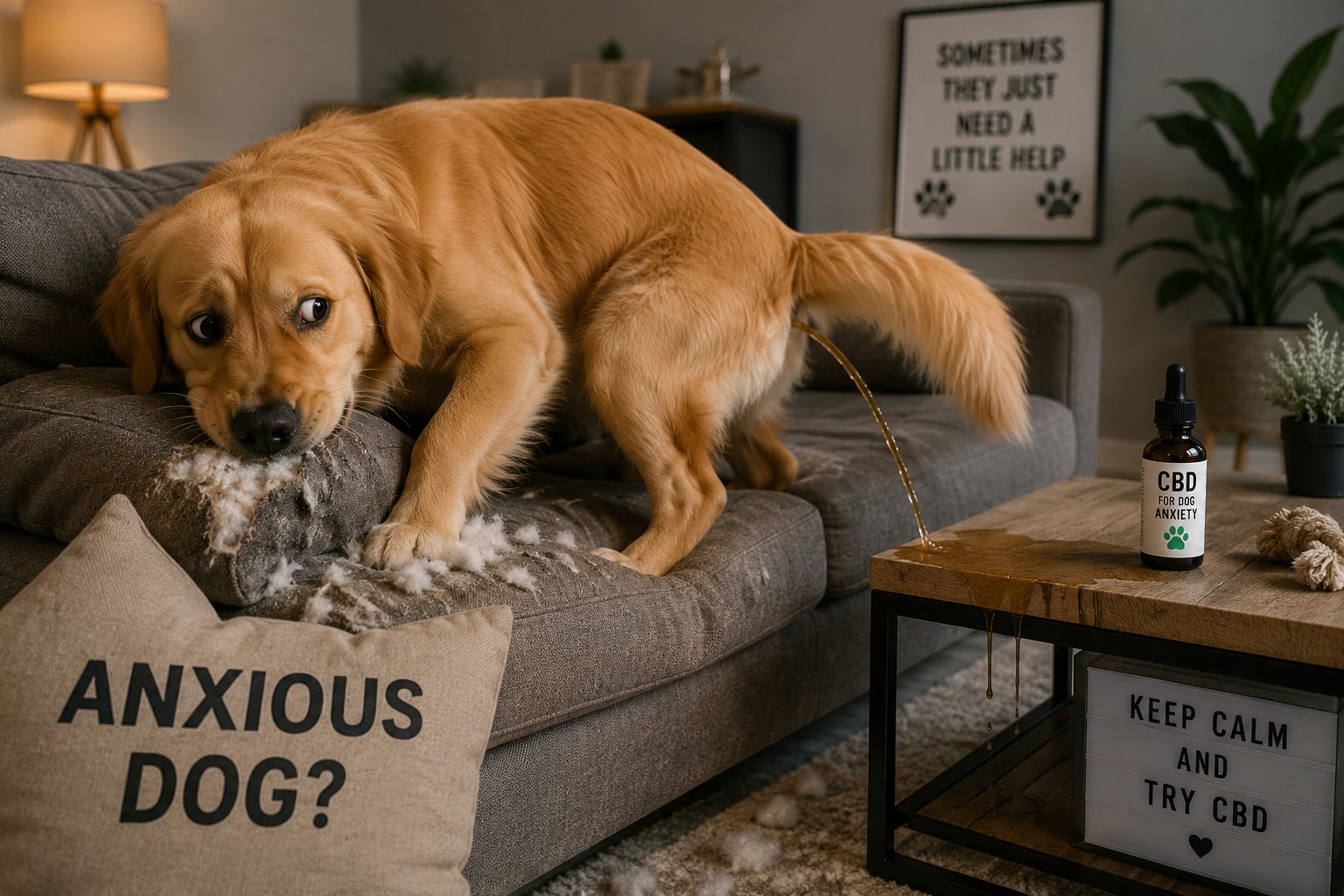
Is your dog pacing before you even pick up your keys? Shaking through every thunderstorm? Destroying a cushion the moment you close the front door? These are three completely different triggers, but they often get lumped together under one label: anxiety. Before looking at whether CBD can help, it’s worth actually naming what you’re seeing, because “anxious dog” covers a lot of different ground.
First, What Does Dog Anxiety Actually Look Like?
Owners usually recognise that something is wrong before they can describe it precisely. Here’s a rundown of the most common patterns, since the type of anxiety often shapes what kind of support actually helps.
- Separation-related anxiety: destructive chewing, howling, house-soiling, or pacing that only happens when you leave
- Noise sensitivity: fireworks, thunder, or even the vacuum cleaner triggering shaking, hiding, or drooling
- Situational anxiety: vet visits, car rides, or unfamiliar places causing stiff body language and refusal to move
- Generalised anxiety: a dog who seems on edge much of the time, regardless of a specific trigger
- Age-related anxiety: older dogs sometimes develop new anxious behaviours tied to cognitive changes, not just habit
If any of this sounds familiar, you’re not imagining it, and you’re also not alone. Anxiety-related behaviour is one of the most common reasons dog owners contact us about CBD in the first place.
Myth vs Fact: What CBD Actually Does for an Anxious Dog
Myth: CBD sedates a dog into calmness
This is probably the single biggest misunderstanding we come across. CBD is not a sedative, and a dog given an appropriate dose shouldn’t seem drowsy or “out of it.” What owners typically describe instead is a dog who still reacts to the trigger, a stranger at the door, a loud bang, but recovers faster and doesn’t spiral as hard. That’s a meaningfully different thing than sedation, and it’s an important distinction if you’re trying to judge whether it’s actually working.
Myth: If a small dose doesn’t work, more will
With CBD, more isn’t automatically better, and this is especially true for anxiety specifically. Several vets we’ve spoken with describe a “sweet spot” effect, where a moderate, consistent dose outperforms an aggressively high one. Doubling the dose because the first amount didn’t seem to do much is one of the most common mistakes we see owners make.
Fact: Consistency matters more than any single dose
The endocannabinoid system, which CBD interacts with, tends to respond to steady, repeated exposure rather than one-off use. A dog given CBD only on fireworks night, with no prior use, is starting from zero. Dogs who take CBD daily, even at a low maintenance dose, often show a more reliable response when a specific stressful event comes up, because their system isn’t encountering the compound for the first time under pressure.
Fact: Not all anxiety responds the same way
Separation anxiety, noise phobia, and generalised anxiety don’t necessarily respond identically. Noise-triggered anxiety, for example, often benefits from a slightly higher dose given proactively before a known event, such as a forecast storm or a fireworks-heavy weekend, rather than only after the anxious behaviour has already started.
How CBD Interacts With an Anxious Nervous System
Dogs, like all mammals, have an endocannabinoid system that plays a role in regulating mood, stress response, and overall balance. CBD doesn’t force a reaction the way a sedative would; it supports the body’s own regulatory processes. This is part of why the effect tends to be gradual rather than immediate, and why a single dose on a bad day often does less than a consistent routine built up over a couple of weeks.
We’ve heard from a number of dog owners that the improvement wasn’t dramatic or sudden. It tended to show up as fewer pacing episodes, a bit less whining at the door, or a dog who settled back down faster after a trigger, rather than a complete personality change overnight.
How Much CBD Should an Anxious Dog Get?
Dosage still starts with body weight as the baseline, the same as with any use case, but anxiety specifically tends to benefit from a slightly different approach to timing than general daily wellness use.
- For situational triggers (vet visits, car rides, fireworks): give a dose 45 to 60 minutes before the expected event, not after anxious behaviour has already started
- For separation anxiety: a small dose roughly 30 minutes before you leave the house tends to work better than dosing right as you’re walking out the door
- For generalised or ongoing anxiety: daily consistent dosing, at the same time each day, tends to outperform occasional use
As with any use case, we’d recommend starting low and observing your dog’s response over several days before adjusting, rather than judging the product on a single dose.
When CBD Isn’t Enough on Its Own
It’s worth being direct about this: CBD is a support tool, not a fix for every underlying cause of anxiety. Severe separation anxiety, for instance, often responds better to a combination of CBD and behavioural training than to CBD alone. If your dog’s anxiety involves self-injury, complete refusal to eat, or extreme aggression, that’s a conversation for your vet first, not something to address with CBD as a first step.
A good general rule: if the anxious behaviour is mild to moderate and situational, CBD alongside consistent routines is often a reasonable place to start. If it’s severe, longstanding, or getting worse, loop in your vet before or alongside trying CBD.
Choosing the Right CBD Product for an Anxious Dog
Broad Spectrum CBD oil, which is THC-free, is generally the safer default for dogs, since their endocannabinoid systems are more sensitive to THC than a human’s. Independent lab testing and a published Certificate of Analysis matter here more than almost anywhere else, since you’re giving this to an animal who can’t tell you if something feels off.
Liquid oils also tend to offer more precise, adjustable dosing than treats or chews, which matters when you’re trying to fine-tune timing around specific triggers rather than just giving a flat daily amount.
Frequently Asked Questions
How long does it take for CBD to calm an anxious dog?
For situational anxiety, effects are often noticeable within 45 minutes to an hour of a dose. For generalised or ongoing anxiety, it typically takes one to two weeks of consistent daily use before a clearer pattern of improvement emerges.
Can I give my dog CBD before a fireworks display?
Yes, this is one of the most common uses. Giving a dose 45 to 60 minutes beforehand, rather than after the fireworks have already started, generally gives better results.
Will CBD make my dog sleepy?
At an appropriate dose, CBD shouldn’t cause noticeable drowsiness. If your dog seems sedated rather than calm, the dose may be too high, and it’s worth reducing it rather than assuming that’s the intended effect.
Is CBD a substitute for anxiety training?
No. For moderate to severe separation anxiety in particular, CBD tends to work best alongside behavioural training, not as a replacement for it.
Can I use the same CBD oil for anxiety and general wellness?
Yes, the same broad spectrum or full spectrum CBD oil can typically be used for both, with dosing and timing adjusted depending on whether you’re managing a specific trigger or supporting general daily balance.
Written by Carmen Dos Anjos Germano, Founder of Pure CBD4U
Carmen founded Pure CBD4U after her own search for reliable, high-quality CBD oil, starting with full spectrum CBD oil 5% as part of her personal wellness routine. That experience shaped the company’s focus on transparency, quality and independent testing. Pure CBD4U works with EU-grown hemp, uses third-party laboratory testing, and makes batch results accessible through QR codes on its products. Carmen remains closely involved in product selection, quality standards and the development of the Pure CBD4U range.

Leave a Reply