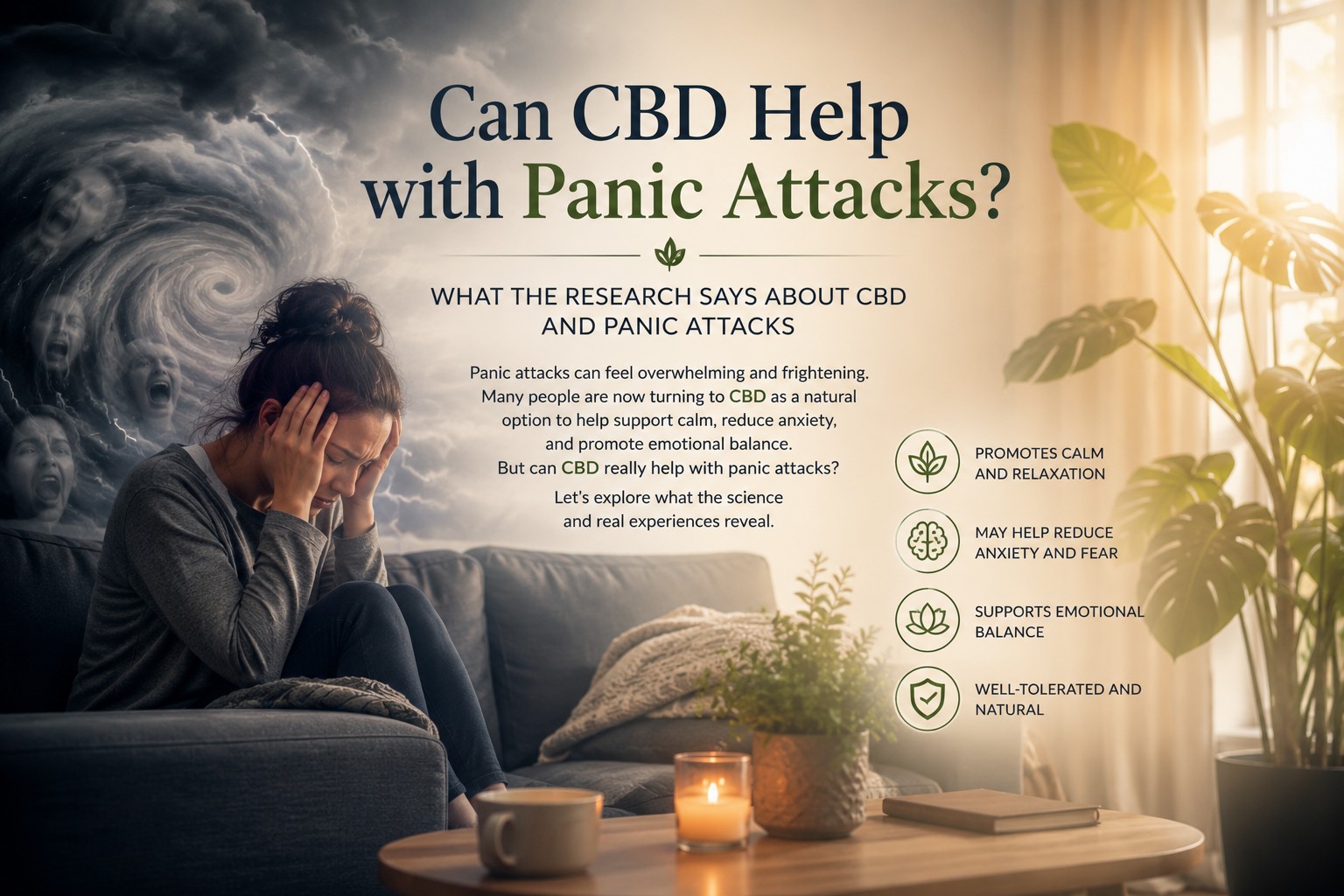
Every month, according to keyword data that search marketers pore over more closely than most people would expect, tens of thousands of people type some version of the same six words into Google: can CBD help with panic attacks. It’s a striking number on its own, but the more interesting question isn’t how many people ask it — it’s what they’re actually asking for.
Nobody typing that phrase at 2 AM is requesting a literature review. They’re usually asking something closer to: will this make it stop? Is there something I can do right now, or the next time, that gives me back a sense of control? That’s not a question about pharmacology. It’s a question about fear, and about wanting a foothold.
The Words We Use Interchangeably — and Shouldn’t
Part of what makes this topic hard to research cleanly is that stress, anxiety, nervousness, overwhelm and panic get used almost interchangeably in everyday conversation, even though they’re not the same experience. Stress is typically a response to an identifiable external pressure — a deadline, a conflict, too much on a plate. Generalized anxiety tends to be broader and more persistent, a background hum that doesn’t always attach to one clear cause. Panic attacks are narrower and more acute: a sudden, intense surge of fear, often accompanied by a racing heart, shortness of breath, dizziness or a sense of losing control, typically peaking within minutes.
That distinction matters here specifically because most of the CBD research search engines will surface under this query wasn’t designed to study panic attacks at all. It studied anxiety — a related but distinct category — and the gap between those two bodies of evidence is one of the more consistently overlooked details in casual coverage of this topic.
What the Investigation Found in the Research
Digging into the actual clinical literature turns up a smaller, more specific body of work than the volume of online CBD content might suggest. A frequently cited 2019 case series published in The Permanente Journal followed a group of adults with anxiety and sleep concerns and reported improvement in self-reported anxiety scores for the majority of participants over the following months. It’s a real, published finding — and also a case series without a placebo control, which limits how much weight it can carry on its own.
Separately, laboratory research has explored how cannabidiol interacts with the body’s serotonin 5-HT1A receptors, a system closely tied to mood and anxiety regulation, offering a plausible biological mechanism for why CBD might influence anxiety-related states. A small but frequently referenced 2011 study also found that CBD reduced subjective anxiety in people with social anxiety disorder during a simulated public speaking task — a controlled, promising result, but again in a narrow and specific context.
What none of this constitutes is a clinical trial testing CBD specifically against diagnosed panic disorder or acute panic attacks. That specific research — the one search engines are implicitly being asked about — essentially doesn’t exist yet in any robust form. Researchers have theoretical reasons to think CBD’s anxiolytic properties might extend to panic states, given the receptor systems involved, but a theoretical mechanism is not the same as clinical proof, and honest reporting has to hold that line.
| What the evidence currently supports — and what it doesn’t Established: CBD interacts with serotonin receptors linked to anxiety regulation Emerging: some trials show reduced anxiety in specific, controlled contexts (social anxiety, case series) Theoretical: extension of these findings to panic attacks specifically, not yet clinically tested Not established: CBD as a treatment or cure for panic disorder |
Why So Many People Report It Helping Anyway
None of this means the thousands of personal accounts online describing CBD helping during a panic episode are fabricated or worthless — they’re simply a different category of evidence than a clinical trial, and conflating the two is where a lot of confident-sounding CBD content goes wrong. Personal experience is real to the person having it. It’s also shaped by factors that are notoriously difficult to separate from a substance’s actual pharmacological effect: the ritual of taking something intentional during a frightening moment, the simple act of pausing to measure a dose, the expectation that relief is coming, and natural fluctuation in panic intensity that would have settled somewhat regardless.
None of that makes those reports meaningless. It does mean that a few dozen forum posts, however sincere, can’t substitute for a randomized controlled trial, and any article implying otherwise is overstating what it actually knows.
Where Marketing Tends to Outrun the Science
This is also the point in the investigation where a fair number of CBD product pages start making claims the underlying research doesn’t yet support — phrases like “stops panic attacks” or “proven to treat anxiety disorders” appear regularly across the industry, despite no clinical evidence establishing CBD as a treatment for panic disorder specifically. That gap between confident marketing language and cautious clinical language is worth naming directly, because it’s often exactly what someone searching this question at a vulnerable moment runs into first.
What a Panic Attack Actually Needs in the Moment
Separate from anything CBD might or might not do, it’s worth being clear about what does have a stronger evidence base for panic attacks specifically: slow, controlled breathing techniques, grounding strategies that redirect attention to the physical environment, and, for recurring or severe panic disorder, cognitive behavioral therapy and, in some cases, prescribed medication under a clinician’s guidance. None of that competes with CBD so much as it exists in a different, better-studied category for this particular condition.
If panic attacks are frequent, severe, or interfering with daily life, that’s a reasonable signal to talk to a doctor or mental health professional rather than to rely on a supplement, however promising its broader research profile looks in adjacent areas like general anxiety.
So, Can CBD Help?
The honest, if unglamorous, answer sits somewhere between yes and not yet proven. There’s a real, mechanistically plausible reason to think CBD may support general anxiety regulation for some people, backed by a modest but genuine body of clinical research. There is not, at this point, a body of research specifically validating CBD as an intervention for panic attacks or panic disorder, and anyone claiming otherwise is speaking beyond what’s currently known.
That’s not the same as saying it definitely doesn’t help — plenty of promising areas of medicine started exactly here, with plausible mechanisms and encouraging early anxiety data well ahead of condition-specific trials. It simply means the evidence hasn’t caught up to the question yet, and being upfront about that gap is more useful, in the long run, than a confident answer the research can’t yet back up.
What’s Actually Worth Taking Away
Perhaps the more valuable outcome of an investigation like this isn’t a verdict at all. It’s a clearer sense of how to read anything else written on this topic going forward — noticing the difference between a claim resting on a controlled trial and one resting on a testimonial, between a plausible mechanism and a proven outcome, between general anxiety research and panic-specific research that largely doesn’t exist yet.
Research into CBD and anxiety-related conditions continues to evolve, and it’s entirely possible that panic-specific studies will eventually close this gap. Until they do, the most responsible answer is the honest one: encouraging, incomplete, and worth watching — not a promise, and not something that should replace professional care for anyone experiencing frequent or severe panic attacks.
This article is intended for general educational purposes and is not medical advice. CBD is not a treatment or cure for panic attacks or panic disorder. Anyone experiencing frequent, severe, or persistent panic attacks should speak with a doctor or qualified mental health professional.
Written by Carmen Dos Anjos Germano, Founder of Pure CBD4U
Carmen founded Pure CBD4U after her own search for reliable, high-quality CBD oil, starting with full spectrum CBD oil 5% as part of her personal wellness routine. That experience shaped the company’s focus on transparency, quality and independent testing. Pure CBD4U works with EU-grown hemp, uses third-party laboratory testing, and makes batch results accessible through QR codes on its products. Carmen remains closely involved in product selection, quality standards and the development of the Pure CBD4U range.

Leave a Reply