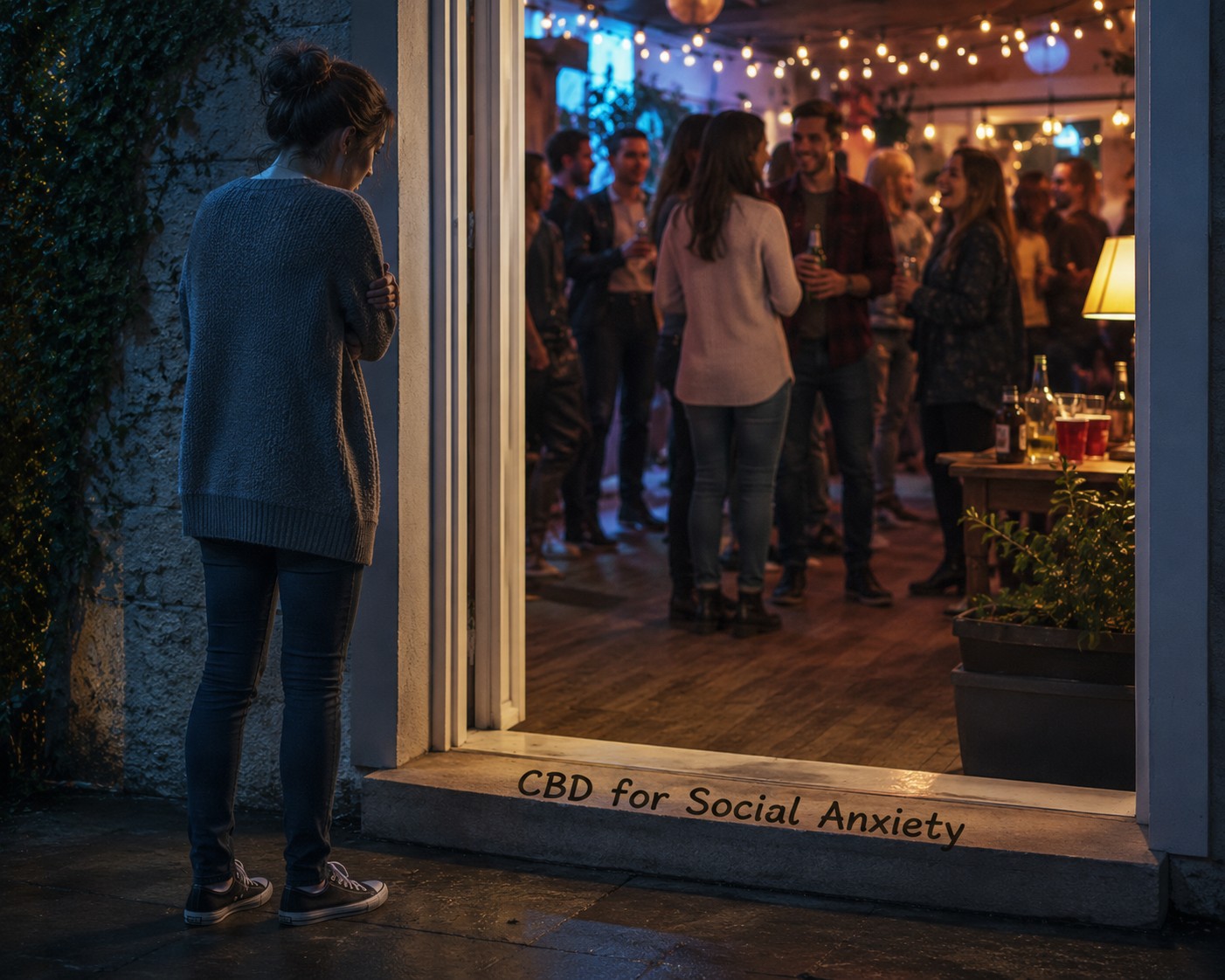
The invitation arrives on a Tuesday — a colleague’s birthday drinks, casual, low-key, nothing that should register as an event at all. Most people would glance at it, tap “going,” and move on with their day. Mara reads it three times. By the third read, she’s already rehearsing an excuse she hasn’t needed yet, already picturing the exact moment she’ll be standing near the bar with nothing to say, already tired from an evening that hasn’t happened.
That gap — between what an invitation is supposed to feel like and what it actually feels like — is where social anxiety tends to live. Not in the event itself, but in everything leading up to it, and often in everything that comes after.
The Version of the Story No One Sees
For someone like Mara, a dinner with a few unfamiliar faces isn’t really one event. It’s three: the days beforehand spent quietly drafting conversation topics that will probably never come up, the event itself spent monitoring her own voice and expression more closely than the actual conversation, and the days afterward spent replaying a comment she made — was it too much, too little, did it land wrong — long after everyone else has forgotten it happened at all.
There’s a particular kind of exhaustion in wanting connection and bracing against it at the same time. Plenty of people with social anxiety aren’t avoiding people because they dislike them; they’re avoiding the physical tightness in their chest before walking into a room, the racing thoughts that arrive uninvited, the sense of being watched and evaluated even in gatherings where nobody is paying that much attention at all. None of that makes someone antisocial, broken, or incapable — it just makes the ordinary more effortful than it looks from the outside.
Where CBD Enters the Picture
It’s in that space — the days of anticipatory dread, the tight chest in the car outside a venue — that CBD has become something a lot of people quietly research, often at 11 PM the night before an event they’ve already half-decided to cancel on. The appeal isn’t mysterious: something that might take the edge off the physical tension, without altering how present or clear-headed someone feels while trying to hold a conversation.
That’s a specific, understandable hope, and it’s worth being honest about both what supports it and what doesn’t yet.
What the Research Actually Says About This
The most directly relevant study here is a small but frequently cited 2011 trial in Neuropsychopharmacology, in which participants with generalized social anxiety disorder were given either 600mg of CBD or a placebo before a simulated public speaking task. Those who received CBD reported significantly less anxiety, cognitive impairment, and discomfort during the speech than the placebo group. It’s a genuine, controlled result specific to social anxiety — which makes it more directly applicable here than much of the broader CBD-and-anxiety literature.
It’s also a single study, with a relatively small sample and a fairly high, clinically administered dose that doesn’t map neatly onto a few drops of oil before a Tuesday dinner. Brain imaging research from around the same period found that CBD appeared to normalize activity in the amygdala and related regions associated with fear processing in people with social anxiety — a genuinely interesting, mechanistically grounded finding, though still early and not yet replicated at scale.
What that leaves is a body of evidence that’s promising and specific to social anxiety, but nowhere near large or repeated enough to call CBD an established treatment. Consumer reports describing calmer, easier social events after taking CBD beforehand are common and consistent — but consistent anecdote isn’t the same evidentiary category as a replicated clinical trial, and treating them interchangeably does readers a disservice.
| What’s known vs. what’s still being tested Established: CBD interacts with brain systems involved in fear and anxiety processing Emerging: one controlled trial found reduced anxiety during simulated public speaking Not yet established: optimal dose, consistent real-world results, effects beyond this narrow context Marketing claiming guaranteed social-anxiety relief goes beyond what this evidence supports |
Why Personal Accounts Vary So Much
Ask ten people who use CBD before social situations how well it worked, and the answers rarely line up. Some describe a genuine easing of physical tension — a looser chest, a quieter internal monologue. Others notice very little. That inconsistency isn’t necessarily a sign the product failed; dose, individual body chemistry, the format used, and how far in advance it was taken all shape the outcome, alongside factors that have nothing to do with CBD at all, like how much sleep someone got or how emotionally significant the event feels to them personally.
It’s also worth naming a myth that circulates fairly widely: that CBD works like a fast, guaranteed social lubricant, comparable to how a sedative or alcohol might blunt social nerves. That comparison doesn’t hold up. CBD doesn’t produce intoxication or a dramatic shift in social confidence, and treating it as an instant fix tends to set people up for disappointment rather than realistic, moderate expectations.
A Broader Toolkit, Not a Single Fix
Managing social anxiety rarely comes down to one solution, and CBD, where it helps at all, tends to work best as one piece among several rather than a stand-alone answer. Cognitive behavioral therapy has among the strongest evidence bases for social anxiety specifically, helping people identify and gradually reframe the anticipatory thought patterns that make an invitation feel like a threat before anything has even happened. Gradual exposure — attending smaller, lower-stakes gatherings before larger ones — is another well-supported approach, as are simple preparation strategies like arriving early, when a room is quieter and easier to settle into.
For someone exploring where CBD might fit into that picture, understanding CBD dosage and the practical differences between oil, gummies and capsules matters more than picking a product at random — sublingual oil’s faster onset, for instance, suits planning around a known event time in a way that a slower-absorbing capsule doesn’t as easily.
When to Reach for More Support
For people whose social anxiety is mild or occasional — nerves before a specific presentation, a bit of dread before meeting new in-laws — these are the kinds of situational patterns many people learn to navigate with time, preparation, and small personal strategies. But when social anxiety becomes persistent, when it consistently limits work, relationships, or day-to-day choices, or when it comes with a level of distress that feels difficult to manage alone, that’s a reasonable point to talk with a doctor or therapist. Social anxiety disorder is a recognized, treatable condition, and professional support exists for exactly this reason — not as a last resort, but as a legitimate first step.
What Actually Helps, in the End
Mara still gets invitations that make her stomach tighten before she’s even opened them fully. What’s changed isn’t that the feeling disappeared — it’s that she’s stopped looking for one thing to make it vanish entirely. Some evenings, a small dose of CBD beforehand seems to take a noticeable edge off the physical tension. Other times, what helps more is simply arriving fifteen minutes early, or having one low-stakes topic prepared in advance so the first few minutes don’t feel so unscripted.
That’s closer to how managing social anxiety actually tends to work: not a single perfect fix, but a gradually built understanding of personal triggers, a small set of coping strategies that fit an individual life, and an honest, unhurried evaluation of which wellness tools genuinely earn a place in that mix. CBD may be one of them for some people. It was never going to be the whole answer for anyone.
This article is intended for general educational purposes and is not medical advice. CBD is not a treatment or cure for social anxiety disorder, and individual experiences vary considerably. Anyone experiencing persistent or severe social anxiety is encouraged to speak with a doctor or qualified mental health professional.
Written by Carmen Dos Anjos Germano, Founder of Pure CBD4U
Carmen founded Pure CBD4U after her own search for reliable, high-quality CBD oil, starting with full spectrum CBD oil 5% as part of her personal wellness routine. That experience shaped the company’s focus on transparency, quality and independent testing. Pure CBD4U works with EU-grown hemp, uses third-party laboratory testing, and makes batch results accessible through QR codes on its products. Carmen remains closely involved in product selection, quality standards and the development of the Pure CBD4U range.

Leave a Reply