
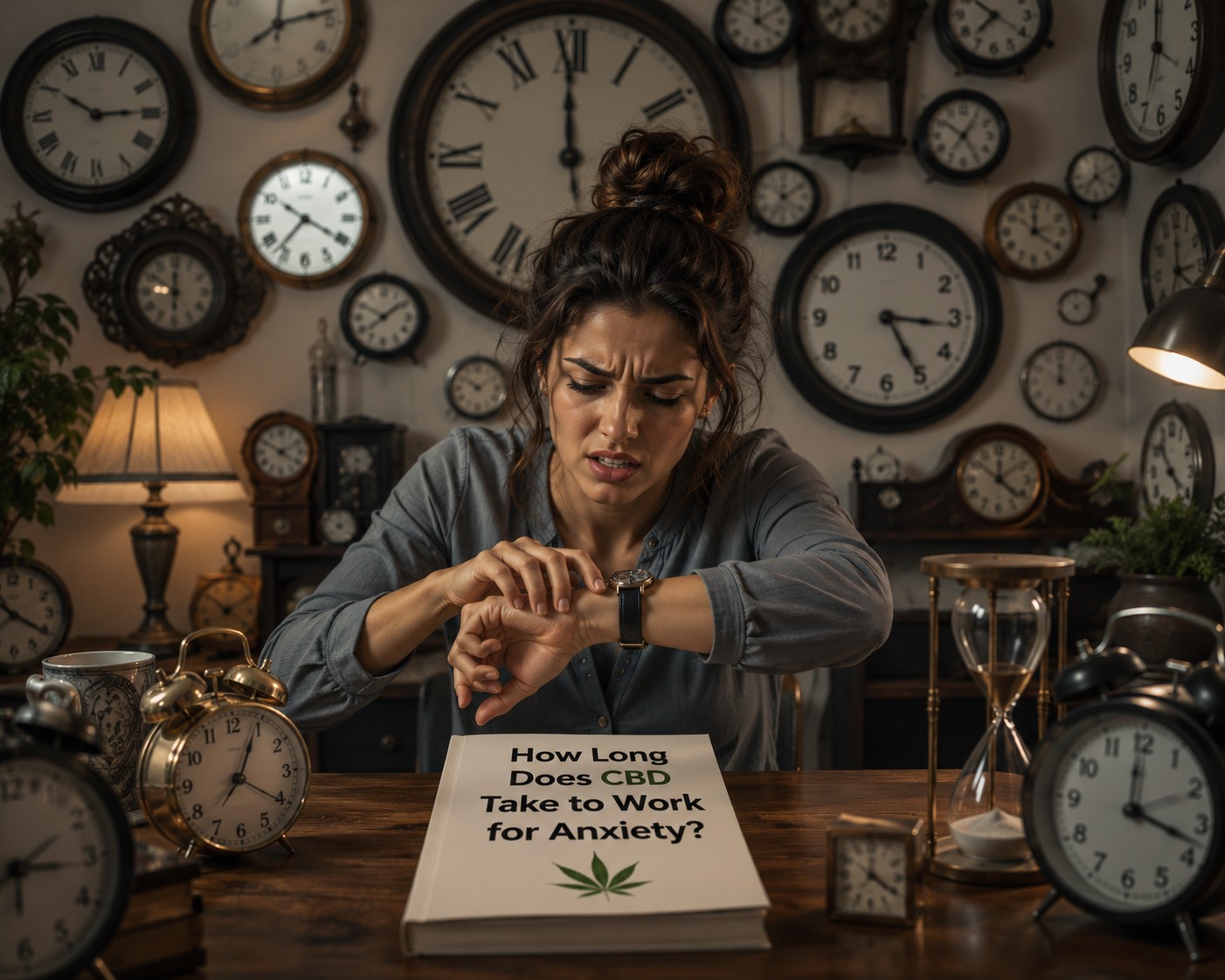
8:14 PM. She places two drops under her tongue, sets a timer out of habit, and puts the bottle back on the shelf. By 8:19, she’s already glanced at her phone twice. Nothing has moved. Not her shoulders, not her breathing, not the loop of thoughts she’d hoped might loosen a little tonight.
By 8:30 she starts wondering if she measured wrong. By 9:00, she’s decided the whole thing was probably a waste of money — right around the moment she notices she’s been sitting still for ten minutes without checking her phone at all.
That’s the part almost nobody warns you about. CBD rarely announces itself. It tends to slip in sideways, and by the time you notice it, you’re often already past the moment where you were watching for it.
A Clock That Doesn’t Cooperate
Most people bring a painkiller’s timeline to their first bottle of CBD oil, whether they realize it or not. Take something, wait twenty minutes, feel a difference — that’s the pattern ibuprofen or an antihistamine teaches us to expect. CBD borrows none of that predictability, and the mismatch is where most disappointment starts.
There’s a reason for that mismatch, and it isn’t a flaw in the product. Cannabidiol has to travel through the body before it can do anything noticeable, and the route it takes changes everything about the timeline.
Three Products, Three Very Different Journeys
Held under the tongue for sixty to ninety seconds before swallowing, CBD oil takes the shortest route available. Small blood vessels in the mouth absorb part of the dose directly, letting it skip the slower path through the stomach. Under reasonably good conditions, that’s often enough to produce a noticeable shift somewhere between fifteen and forty-five minutes in — though “noticeable” here usually means subtle, not dramatic.
Capsules take the long way around. Everything you swallow has to survive stomach acid, get absorbed through the gut wall, and pass through the liver before it reaches general circulation — a detour known as first-pass metabolism. That detour typically pushes capsule onset to somewhere between sixty and ninety minutes, sometimes further out, though what arrives tends to last longer and build more gradually than oil.
Gummies travel a route similar to capsules, since they too must be digested before anything reaches the bloodstream. Their onset commonly lands in that same sixty-to-ninety-minute window, though sugar content, how full your stomach already is, and your own digestive pace can shift that earlier or later. Anyone expecting a gummy to behave like a sublingual oil is usually the one who walks away thinking gummies simply underperform — when really, they were just never built for speed.
| Typical onset windows by delivery method Sublingual oil: roughly 15–45 minutes Gummies: roughly 60–90 minutes, shaped by digestion Capsules: roughly 60–90 minutes, often slower to build and slower to fade These are general patterns drawn from user reporting and absorption research, not fixed timelines. |
Why Two People Can Take the Same Dose and Notice Nothing Alike
Body weight, metabolic rate, and liver function all shape how quickly cannabinoids move through a person’s system, which means two people taking an identical 10mg dose of the same broad spectrum oil can end up on genuinely different timelines. A faster metabolism might mean quicker absorption — and also a shorter window before the effect tapers off again.
Food complicates things further, and not always in an intuitive direction. Taking oil on an empty stomach can sometimes speed up initial absorption, while research on cannabinoid pharmacokinetics suggests a meal containing fat may increase the total amount absorbed, even as it stretches out the timeline for feeling it. This is genuinely one of the areas where research is still catching up to lived experience, and pretending otherwise wouldn’t serve anyone.
Dosage plays its own role too. A very small serving may take longer to produce anything perceptible simply because there’s less of it circulating, which is one reason people sometimes increase their dose too quickly rather than giving a lower one time to build.
Where Consistency Quietly Outweighs Timing
Something that rarely makes it into onset-time discussions: for many people, the single dose isn’t really the story. Reports from regular users — and a growing body of research on repeated cannabinoid exposure — suggest that consistent daily use over one to several weeks tends to shift baseline anxiety more noticeably than any one serving does on its own. That reframes the entire question. Someone judging CBD purely by what happened in the first hour after their first dose may be measuring the wrong thing entirely.
When It Feels Like Nothing Is Happening
A low starting dose. A slow-absorbing capsule. A single try instead of sustained use. Any one of these can produce the sense that a product has failed when, in fact, a subtle shift may have occurred and simply gone unnoticed — partly because close self-monitoring makes small changes harder to detect, not easier. Watching intently for relief is, ironically, one of the more reliable ways to miss it.
A few adjustments can shift the odds toward a faster, clearer onset without changing anything about the product itself: taking oil sublingually rather than swallowing it right away, holding it under the tongue for the full sixty to ninety seconds, and staying consistent about how it’s taken relative to meals. None of this guarantees a specific outcome — it simply stacks the conditions in favor of absorption doing its job.
What Happens After the Effect Arrives
For most users, CBD’s felt effects last somewhere around four to six hours, though the compound itself can remain detectable in the body for considerably longer — sometimes several days, depending on dose, frequency of use, and individual metabolism. Feeling calmer and having CBD still present in your system are two separate things, and conflating them is a common source of confusion around drug testing and dosing schedules alike.
Separating What’s Known From What’s Assumed
Clinical interest in cannabidiol’s relationship to anxiety has grown substantially, with research published in outlets such as The Permanente Journal exploring reduced self-reported anxiety following CBD administration, alongside laboratory work on how cannabidiol interacts with serotonin and other anxiety-related receptor systems. That’s meaningful, established territory.
Onset timing specifically is a thinner body of evidence. Much of what’s understood about how quickly oil, gummies, or capsules take effect comes from pharmacokinetic studies tracking cannabinoid levels in the bloodstream, combined with a large volume of consistent consumer reporting — not from head-to-head clinical trials measuring anxiety relief minute by minute. Nobody has rigorously proven that gummies take precisely seventy-eight minutes for a given person; what exists is a reasonably consistent pattern across absorption science and user experience.
Marketing language promising anxiety relief “within minutes” or guaranteeing a specific result reaches beyond what any of this evidence can responsibly support. CBD is not a treatment for anxiety disorders, and nothing here should be read as a promise of how any individual will respond.
A Different Question Worth Asking
Somewhere around the second or third bottle, the original question tends to fade in importance. It stops being about minutes on a clock and starts being about pattern recognition — noticing what a given dose, delivery method, and few weeks of consistent use actually produce for you specifically, rather than chasing a number that was always going to vary.
Getting there usually means understanding a bit more about CBD dosage and how full spectrum and broad spectrum formulations differ, since both shape what a person should reasonably expect from a given bottle. It also means matching the delivery method to the goal: oil’s faster window may suit someone reaching for relief in the moment, while the slower, steadier release of capsules or gummies may fit better into a daily routine built around long-term consistency rather than immediate feedback.
This article is intended for general educational purposes and is not medical advice. CBD may affect each person differently, and anyone experiencing persistent or severe anxiety should speak with a healthcare provider before starting any new supplement.
Written by Carmen Dos Anjos Germano, Founder of Pure CBD4U
Carmen founded Pure CBD4U after her own search for reliable, high-quality CBD oil, starting with full spectrum CBD oil 5% as part of her personal wellness routine. That experience shaped the company’s focus on transparency, quality and independent testing. Pure CBD4U works with EU-grown hemp, uses third-party laboratory testing, and makes batch results accessible through QR codes on its products. Carmen remains closely involved in product selection, quality standards and the development of the Pure CBD4U range.

Leave a Reply