
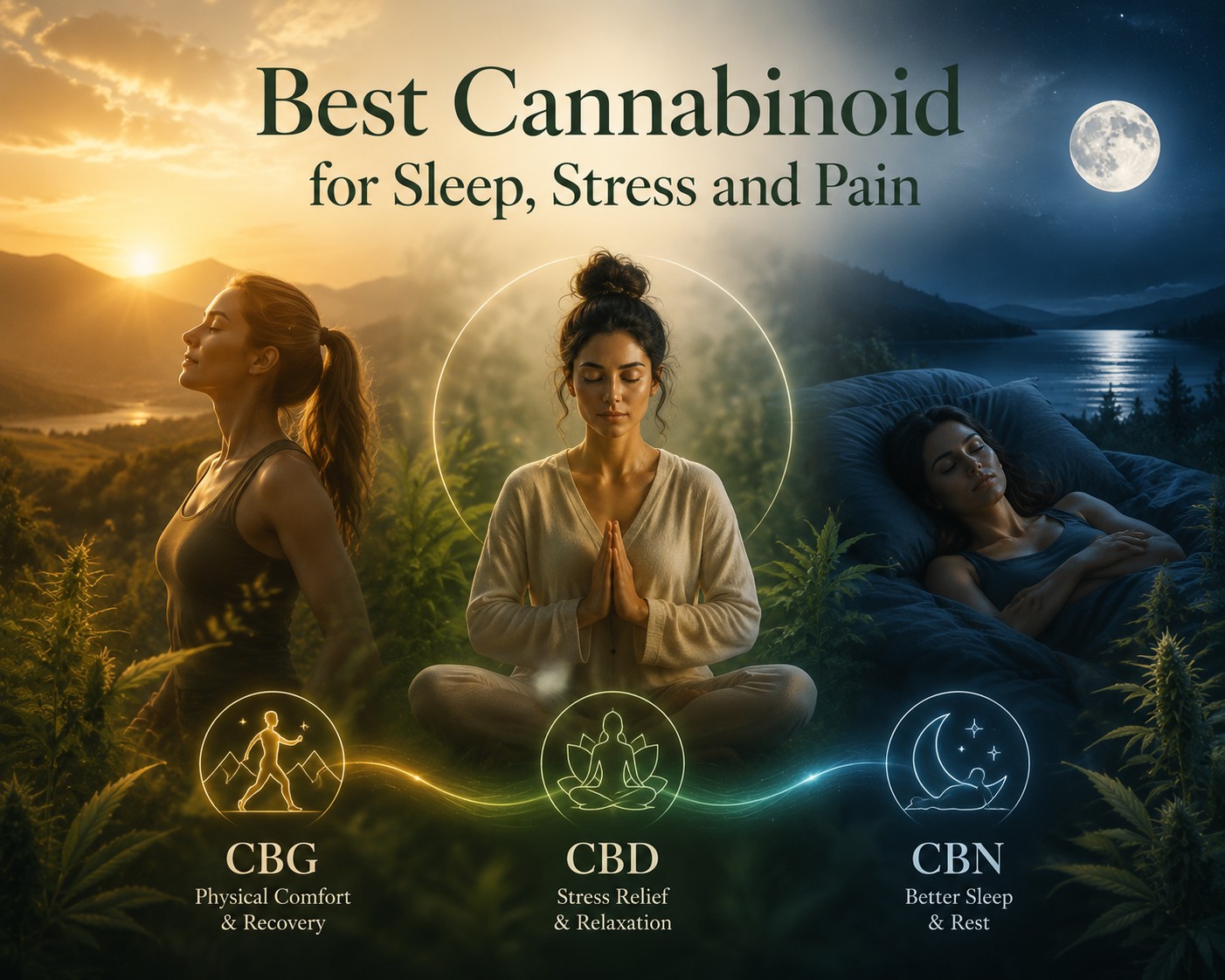
There isn’t a single “best” cannabinoid. That might not be the answer you were hoping to find, but it’s the honest one — and understanding why makes the actual decision much easier. CBD, CBG and CBN each behave differently, and which one suits you best depends entirely on what you’re trying to solve: sleep, everyday stress, or physical comfort. Think of this less as a ranking and more as a decision process.
Here’s a quick snapshot before we go goal by goal:
| Goal | Cannabinoid | Why |
| Better sleep | CBN (often + CBD) | Most closely associated with evening routines; frequently combined with CBD in sleep-focused blends |
| Everyday stress and relaxation | CBD | The most researched, broadly used cannabinoid for daily balance and calm |
| Physical comfort and recovery | CBG | Increasingly chosen for daytime use, focus, and post-exercise comfort |
| Broader, all-round profile | Full Spectrum blend | Combines multiple cannabinoids for a wider, whole-plant effect |
Best Cannabinoid for Sleep
CBN has become the cannabinoid most closely associated with sleep support, and it’s usually the first one people reach for when building an evening routine. Its reputation comes from a mix of early research, its natural association with aged hemp material, and heavy positioning by brands building nighttime product lines around it.
Consumers choose CBN largely because of consistent, if subtle, feedback around winding down — not because it acts as a strong sedative. Scientifically, human research specifically isolating CBN’s effect on sleep remains limited; much of the interest is still at the laboratory or early-observation stage rather than large clinical trials. That’s worth knowing before expecting dramatic results.
In practice, CBN is frequently combined with CBD rather than used alone, since CBD’s broader calming reputation can complement CBN’s more specific evening association. If sleep is your primary goal, a CBD + CBN evening blend is generally a more balanced starting point than CBN by itself.
Best Cannabinoid for Stress and Relaxation
For everyday stress and general relaxation, CBD remains the default recommendation — and for good reason. It has by far the largest research base of the three cannabinoids, spanning general wellness, calmness, and everyday balance. It’s also the most widely available and the easiest to dose confidently, given how much documentation exists around typical serving sizes.
That said, “most researched” doesn’t mean “fully proven” for every specific claim. Evidence around CBD’s calming effects continues to grow, but individual results still vary, and CBD is not positioned as a treatment for diagnosed anxiety disorders. For daily stress management and general relaxation, though, it’s the most well-documented option available, and it’s rarely combined out of necessity — CBD alone is usually sufficient for this particular goal.
Best Cannabinoid for Physical Comfort and Recovery
CBG has carved out a specific niche here. It’s increasingly chosen by people focused on recovery after physical activity and everyday physical comfort, and it fits naturally into a daytime routine rather than an evening one. Part of its appeal is practical: CBG doesn’t carry any drowsy associations, so it fits into an active day without competing with focus or alertness.
Research interest in CBG for these specific goals is growing, but it’s earlier stage than CBD’s research base — there’s meaningful scientific curiosity, but the large-scale human studies needed to draw firm conclusions are still catching up. Some people combine CBG with CBD for a broader daytime formula, particularly if general wellness and physical comfort are both priorities.
Why CBD Remains the Most Versatile Choice
Across all three goals, CBD keeps showing up — either as the primary recommendation or as a complementary partner to CBG or CBN. That versatility isn’t marketing; it reflects how much broader CBD’s research base and product ecosystem are compared to the newer cannabinoids. If you only want to try one cannabinoid before deciding whether to expand into CBG or CBN, CBD is the most logical starting point.
Why CBN Has Become an Evening Specialist
CBN’s identity is narrower than CBD’s, and that’s not necessarily a downside — it simply means CBN has found a specific job rather than trying to do everything. Its formation process, tied to aging THC, and its consistent evening-use positioning have made it the go-to choice for nighttime formulas specifically, rather than a general-purpose wellness cannabinoid.
Why CBG Is Gaining Ground for Daytime Wellness
CBG’s rise reflects a gap in the market: until recently, there wasn’t a well-known cannabinoid built specifically around daytime focus and recovery rather than general calm or sleep. CBG has filled that space, and growing cultivation of CBG-rich hemp has made it increasingly available, even though it still commands a higher price than CBD due to extraction costs.
Should You Consider a Full Spectrum Product?
Full Spectrum products, which combine multiple cannabinoids along with terpenes and other plant compounds, appeal to people who want broader coverage rather than targeting one specific goal. The reasoning behind this is often described through the entourage effect — the idea that cannabinoids may work better together than in isolation. It’s a reasonable theory with growing scientific interest, though it remains a working hypothesis rather than settled fact. If you’re drawn to this approach, our guide on What Is the Entourage Effect? explains the concept in more depth, and Can You Take CBD, CBG and CBN Together? covers the practical side of combining cannabinoids yourself rather than relying on a single blended product.
Choosing Based on Goals, Not Marketing
The most useful question to ask isn’t “which cannabinoid is best,” but “what am I actually trying to achieve.” Once that’s clear, the decision becomes far more straightforward:
- Sleep → CBN, often paired with CBD
- Everyday stress and relaxation → CBD
- Physical comfort and recovery → CBG
- Broader, whole-plant coverage → a Full Spectrum blend
Whichever direction you choose, product quality matters more than the cannabinoid itself. Look for independent third-party lab testing, a current Certificate of Analysis (COA) that lists each cannabinoid’s actual content, and a brand willing to be transparent about sourcing and formulation. A well-tested single-cannabinoid product will generally serve you better than an untested blend with an impressive-sounding label.
| Key Takeaways There’s no universal “best” cannabinoid — the right choice depends on your specific goal.CBN is most associated with sleep, CBD with everyday stress and relaxation, and CBG with daytime comfort and recovery.Combining cannabinoids can make sense, but more ingredients don’t automatically mean a better product.Always verify claims with third-party lab testing and a current COA before buying. |
Related reading: CBG vs CBN: Which One Should You Choose?
Written by Carmen Dos Anjos Germano, Founder of Pure CBD4U
Carmen founded Pure CBD4U after her own search for reliable, high-quality CBD oil, starting with full spectrum CBD oil 5% as part of her personal wellness routine. That experience shaped the company’s focus on transparency, quality and independent testing. Pure CBD4U works with EU-grown hemp, uses third-party laboratory testing, and makes batch results accessible through QR codes on its products. Carmen remains closely involved in product selection, quality standards and the development of the Pure CBD4U range.

Leave a Reply