“Serotonin is the happiness chemical.” It’s one of the most repeated lines in popular science writing, confident and tidy enough that almost everyone has absorbed it without ever really questioning it. But is it really that simple? Modern neuroscience suggests not — the actual picture is considerably more interesting, and considerably more complicated, than a single molecule responsible for happiness. This isn’t really an article about serotonin itself, though. It’s about a narrower, more specific question: where does CBD actually fit into current serotonin research, and where does it not?
Serotonin, Briefly
Serotonin is a signaling molecule involved in regulating a surprisingly wide range of processes — mood, certainly, but also sleep, appetite, learning, emotional processing, and digestion, among others. It’s less a single “happiness switch” and more a versatile messenger doing different jobs in different parts of the body. Here’s the detail that tends to genuinely surprise people: around 90% of the body’s serotonin is actually found in the gut, not the brain, involved primarily in digestive processes rather than mood at all. Serotonin performs very different jobs depending on where it’s located and which receptors it interacts with — which is really the first clue that “the happiness chemical” was always an oversimplification.
This matters for understanding CBD research too, since a lot of popular coverage talks about “serotonin” as though it were one single, uniform substance doing one single job everywhere in the body. In reality, gut serotonin and brain serotonin operate largely independently, involved in different processes and regulated by different mechanisms. Most discussions of mood, including any discussion of CBD’s possible relationship to it, are really talking about a small fraction of the body’s total serotonin — the portion active in the brain and central nervous system, not the much larger reservoir doing entirely separate work in the digestive tract.
One Receptor Worth Knowing: 5-HT1A
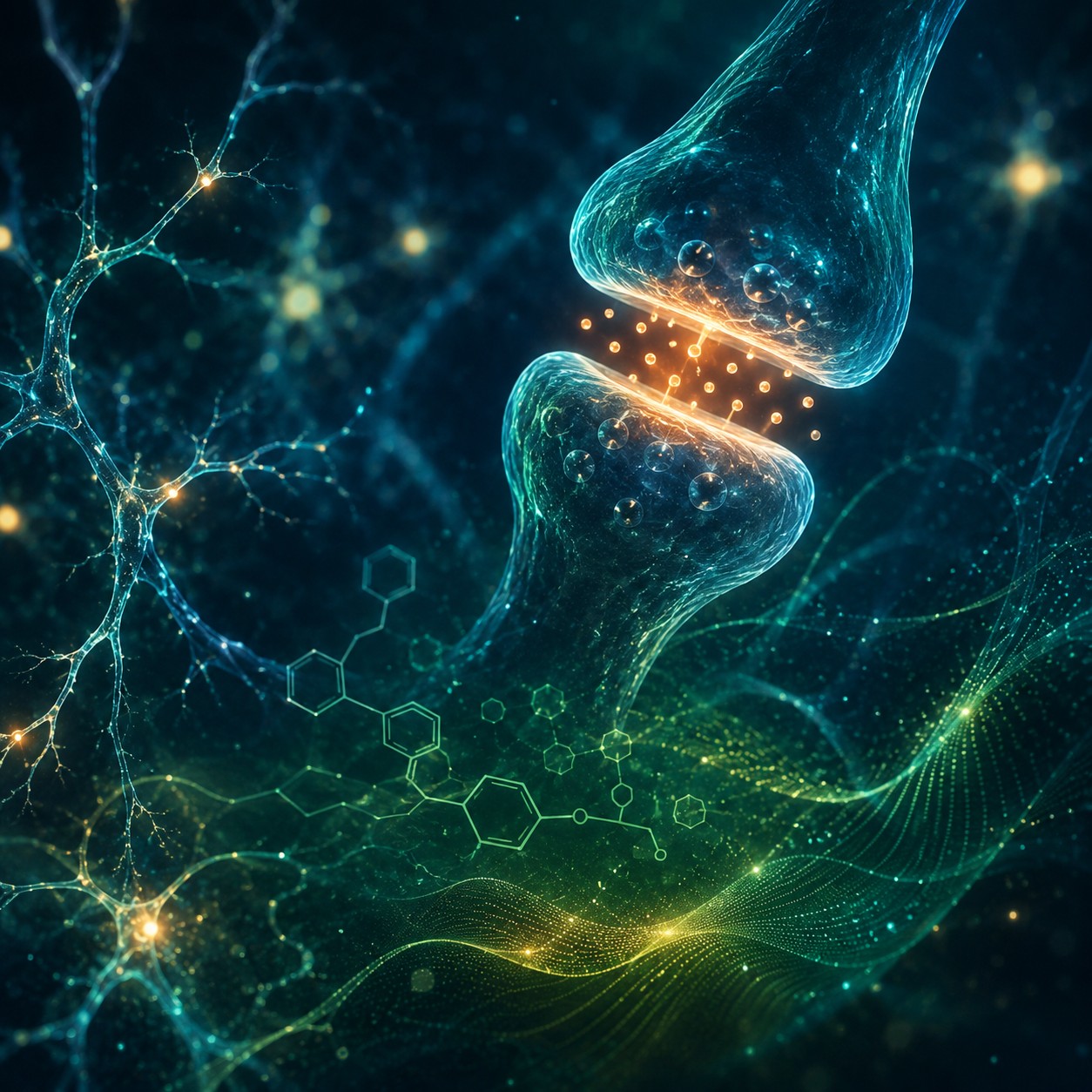
Serotonin doesn’t act alone — it works through a whole family of different receptors, each doing something distinct. There are at least fourteen known serotonin receptor subtypes, each triggering different effects depending on where they’re located and what they’re bound to. For this discussion, only one matters: 5-HT1A. A useful way to picture it: think of serotonin as a key, and 5-HT1A as one of several locks it can fit into, each lock triggering a different downstream effect once the key turns it. This particular lock is heavily involved in mood and anxiety-related processes, which is exactly why it’s drawn so much research attention.
Here’s where CBD actually enters the picture, and where it’s worth being precise. CBD does not become serotonin. CBD does not increase serotonin directly, in the way a key doesn’t multiply itself by fitting into a lock. What research suggests, instead, is narrower and more specific: CBD may influence signaling involving the 5-HT1A receptor — interacting with the lock itself, in a sense, rather than manufacturing more keys. That’s a meaningfully different, more modest claim than “CBD boosts serotonin,” and the distinction matters considerably for understanding what’s actually being studied.
Busting a Few Common Myths
A few ideas circulate often enough to deserve direct correction. “CBD boosts serotonin” is the most common, and it’s an oversimplification of the actual research — influencing receptor signaling is a different mechanism than increasing the amount of serotonin present, and conflating the two misrepresents what studies have actually found. “CBD replaces antidepressants” is another, and it doesn’t hold up either — antidepressants work through specific, well-studied mechanisms, often involving serotonin reuptake directly, and no credible research supports CBD replicating that specific pharmacological action.
“Depression is simply low serotonin” is perhaps the broadest oversimplification of the three, and modern depression research has moved considerably beyond this idea, which dominated public understanding for decades, largely thanks to how early antidepressant marketing explained its own mechanism in simple terms. Depression involves a complex interplay of neurotransmitter systems, brain structure and connectivity, genetics, life circumstances, and more — a single-neurotransmitter explanation is now understood as, at best, a very partial piece of a much larger picture. All three myths share a common flaw: they take a real, narrow research finding and stretch it into a much bigger, tidier claim than the evidence actually supports, which is a pattern worth watching for in health marketing generally, not just here.
What CBD Research on Serotonin Actually Shows
Sorting the evidence honestly means separating it by type. What’s established: CBD’s interaction with the 5-HT1A receptor is real, published pharmacology, replicated across multiple studies — solid ground. What’s emerging: research connecting this receptor interaction to anxiety-related outcomes in various studies, a genuinely active and developing area. Animal studies have shown antidepressant-like behavior in various rodent models following CBD administration, which is mechanistically interesting and worth taking seriously as an early signal, though animal behavior studies don’t automatically confirm the same effect in humans.
Human studies specifically examining CBD’s effect on serotonin signaling remain limited — there’s meaningfully less human data here than the popular narrative around “CBD and serotonin” might suggest. What is not established, and deserves stating plainly: CBD has not been shown to increase serotonin levels in humans, and CBD has not been shown to treat depression. Both of these would require a different, more robust body of clinical evidence than currently exists.
| Sorting the evidence by type Established: CBD interacts with the 5-HT1A serotonin receptor Emerging: research linking this interaction to anxiety-related outcomes Animal studies: antidepressant-like behavior observed in several rodent models Not established: CBD increasing serotonin levels in humans, or treating depression |
Why Scientists Are Still Interested
Given how much remains unsettled, it’s worth asking why this research area continues to attract serious scientific attention at all. The answer lies in the plausible, mechanistically grounded connections still being explored — potential influence on stress response, since the 5-HT1A receptor is involved in how the body regulates reactions to stress; potential relevance to emotional regulation more broadly, given serotonin’s wide-ranging role in mood-related processes; and a continued, active interest in anxiety specifically, an area where CBD research is somewhat more developed than in mood disorders generally.
Part of what keeps researchers engaged is that the mechanism itself — a non-intoxicating compound interacting with a receptor system already central to several approved psychiatric medications — is genuinely unusual and worth understanding properly, independent of any immediate treatment application. Science doesn’t always need an imminent product to justify continued study; sometimes a plausible, well-grounded mechanism is reason enough to keep investigating, precisely because the eventual answer, whatever it turns out to be, will meaningfully improve understanding of how mood regulation actually works. None of this amounts to a treatment claim. It amounts to a genuinely interesting, still-unfolding area of pharmacology that hasn’t yet produced definitive answers, which is precisely why researchers keep investigating it rather than considering the question closed.
What We Can Honestly Say Today
Here’s a fair, balanced summary of where things actually stand: we know considerably more today than we did ten years ago about how CBD interacts with serotonin-related pathways in the body. We still know far less than many advertisements suggest. The receptor interaction is real. The leap from that interaction to claims about mood-boosting or depression treatment is not supported by current evidence — it’s a gap that marketing tends to fill with confidence the research itself doesn’t yet have.
Back to the Opening Line
Serotonin was never simply the “happiness chemical” — that framing undersells a molecule doing complex, wide-ranging work throughout the body, most of it in the gut rather than the brain. CBD was never simply a serotonin booster either — the real mechanism, as far as current research shows, is narrower and more specific: a receptor interaction, not a supply increase. The actual science, in both cases, is more interesting than the popular shorthand — not because it offers a tidier answer, but because it doesn’t pretend to have one yet.
As research continues, scientists are learning more about how the endocannabinoid system and serotonin signaling may interact with each other. But plenty of important questions remain genuinely unanswered, and that honest uncertainty is a more accurate place to end than any confident claim currently allows.
This article is intended for general educational purposes and is not medical advice. CBD has not been shown to increase serotonin levels or to treat depression or any mental health condition. Anyone experiencing symptoms of depression or anxiety is encouraged to speak with a doctor or qualified mental health professional.
Written by Carmen Dos Anjos Germano, Founder of Pure CBD4U
Carmen founded Pure CBD4U after her own search for reliable, high-quality CBD oil, starting with full spectrum CBD oil 5% as part of her personal wellness routine. That experience shaped the company’s focus on transparency, quality and independent testing. Pure CBD4U works with EU-grown hemp, uses third-party laboratory testing, and makes batch results accessible through QR codes on its products. Carmen remains closely involved in product selection, quality standards and the development of the Pure CBD4U range.

Leave a Reply