
How many times have your knees, hips, shoulders, fingers, and ankles quietly carried you today without asking for a single moment of attention? Walking downstairs this morning. Opening a stubborn jar. Typing an email. Standing up from the sofa. Getting into the car. Turning a key in a lock that always sticks slightly. Picking up the shopping bags from the trunk. Multiply that across a single ordinary day and the number runs into the hundreds — across a week, the thousands. Healthy joints are almost entirely invisible. Most people only notice them the day they stop moving comfortably.
The Hardest-Working Structures You Never Think About
Joints are, without much exaggeration, among the hardest-working structures in the human body. Every single movement — reaching for a coffee cup, climbing a curb, turning to check a blind spot — depends on a joint somewhere doing its job quietly and without complaint. They’re the hinges, pivots, and gliding surfaces that make an otherwise rigid skeleton capable of the extraordinary range of motion daily life requires, and they do this thousands of times a day for decades, largely without a single conscious thought from the person using them.
Why Joints Become Uncomfortable
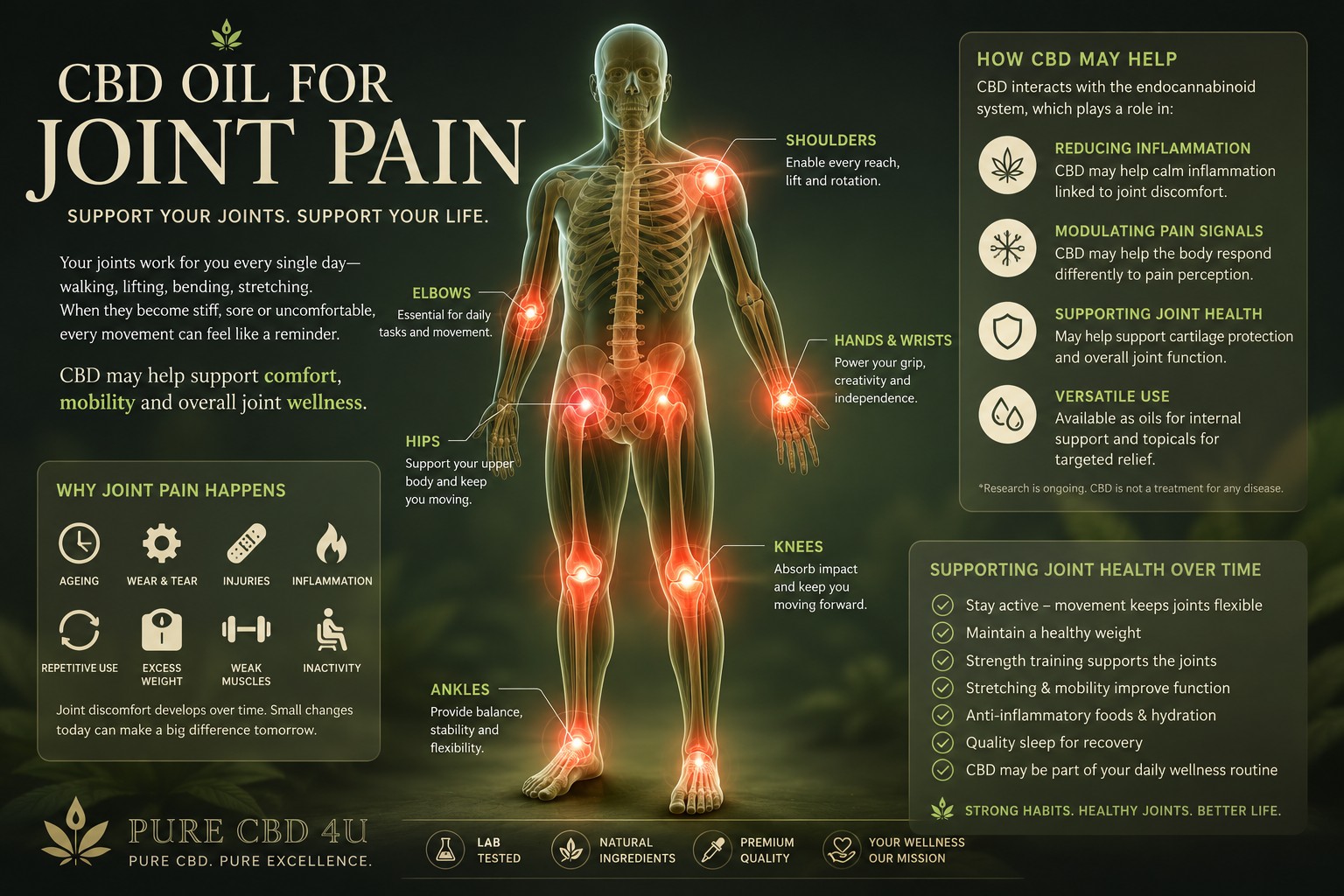
Joint discomfort rarely appears overnight. It’s usually the result of a gradual process building over years, shaped by several contributing factors that often overlap. Ageing is one of the more familiar contributors — cartilage, the smooth tissue that cushions joints, naturally thins somewhat over time, and the fluid that lubricates joint movement can become less effective with age. Normal wear, simply from decades of use, plays its own cumulative role, distinct from any specific injury.
Previous injuries — a sprained ankle in someone’s twenties, a knee injury from years of running — can leave lasting vulnerabilities that surface as discomfort much later, even after the original injury felt fully healed. Inflammation, whether from an underlying condition or simply the joint’s own response to strain, contributes directly to pain and stiffness. Repetitive movement, particularly in certain occupations or sports, loads specific joints in the same way over and over, which can accelerate wear in exactly those areas. Excess body weight increases mechanical load on weight-bearing joints, particularly the knees and hips, and reduced muscle strength around a joint leaves it with less support and shock absorption than it needs. Inactivity, perhaps counterintuitively, contributes too — joints that move through their full range regularly tend to stay more comfortable than joints that sit still for long stretches.
With this many contributing factors, often building simultaneously over years rather than announcing themselves at once, it makes sense that joint discomfort tends to creep in gradually rather than arriving as a single dramatic event.
A Common Misunderstanding
A lot of people, the first time a knee or shoulder starts complaining, reach for the same explanation: “it’s just old age.” Age is a genuine risk factor, and it would be dishonest to suggest otherwise — cartilage changes and cumulative wear are real, age-related processes. But this explanation, offered alone, misses a considerable amount of the actual picture. Plenty of younger adults experience real joint discomfort too, often following a specific injury, years in a physically repetitive occupation, or intensive sports involvement that loaded particular joints well beyond what casual use would. A twenty-eight-year-old former athlete with a knee that aches on stairs isn’t experiencing “old age” — they’re experiencing the accumulated effect of specific, identifiable strain, which is a meaningfully different situation with different implications for what might actually help.
Where CBD Enters the Picture
It’s within this layered, often multi-decade picture that CBD has become a product a lot of people with joint discomfort start looking into — whether that discomfort arrives at sixty or thirty-five.
CBD’s interaction with the endocannabinoid system, which has documented involvement in pain perception and inflammatory regulation, rests on genuine, established pharmacology — CB2 receptors in particular are present in joint tissue and immune cells relevant to inflammatory processes, offering a plausible mechanism for cannabinoids to influence joint-related discomfort specifically. Laboratory research has shown CBD reducing inflammatory markers in joint tissue under controlled conditions, and some animal studies suggest a role in reducing pain behavior associated with joint inflammation — encouraging, mechanistically grounded findings that don’t automatically confirm the same effect in humans.
Human clinical research specifically on CBD for joint discomfort remains genuinely limited, though a growing number of small studies and surveys report reduced discomfort and improved daily function among users. Topical CBD applied directly over affected joints has some early research support for localized relief, working through skin and underlying tissue rather than systemic absorption, which is a mechanistically distinct pathway from oral CBD’s broader, whole-body effect. Neither route currently has the kind of large, well-controlled clinical trial evidence needed to call CBD a proven treatment for joint pain — the overall evidence base is genuinely promising but still developing. Consumer reports describing meaningful relief, particularly with topical products used consistently, are common and worth taking seriously as a signal, though they remain a different category of evidence than a rigorous clinical trial, and marketing promising guaranteed joint pain relief goes beyond what current research supports.
| What’s known vs. what’s still developing Established: CB2 receptors in joint tissue give a plausible mechanism for cannabinoid involvement Emerging: some human studies and surveys report reduced discomfort and improved function Lab/animal research: encouraging anti-inflammatory findings, not yet fully confirmed in humans Not established: CBD, oral or topical, as a proven treatment for joint pain |
Why Joint Pain Is Different From Muscle Pain
It’s worth understanding why joint discomfort often behaves differently from a sore muscle, since the two get grouped together constantly despite being genuinely different problems. Muscles have a rich blood supply and heal relatively quickly and efficiently after strain or minor injury. Joints are different — cartilage in particular has a limited blood supply and a much slower capacity for repair, meaning joint tissue often takes considerably longer to recover from strain, if it fully recovers at all.
Inflammation behaves differently in each context too. Muscle inflammation is often a normal, temporary part of the repair process after exercise or minor strain, resolving within days. Joint inflammation can become more persistent, particularly where cartilage or the joint lining is involved, and chronic joint inflammation is a meaningfully different physiological situation than the short-term inflammation following a hard workout. Movement itself plays a somewhat paradoxical role in joints compared to muscles — gentle, regular movement often genuinely helps joint comfort by promoting circulation of joint fluid and maintaining range of motion, whereas a strained muscle sometimes benefits more from a short period of actual rest. Prolonged inactivity, meanwhile, can worsen joint stiffness specifically, in a way that doesn’t apply the same way to a resting muscle. Treating joint discomfort with the same instincts that work for a sore muscle — rest until it feels better — can sometimes make joint stiffness worse rather than better.
Supporting Joint Health Over Time
Given how gradually joint discomfort tends to build, supporting joint health is generally more effective as a long-term, ongoing practice than a reactive fix applied only once discomfort has already set in. Regular movement, particularly low-impact activity like walking, swimming, or cycling, keeps joint fluid circulating and maintains range of motion in a way that directly counters the stiffness inactivity produces. Maintaining a healthy body weight reduces mechanical load on weight-bearing joints, particularly knees and hips, often more meaningfully than any other single change available.
Strength training around major joints provides the muscular support that reduces strain on the joint structures themselves, and flexibility work maintains the range of motion that keeps joints moving through their full, comfortable arc. Physiotherapy offers targeted, individualized guidance, particularly useful for joint discomfort tied to a specific old injury or movement pattern. Broader anti-inflammatory lifestyle habits — balanced nutrition, moderate alcohol intake, not smoking — support the body’s overall inflammatory balance, and adequate sleep matters more than people tend to realize, since sleep plays a genuine role in the body’s inflammatory and repair processes.
CBD, within this longer-term picture, occupies a modest, supportive role for those who find it useful — one possible addition among several habits that address joint health directly, not a substitute for any of them.
Back to All Those Unnoticed Movements
Think back to today — the stairs, the jar, the typing, the car door, the shopping bags. Thousands of small movements, each one depending on a joint that asked for nothing in return. Healthy joints rarely demand attention, which is exactly why they’re so easy to take for granted until the day they don’t work quite as smoothly as they used to.
Looking after joints before they become the center of attention is, in almost every case, considerably easier than trying to address the problem after discomfort has already settled in. For some people, CBD becomes one supportive part of that longer-term approach. But joint health, in the end, is built through movement, strength, healthy body weight, and consistent habits sustained over years — not through any single product, however promising its research profile looks.
This article is intended for general educational purposes and is not medical advice. CBD is not a proven treatment for joint pain or any medical condition. Anyone experiencing persistent or severe joint discomfort is encouraged to speak with a doctor or qualified healthcare professional.
Written by Carmen Dos Anjos Germano, Founder of Pure CBD4U
Carmen founded Pure CBD4U after her own search for reliable, high-quality CBD oil, starting with full spectrum CBD oil 5% as part of her personal wellness routine. That experience shaped the company’s focus on transparency, quality and independent testing. Pure CBD4U works with EU-grown hemp, uses third-party laboratory testing, and makes batch results accessible through QR codes on its products. Carmen remains closely involved in product selection, quality standards and the development of the Pure CBD4U range.

Leave a Reply