
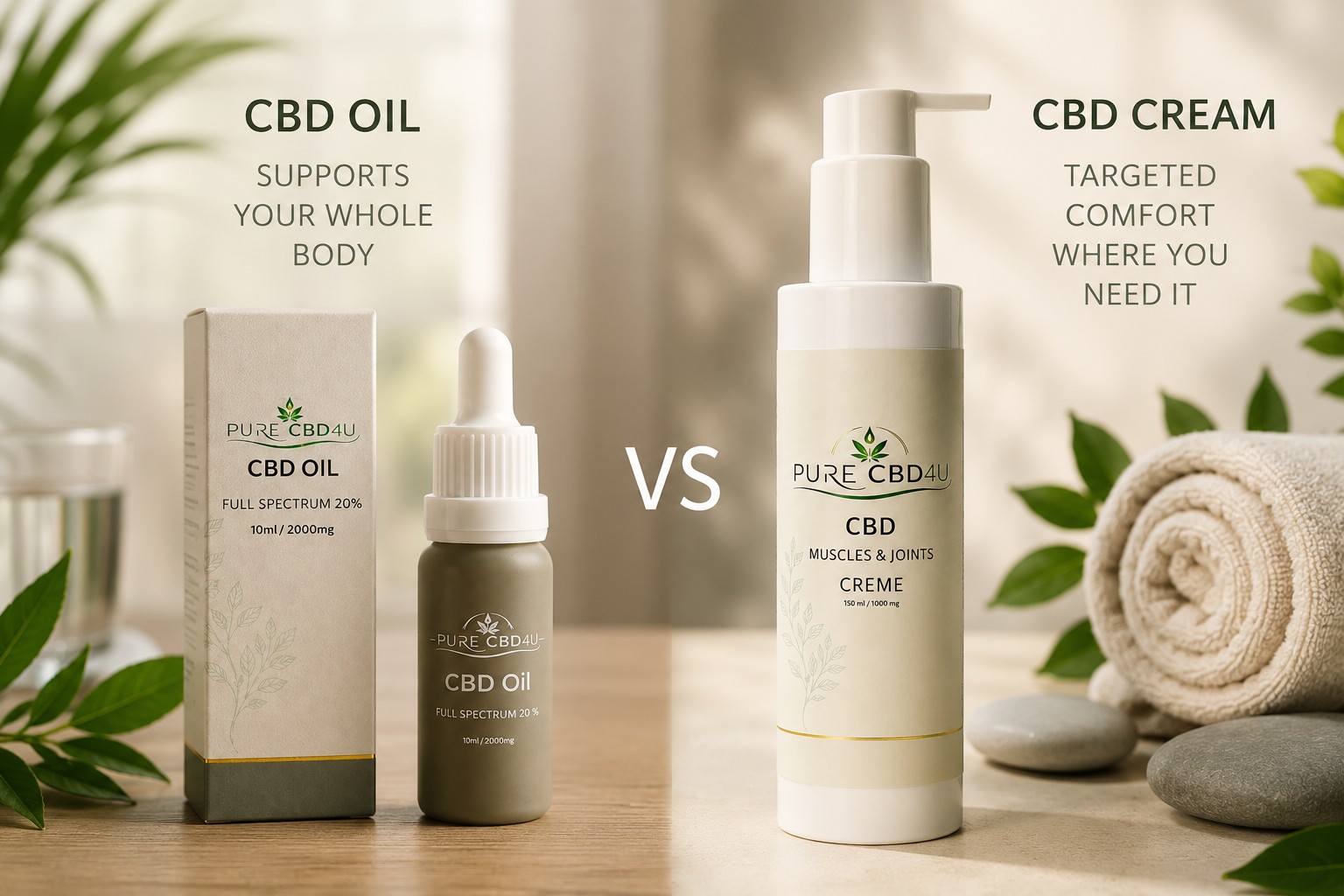
Before comparing ingredients, price, or reviews, one question actually matters more than any of it: where exactly is your pain? A shoulder? A knee? Your neck? Is it more of a whole-body ache? Or is it something that seems tangled up with stress, poor sleep, or general wellbeing rather than one specific spot? That single question tends to point toward one product over the other long before anything else gets compared.
Two Genuinely Different Approaches
Both products contain CBD, but from there, they work in very different ways. If you are still weighing up whether CBD suits your pain at all, our guide to CBD oil for pain relief covers that ground first. CBD cream stays local — applied directly to the skin over a specific area, doing whatever it does right where it’s put. CBD oil is taken orally, absorbed into the body and circulated more broadly rather than concentrated in one place. That practical difference — stays put versus goes everywhere — is the part worth understanding first, before getting into anything about absorption rates or bioavailability.
This distinction shapes almost everything else about how each product actually gets used day to day. A cream becomes part of a routine built around a specific body part — applied when that particular knee or shoulder is bothering someone, skipped on days when it isn’t. An oil, by contrast, tends to become part of a more general daily habit, taken on a consistent schedule regardless of which specific area feels fine or doesn’t on any given day. Neither pattern is more disciplined or more effective than the other — they’re just suited to different kinds of problems from the outset.
Thinking Through Your Own Situation
Consider a few everyday scenarios, and notice which one sounds like you.
Someone spends Saturday gardening and ends the day with one distinctly sore knee. Just the knee — nothing else. Would they naturally reach for a cream, rubbed directly onto that one joint? Probably, since the problem is entirely local and a cream matches that exactly.
Someone else deals with discomfort that shows up across several joints at once — both knees, a shoulder, some fingers some mornings. Would applying cream to every affected area, several times a day, be practical? Probably not — that’s a lot of separate applications for a problem that isn’t really localized to begin with.
A third person notices their discomfort seems closely tied to stress and poor sleep — a general tension that isn’t really about one joint at all. Would a topical product applied to a specific spot make much sense here? Not obviously — an oral product, working more broadly through the body, fits a whole-body pattern more naturally than a cream ever could.
A fourth scenario: someone wants something fast to reach for immediately after a workout, applied right to the muscle that’s tightest. A cream, rubbed in on the spot, matches that immediate, localized need directly.
A fifth: someone is building a longer-term daily wellness routine, more interested in general comfort and consistency than treating one specific flare-up. An oil, taken as part of a daily habit, fits that ongoing, whole-body approach better than reapplying cream to a rotating cast of sore spots.
And a sixth: someone traveling for work wants something discreet and simple to pack, without worrying about a cream tube leaking in a suitcase. A small bottle of oil, or capsules, often travels more easily than a jar meant for repeated topical application.
A useful way to sum up the pattern across all six: the more specific and localized the discomfort, the more naturally a cream tends to fit. The more general, whole-body, or wellness-oriented the goal, the more naturally an oil tends to fit. Most people, on reflection, already know which category their own situation falls into — the harder part is usually just pausing long enough to ask the question honestly, rather than defaulting to whichever product happened to come up first in a search or a recommendation from a friend.
What’s Actually Happening, Scientifically
Topical CBD works by penetrating the skin barrier and interacting with cannabinoid receptors in the skin and underlying tissue directly at the site of application, without necessarily entering the bloodstream in meaningful amounts — which is exactly why its effects tend to stay local rather than being felt more broadly. The skin barrier itself is reasonably effective at limiting what passes through it, which is part of why topical formulations often use specific delivery techniques to help CBD penetrate deeply enough to reach relevant tissue rather than sitting on the surface. Oral CBD, once absorbed through the digestive system, circulates systemically through the bloodstream, reaching cannabinoid receptors throughout the body rather than concentrating anywhere specific.
Laboratory research on topical cannabinoid application has shown promising early results for localized inflammation and discomfort in animal models, and a small but growing number of human studies support topical CBD for conditions like localized joint discomfort, though this research base remains genuinely limited in size and scope. Oral CBD has a broader body of human research behind it generally, more centered on systemic effects like general anxiety and overall pain perception than on any single localized area specifically. Consumer experience for both routes is fairly positive and consistent, though it remains a different category of evidence than a controlled clinical trial for either product. Neither route currently has robust, large-scale clinical evidence that would support calling it clearly superior to the other — they appear to work through different pathways for different kinds of problems, rather than one simply outperforming the other.
| What’s known vs. what’s still developing Established: topical and oral CBD interact with cannabinoid receptors via genuinely different pathways Emerging: small human studies support topical CBD for localized joint and muscle discomfort Broader but still developing: oral CBD research, more centered on systemic effects than local ones Not established: either route as a proven treatment, or one as clearly superior to the other |
A side-by-side look at the practical differences:
| What Matters | CBD Cream | CBD Oil |
| Where it’s applied | Directly on skin, over the affected area | Taken orally, absorbed internally |
| Convenience | Quick to apply, no measuring required | Quick to take, dropper measuring involved |
| Targeted use | Well suited to one specific area | Not targeted — works throughout the body |
| Whole-body use | Impractical for widespread discomfort | Well suited to general, whole-body patterns |
| Onset expectations | Often noticeable fairly quickly at the site | Typically 15–90 minutes, depending on format |
| Duration | Effects generally local and shorter-lived | Effects broader, often longer-lasting systemically |
| Flexibility | Easy to apply more if needed, area-specific | Dose adjustable, but affects the whole body |
| Practicality for travel | Jar or tube, some spill risk | Compact, generally easier to pack |
Can You Use Both?
Some people do, and it’s a genuinely reasonable approach rather than an either-or decision. A common pattern is using oil as part of a broader daily wellness routine — general consistency, whole-body support — while keeping a cream on hand specifically for one recurring trouble spot, like a knee that flares up after longer walks or a shoulder that tightens after a long day at a desk. This isn’t a matter of one approach being superior to using either alone; it simply reflects that the two products are solving different kinds of problems, and some people happen to have both kinds of problems at once.
There’s nothing wrong with using only one, either — it depends entirely on what someone’s actual pattern of discomfort looks like. Someone with a single, well-defined trouble spot and no broader wellness goals may find a cream alone does everything they need, with no reason to add an oil into the mix at all. Someone whose main interest is a general daily routine, without any one specific area causing trouble, may find an oil alone covers their situation just as completely. Combining both only makes sense where both kinds of need genuinely exist side by side — it isn’t a default upgrade so much as a reasonable option for a specific, dual situation.
Back to the Original Question
The right question was never “which product is better” — not in the abstract, and not as a general rule. It’s a more specific, more personal question: where is your discomfort, and what are you actually hoping to achieve? Sometimes the honest answer points naturally toward a cream — one sore knee, one tight shoulder, a specific, localized spot. Sometimes it points toward an oil — general tension, stress-linked discomfort, a whole-body pattern that a tube of cream was never going to address efficiently. And sometimes, honestly, it points toward neither, or toward both used differently for different problems.
Making the right choice starts with understanding your own situation — where the discomfort actually is, and what pattern it follows — rather than assuming either format is automatically the better one before that question’s even been asked. A tube of cream and a bottle of oil, sitting side by side on a shelf, aren’t really competing products at all. They’re two different tools, built for two different jobs, and the only thing that determines which one belongs in your routine is the specific shape of what you’re actually dealing with.
This article is intended for general educational purposes and is not medical advice. CBD is not a proven treatment for pain and has not been established as more effective in one delivery format over another. Anyone experiencing persistent or severe pain is encouraged to speak with a doctor or qualified healthcare professional.
Written by Carmen Dos Anjos Germano, Founder of Pure CBD4U
Carmen founded Pure CBD4U after her own search for reliable, high-quality CBD oil, starting with full spectrum CBD oil 5% as part of her personal wellness routine. That experience shaped the company’s focus on transparency, quality and independent testing. Pure CBD4U works with EU-grown hemp, uses third-party laboratory testing, and makes batch results accessible through QR codes on its products. Carmen remains closely involved in product selection, quality standards and the development of the Pure CBD4U range.

Leave a Reply