
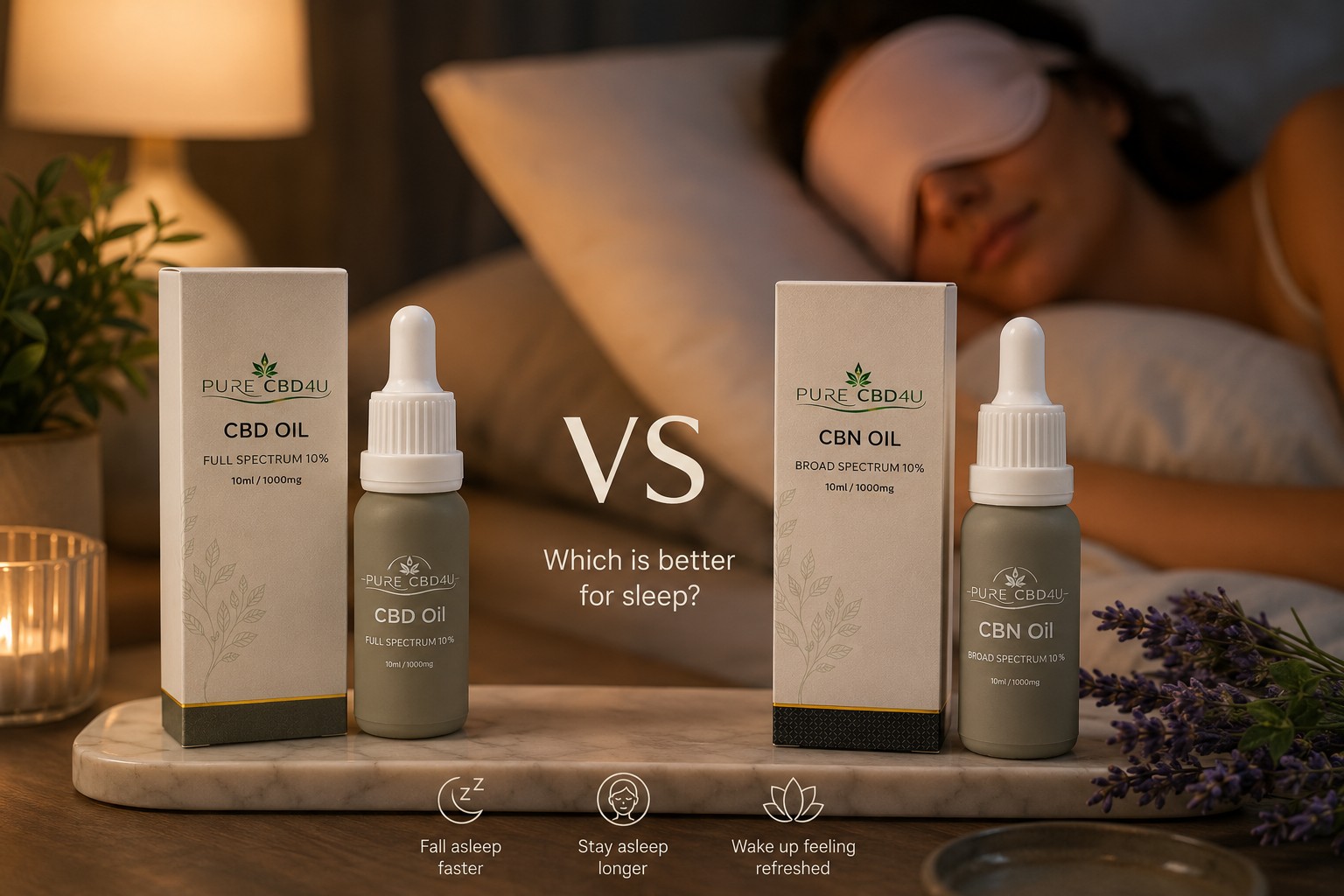
Two tabs open, two bottles, both claiming to support a better evening. One is labeled CBD Oil. The other, CBN Oil. Both sit at a similar price point. Both have a wall of five-star reviews describing the same general outcome: falling asleep more easily, waking up less, feeling calmer at night. A buyer with no particular loyalty to either compound, wanting exactly one bottle for exactly one purpose — better sleep — is left with a genuinely reasonable question: which one actually makes more sense?
That’s the question this review sets out to answer honestly, without assuming the reader already knows what either compound is, and without picking a winner just to have a clean ending.
What Each Bottle Is Actually Designed to Do
Reading past the marketing copy, the two products are making subtly different promises. The CBD oil markets itself broadly — calm, balance, everyday wellness, evening relaxation among several other claimed benefits. The CBN oil markets itself more narrowly, almost entirely around sleep specifically, often invoking the idea that CBN is “the sleep cannabinoid.” That distinction alone is worth pausing on: one product is a generalist, the other is positioning itself as a specialist. Whether that specialization is backed by evidence, or is mostly clever framing, is the first thing worth investigating.
The Evidence Behind Each Claim
CBD’s research base is, by a wide margin, the more established of the two. Its interaction with the endocannabinoid system and serotonin 5-HT1A receptors rests on solid, published pharmacology, and a frequently cited case series in The Permanente Journal found improved anxiety scores in the large majority of adult participants, with more modest, less consistent improvements in sleep. That’s genuine evidence, if evidence more centered on anxiety and general stress regulation than sleep specifically — which matters for a buyer whose primary goal is falling and staying asleep rather than daytime calm.
CBN’s research position is considerably thinner. Much of the “CBN for sleep” narrative traces back to older, small, and often poorly controlled studies, alongside a widely cited but frequently misrepresented data point: CBN is a breakdown product of THC that forms as cannabis ages, which led to early speculation that aged cannabis’s sedating reputation came from CBN specifically. That mechanistic story is plausible but has not been robustly confirmed in rigorous human trials, and more recent research has actually raised questions about whether CBN alone produces meaningful sedation independent of other compounds. In plain terms: CBD has a broader, more established evidence base overall; CBN’s sleep-specific reputation is popular and mechanistically interesting but considerably less proven than its marketing suggests.
| Scoring the evidence honestly CBD: broader research base, stronger for anxiety and general stress, more modest for sleep specifically CBN: popular sleep narrative, but thin, small-scale, and not yet robustly confirmed in humans Both: consumer reports of improved sleep are common for each, though anecdotal rather than clinical Neither: clinically proven as a reliable, guaranteed sleep aid |
Falling Asleep vs. Staying Asleep — Would This Matter to an Ordinary Customer?
It genuinely would, since these are different problems. For someone whose main struggle is a racing mind at bedtime — difficulty falling asleep in the first place — CBD’s better-established relationship with anxiety and stress regulation is arguably the more relevant fit, even without sleep-specific data to back it fully. For someone who falls asleep fine but wakes at 2 or 3 AM and struggles to drift off again, CBN’s marketed reputation for supporting sleep maintenance is the more direct pitch — though it’s worth repeating that this specific claim rests on thinner science than the marketing tone implies.
Onset time is a smaller but practical consideration either way. Both are typically available as oils, taken sublingually, with effects generally appearing in the fifteen-to-forty-five-minute range — similar enough between the two that onset shouldn’t really be the deciding factor for most buyers.
Consumer Experience: A Real Signal, With Real Limits
Reviews for both products describe broadly similar outcomes — easier evenings, less tossing and turning, a calmer mind at bedtime. That consistency is worth taking seriously as a signal. It’s also worth being honest about its limits: reviews aren’t blinded, aren’t controlled for dose or individual metabolism, and are subject to expectation effects that a five-star rating can’t distinguish from an actual pharmacological effect. Would this matter to an ordinary customer reading reviews before buying? It should — enthusiastic reviews are a reasonable input into a purchasing decision, but they’re not the same category of evidence as a clinical trial, for either product.
Flexibility, and Who Each Product Actually Suits
CBD’s broader research base and everyday-use profile make it the more flexible bottle of the two — useful for evening wind-down, but also relevant to general stress across the rest of the day, which matters to a buyer who wants one product doing more than a single job. CBN’s narrower positioning suits someone with a specific, defined complaint — sleep maintenance particularly — who isn’t looking for a general wellness product and would rather try something targeted, understanding that the targeting is more marketing-driven than clinically proven at this stage.
Previous experience matters here too. Someone who has already used CBD regularly and found it only modestly helpful for sleep specifically, despite it helping with general stress, is a more logical candidate for trying CBN next — they’ve already tested the broader option and are looking for something more targeted. Someone entirely new to cannabinoids, by contrast, generally has less to gain from starting with the less-established, more narrowly marketed option first.
Price and Practical Considerations
One more practical note worth a reviewer’s attention: CBN oil, given its narrower market and generally more complex extraction process, often carries a modestly higher price per milligram than a comparable CBD oil. Whether that premium is worth paying depends entirely on the buyer’s specific goal — if sleep maintenance is the singular concern and CBD hasn’t fully addressed it, the added cost may be reasonable to test. If someone hasn’t yet tried CBD at all, paying more for the less-established option first is difficult to justify on the evidence alone, regardless of how the marketing frames it.
If We Had to Recommend One…
Here’s where this review resists the easy version of an ending. For someone completely new to cannabinoids, CBD is the more logical starting point — not because it’s guaranteed to solve a sleep problem, but because it has a considerably larger body of research, a longer track record of everyday use, and broader relevance beyond sleep alone, which makes it a more sensible first purchase while someone is still learning how their body responds to cannabinoids generally.
For someone who has already tried CBD, is reasonably familiar with how it affects them, and is specifically troubled by staying asleep rather than falling asleep, CBN may be worth discussing and testing — with realistic expectations that its sleep-specific reputation currently outpaces its clinical evidence, and that individual response is likely to vary considerably given how thin the underlying research still is.
This isn’t a universal recommendation either way. It’s a starting point based on where someone actually is in their own cannabinoid experience, not a verdict on which molecule is objectively superior — because on the current evidence, neither one clearly is.
Closing the Test
The goal of this review was never to crown a winner, and it wouldn’t be honest to pretend one bottle definitively outperforms the other for every buyer standing in front of that same two-tab decision. CBD carries broader, more established science and everyday flexibility; CBN carries a narrower, more specific pitch that’s popular, plausible, and considerably less proven than its five-star reviews suggest. Both may genuinely help some people sleep better. Neither is a guaranteed fix for anyone.
What actually matters, standing in front of that shelf or that browser tab, is less about which molecule wins and more about which one matches your own situation — your sleep challenge specifically, your prior experience with cannabinoids, and whether you’re looking for a broad wellness product or a narrowly targeted one. Knowing how to ask that question is worth more, in the end, than any single answer this review could hand you.
This article is intended for general educational purposes and is not medical advice. Neither CBD nor CBN is a clinically proven treatment for insomnia or sleep disorders. Anyone experiencing persistent sleep difficulties is encouraged to speak with a doctor or qualified healthcare professional.
Written by Carmen Dos Anjos Germano, Founder of Pure CBD4U
Carmen founded Pure CBD4U after her own search for reliable, high-quality CBD oil, starting with full spectrum CBD oil 5% as part of her personal wellness routine. That experience shaped the company’s focus on transparency, quality and independent testing. Pure CBD4U works with EU-grown hemp, uses third-party laboratory testing, and makes batch results accessible through QR codes on its products. Carmen remains closely involved in product selection, quality standards and the development of the Pure CBD4U range.

Leave a Reply