
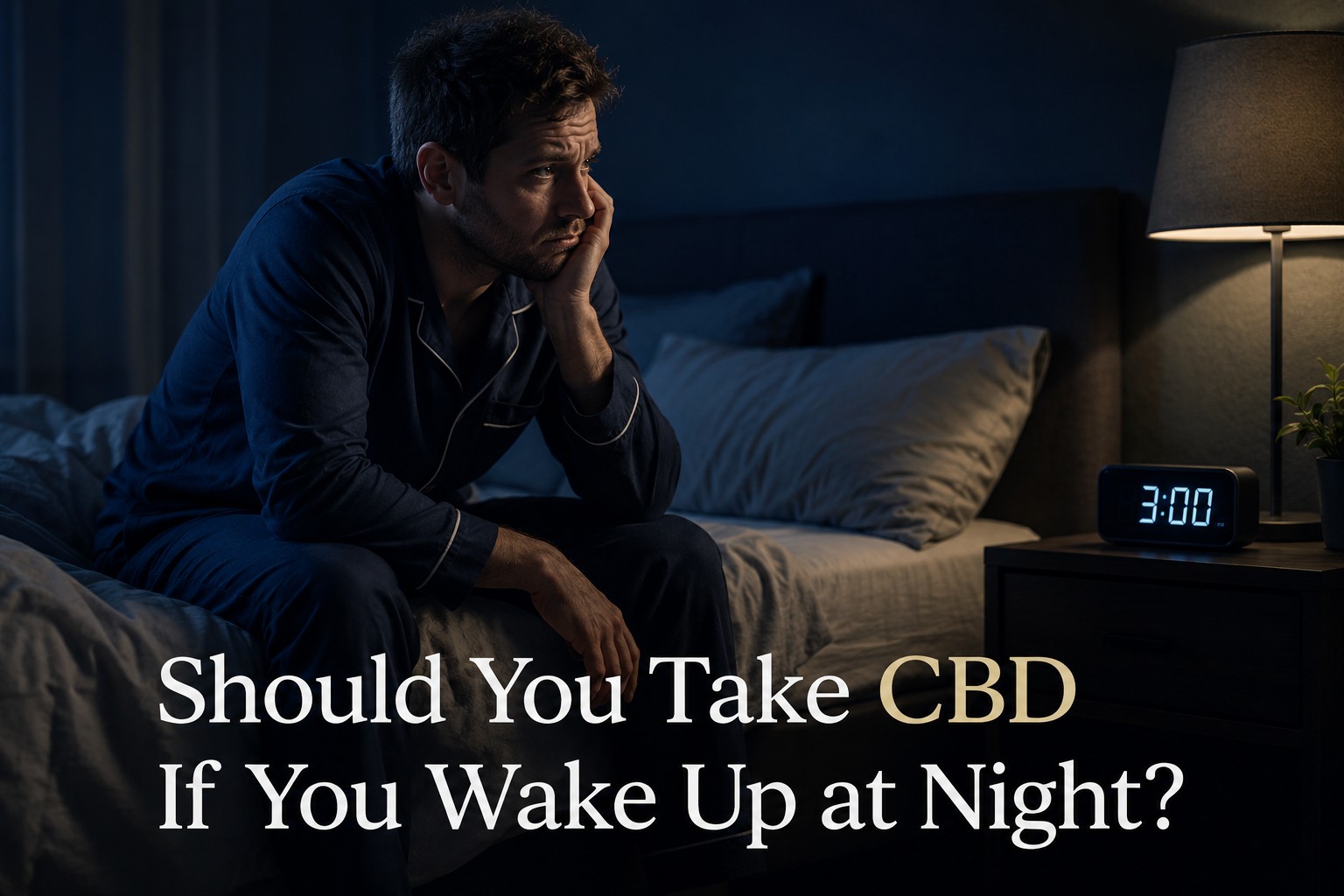
Eyes open. The room is completely dark. The clock, when it finally comes into focus, reads 2:43 AM. No alarm went off. Nothing crashed, nothing rang, no obvious reason presents itself. Just — awake. The house is silent. Everyone else, everything else, is still asleep. Except, apparently, you.
The first question that matters here isn’t “should I take CBD?” It’s simpler, and worth sitting with for a moment before reaching for anything at all: why did I wake up?
The Investigation Begins
Consider this a case with several plausible suspects, each worth examining before jumping to a conclusion. Stress is an obvious early candidate — an unusually demanding day can leave the nervous system running slightly hotter than usual, more prone to surfacing into wakefulness during a natural lighter phase of sleep. Anxiety, related but distinct, often shows a specific signature: waking with a thought already mid-sentence, the mind picking up a worry precisely where it left off.
Alcohol deserves suspicion too, even in modest amounts — it can ease the process of falling asleep while disrupting sleep architecture several hours later, which is exactly why a 2 AM waking sometimes follows an evening drink that felt harmless at the time. Caffeine, if it was consumed later than realized, can still be circulating enough hours later to fragment sleep without anyone connecting the two. Room temperature is a quieter suspect — a bedroom that’s slightly too warm is one of the more common, most overlooked causes of a mid-night surfacing.
Then there’s the simply physical: a body that needs the bathroom, which is its own straightforward explanation requiring no further investigation at all. Sleep cycles themselves are worth naming directly, since they’re so often overlooked — the body moves through several cycles a night, and a brief surfacing between them is built into normal sleep architecture, not a malfunction of it. Blood sugar dips overnight can rouse some people, particularly after a light dinner or an early one. Noise — a passing car, a partner shifting, a pipe settling — and light, even a small amount leaking in around a curtain, both register more than people expect during lighter sleep phases.
For some, the suspects are more specific still: menopause-related night waking is well documented and common, ageing naturally shifts sleep toward lighter, more fragmented patterns even in otherwise healthy adults, and certain medications carry night-waking as a known, listed effect. Any of these, alone or in combination, could plausibly explain 2:43 AM. Often, no single one is identifiable at all — and that, as it turns out, is completely fine.
The Twist: Waking Up Isn’t the Problem
Here’s what the investigation actually reveals, once the suspects have all been considered: for most adults, briefly waking during the night is normal, expected sleep architecture, not a sign that something has gone wrong. Sleep moves in cycles of roughly ninety minutes, transitioning between lighter and deeper stages, and a brief surfacing at the boundary between cycles happens often — many people simply fall back asleep quickly enough that they never remember it in the morning. The waking itself was likely never the mystery worth solving.
The real question, quietly, is different: not why did I wake up, but why am I still awake ten minutes later? That’s usually where the actual disruption happens — not in the waking, but in what follows it: checking the phone, doing the mental math on remaining sleep hours, letting one clear thought spiral into several. A brief, forgettable waking becomes a genuine one the moment it’s met with that kind of activation.
So — Would CBD Actually Make Sense Right Now?
This is where CBD enters the investigation, and it deserves an honest, unglamorous look rather than either a confident yes or a dismissive no.
Start with onset time, because it matters more here than almost anywhere else CBD gets discussed. Sublingual oil typically produces a noticeable effect somewhere in the fifteen-to-forty-five-minute range. Gummies or capsules, needing to be digested first, generally take sixty to ninety minutes. At 2:43 AM, with a full workday still hours away, that timeline is worth doing the arithmetic on honestly: even oil, the faster of the two, may not produce anything noticeable until closer to 3:15 or 3:30, and a gummy’s effects might not arrive until well past 4 AM — territory where the original sleep cycle has likely either resolved itself or turned into a longer bout of wakefulness for entirely separate reasons.
What does the actual evidence say here? CBD’s interaction with the endocannabinoid system and serotonin 5-HT1A receptors is grounded in real, established pharmacology, and a frequently cited case series in The Permanente Journal found improved anxiety and modestly improved sleep scores in adults using CBD consistently over time. That’s a genuine finding — about consistent use, not about a single dose taken mid-crisis at 3 AM. There is no clinical research specifically evaluating CBD as an in-the-moment remedy for a middle-of-the-night waking, and it’s worth naming an internet myth directly: CBD is not a fast-acting sedative, and taking it reactively in the middle of the night is a meaningfully different scenario than taking it consistently as part of an evening routine, where its slower, cumulative relationship with sleep quality has at least some supporting research behind it.
| Two different situations, worth telling apart Consistent evening use: some supporting evidence for anxiety and modest sleep benefits over time Reactive 3 AM use: onset time likely too slow to meaningfully help with that specific waking Consumer reports of it helping mid-night exist, but remain anecdotal and unstudied specifically Neither taking it nor skipping it in the moment is inherently the “right” choice |
What to Do Before Reaching for Anything
Before any decision about CBD or anything else, a few quiet habits tend to matter more than whatever gets reached for. Don’t check the time repeatedly — each glance tends to trigger a small mental calculation about remaining sleep hours, which does more to wake the mind than the original disruption did. Avoid a bright phone screen entirely if at all possible; the light alone can be enough to push the body further from sleep rather than back toward it.
Keep the room dim rather than turning on a bright light for any reason that can wait until morning. Slow, unhurried breathing — nothing elaborate, just longer exhales than inhales — can ease the body gently without requiring full alertness to do it. Try not to panic if sleep doesn’t return within a minute or two; that mild alarm is often what turns a brief waking into a genuinely long one. And perhaps most usefully: resist letting one ordinary waking become an hour of frustrated wakefulness. Lying quietly, even without sleep, in a dim and calm room is a considerably better use of 3 AM than a fully lit phone screen and a spiral of calculations about tomorrow.
Back to 2:43 AM
The clock still reads the middle of the night. Nothing about the room has changed. But the question sitting in it has — quietly, but meaningfully. It was never really “should I take CBD right now,” not in any way that a mid-night decision could answer cleanly. The more useful question turned out to be: why did I wake up in the first place, and what’s actually the most sensible response to that, tonight specifically?
For someone who already takes CBD consistently as part of an evening routine, tonight’s waking doesn’t necessarily call for anything different — the routine is already doing its work over time, not in any single moment. For someone reaching for it reactively, for the first time, at 2:43 AM specifically hoping for something fast, the honest answer is that the timing may not cooperate the way it’s hoped to. Either way, one brief awakening is rarely the real story. Long-term sleep quality is shaped far more by consistent evening habits, kept steadily over weeks, than by whatever gets decided in any single dark, quiet, 3 AM moment — including this one.
This article is intended for general educational purposes and is not medical advice. CBD is not a sedative and has not been studied as an in-the-moment remedy for night waking. Anyone experiencing frequent or persistent sleep disruption is encouraged to speak with a doctor or qualified healthcare professional.
Written by Carmen Dos Anjos Germano, Founder of Pure CBD4U
Carmen founded Pure CBD4U after her own search for reliable, high-quality CBD oil, starting with full spectrum CBD oil 5% as part of her personal wellness routine. That experience shaped the company’s focus on transparency, quality and independent testing. Pure CBD4U works with EU-grown hemp, uses third-party laboratory testing, and makes batch results accessible through QR codes on its products. Carmen remains closely involved in product selection, quality standards and the development of the Pure CBD4U range.

Leave a Reply