
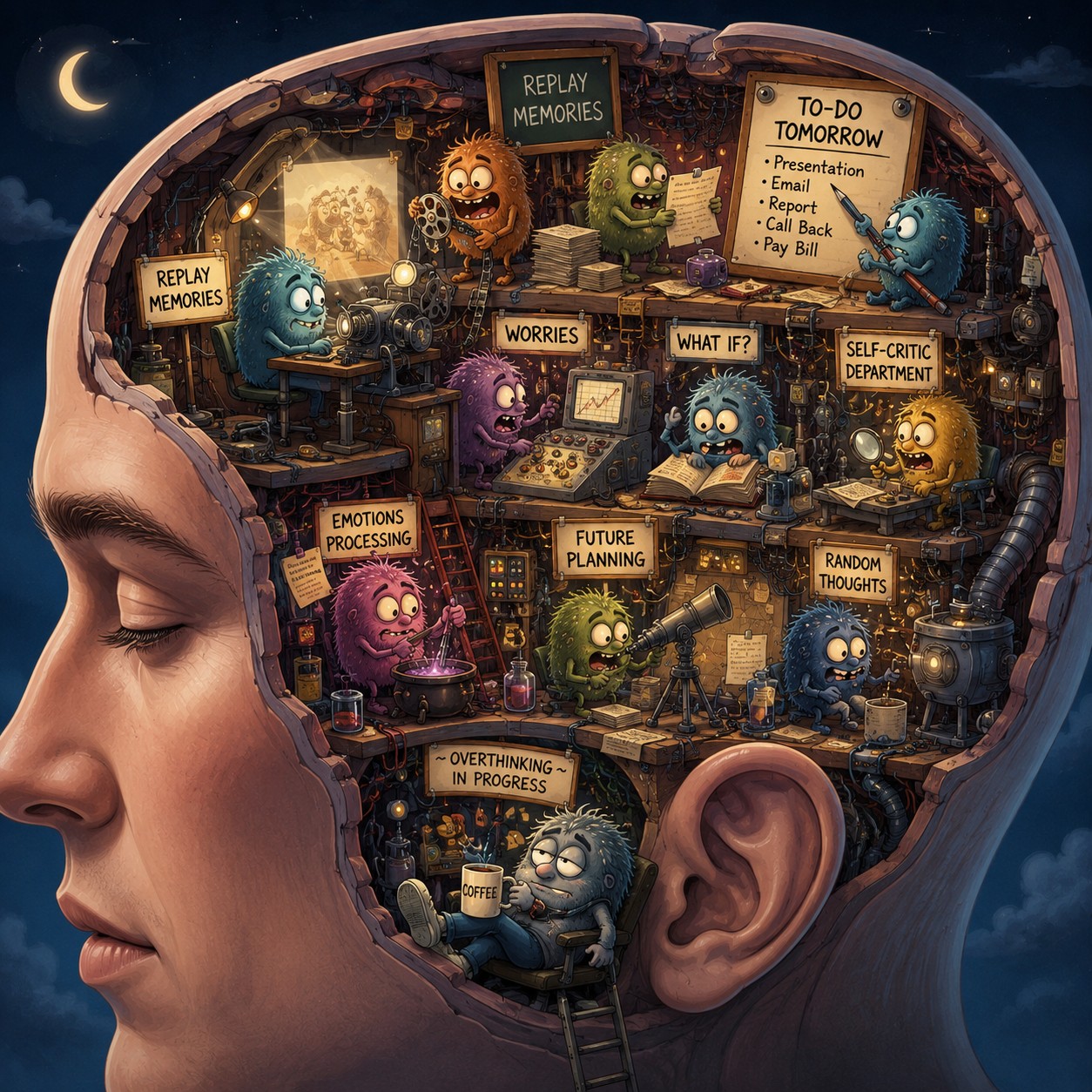
It’s finally quiet. The emails have stopped. The television is off. The kids are asleep. The house has settled into that specific, peaceful stillness that should, by every reasonable measure, be an ideal moment to drift off. And this, with almost comic timing, is precisely when the brain chooses to replay an embarrassing thing you said in a meeting five years ago. Or tomorrow’s presentation. Or a bill you’re fairly sure you forgot to pay.
Why does the brain wait until the exact moment everything goes quiet to suddenly become so productive?
The Brain Isn’t Getting More Active — It’s Finally Getting a Turn
Here’s the twist worth sitting with: your brain almost certainly isn’t becoming more active at night. It’s active all day too — arguably busier during daylight hours, just occupied with different work. What changes at night isn’t the amount of activity. It’s what that activity is finally allowed to focus on.
During the day, attention is almost constantly pulled outward — toward a conversation, a screen, a task, a notification, another task. That external pull is relentless enough that it crowds out a huge amount of internal processing the brain still needs to get through: unresolved emotional moments, loose ends from a conversation, half-formed worries that never got a clear turn. The moment external stimulation drops away — lights off, phone down, house quiet — attention naturally turns inward, and all that backlogged processing finally gets some room to run. It isn’t malfunctioning. It’s catching up.
A Quick Look at What’s Actually Happening
Neuroscientists have a name for the brain network that tends to switch on during exactly this kind of quiet, unfocused moment: the default mode network. In plain terms, it’s the brain’s internal, self-referential mode — active when you’re not concentrating on an external task, and it’s specifically involved in reflecting on yourself, replaying memories, and simulating future scenarios like tomorrow’s meeting. It’s less active while you’re absorbed in a task during the day and considerably more active the moment that absorption stops, which lines up almost exactly with the lying-in-bed experience.
Cognitive load plays a role too — essentially, how much mental “stuff” you’re carrying at any given moment. During a full day, load is spread across dozens of small demands, none of which linger long enough to be fully processed. At night, with the load no longer being replenished by new inputs, the backlog gets its turn, one item surfacing after another, often with no logical order at all. Emotional processing follows a similar pattern — the brain uses quiet, unstimulated time to work through the emotional residue of the day, which is part of why an unresolved conflict or an awkward exchange tends to resurface specifically at night rather than during a busy afternoon.
There’s also a biological backdrop to all this. Circadian rhythm — the roughly 24-hour internal clock governing alertness and sleepiness — and its related cortisol rhythm typically has cortisol declining through the evening, which should support winding down, but stress or irregular schedules can disrupt that decline, leaving alertness higher than it should be at exactly the wrong hour. Sleep pressure, the gradually building biological drive to sleep that accumulates the longer you’ve been awake, is usually strong by bedtime — but a suddenly overactive default mode network can override that pressure temporarily, creating the strange sensation of being simultaneously exhausted and wide awake.
Your Brain Isn’t Working Against You
It’s worth pausing here specifically to say: this experience is remarkably common, not a personal malfunction or a sign that something is wrong. Nearly everyone has had a version of the 11 PM replay — the old conversation, the future worry, the forgotten task — arriving uninvited the moment the day’s noise stops. It happens because the brain evolved to use quiet, low-threat moments for exactly this kind of internal housekeeping, not because modern life has broken something that used to work better. A mind that goes quiet at 2 PM during a busy day and gets loud at 11 PM in a silent bedroom is behaving entirely as expected — not the other way around.
Where CBD Enters This Picture
It’s in this specific context — a mind that’s finally been handed the floor and doesn’t quite know when to stop — that a lot of people first become curious about CBD. The hope tends to be modest and specific: something that might ease the volume of that internal replay a little, not eliminate thinking altogether, and certainly not force sleep on command.
That’s worth examining honestly against what research can and can’t currently say.
What the Evidence Actually Supports
CBD’s interaction with the endocannabinoid system, a regulatory network connected to stress response and emotional balance, along with serotonin 5-HT1A receptors involved in anxiety regulation, rests on genuine, established pharmacology — solid ground to start from. Several small clinical studies and a frequently cited case series in The Permanente Journal have reported improved anxiety scores among adults using CBD regularly, offering real, if modest, support for its role in general stress and emotional regulation.
Where the evidence gets thinner is anything specific to this exact phenomenon — an overactive default mode network at bedtime, or the specific sensation of a mind that won’t stop replaying the day. That precise question hasn’t been directly studied. What research does support, indirectly, is that reducing overall stress and anxiety may lessen how much unresolved emotional material is available to surface at night in the first place — a plausible, logical connection, but a theoretical one rather than something directly demonstrated in a controlled trial. Consumer reports describing a quieter mind at bedtime after consistent CBD use are common, and worth taking seriously as a signal, though they remain anecdotal rather than proof.
It’s worth being direct about a few things CBD is not: it does not switch the brain off, it does not stop thoughts from occurring, and it does not guarantee sleep. Marketing suggesting otherwise reaches well past what current evidence supports.
| Separating what’s known from what’s hoped for Established: CBD interacts with stress- and mood-regulating receptor systems Emerging: modest evidence for reduced anxiety in small clinical studies Theoretical: less unresolved stress may mean less material surfacing at bedtime Not established: CBD switching off thoughts, stopping mental replay, or guaranteeing sleep |
Helping Your Brain Slow Down Naturally
Whatever role CBD plays for someone, a handful of habits address this specific phenomenon more directly, since they reduce the backlog itself rather than trying to quiet it after the fact. Brain dumping — writing down tomorrow’s tasks and any lingering worries on paper before bed — gives the mind’s unfinished business somewhere to go other than the inside of your skull at 11 PM, and it’s one of the more consistently effective techniques for this exact problem. Reading an actual book, rather than scrolling, gives attention something linear and absorbing to follow instead of leaving it free to wander toward the default mode network’s usual material.
Reducing evening notifications removes a steady source of small, unresolved mental loose ends before they even have a chance to accumulate. Dimming lights in the hour before bed supports the natural decline in alertness that circadian rhythm is already trying to produce. Avoiding work shortly before bed matters more than it might seem — unfinished tasks are exactly the kind of unresolved material that surfaces later at the worst possible time. Simple breathing exercises can ease the physiological side of an overactive mind, even without stopping the thoughts themselves, and a consistent sleep schedule supports the whole system — circadian rhythm, cortisol decline, and sleep pressure alike — working the way they’re designed to.
CBD, for those who find it useful, fits most naturally as one small addition within this kind of routine — not the center of it, and not a substitute for reducing the backlog that causes the busy-mind feeling in the first place.
Back to the Quiet House
The house is still quiet. The emails are still stopped, the television’s still off, the day’s noise has fully faded. And the mind, predictably, is still doing what it always does the moment it’s finally handed the floor. None of that means anything has gone wrong. It means a completely ordinary brain is completing a completely ordinary process — the exact one it evolved to run whenever the world finally goes silent enough to let it.
The goal was never to force those thoughts to disappear entirely, since that was likely never realistic to begin with. It’s to build an evening that gives the mind fewer unresolved reasons to stay so busy in the first place — a shorter backlog, a calmer wind-down, and for some people, CBD as one small, honest part of that picture. That actually makes perfect sense, once you know what’s really happening up there.
This article is intended for general educational purposes and is not medical advice. CBD does not stop thoughts, switch off the brain, or guarantee sleep. Anyone experiencing persistent difficulty with an overactive mind at night, particularly if it affects daily functioning, is encouraged to speak with a doctor or qualified healthcare professional.
Written by Carmen Dos Anjos Germano, Founder of Pure CBD4U
Carmen founded Pure CBD4U after her own search for reliable, high-quality CBD oil, starting with full spectrum CBD oil 5% as part of her personal wellness routine. That experience shaped the company’s focus on transparency, quality and independent testing. Pure CBD4U works with EU-grown hemp, uses third-party laboratory testing, and makes batch results accessible through QR codes on its products. Carmen remains closely involved in product selection, quality standards and the development of the Pure CBD4U range.

Leave a Reply