Many CBD products proudly advertise “THC-free.” But what does that claim actually mean — and should you simply take it at face value?
The reality is more precise: understanding the distinction between “THC-free” as a marketing claim and as a verified laboratory result is one of the most practically useful things anyone considering broad spectrum CBD can know.
Is broad spectrum CBD THC-free? Reputable broad spectrum CBD THC free products are verified against laboratory detection standards. The short answer is yes — the longer answer explains how to verify that claim rather than simply trust it, and why THC free CBD means something more specific than the label suggests.
What Broad Spectrum CBD Actually Is
Broad spectrum CBD typically begins life as a full spectrum hemp extract — the complete, unmodified result of extracting cannabinoids and terpenes from hemp plant material. Full spectrum retains everything the plant contains, including trace THC.
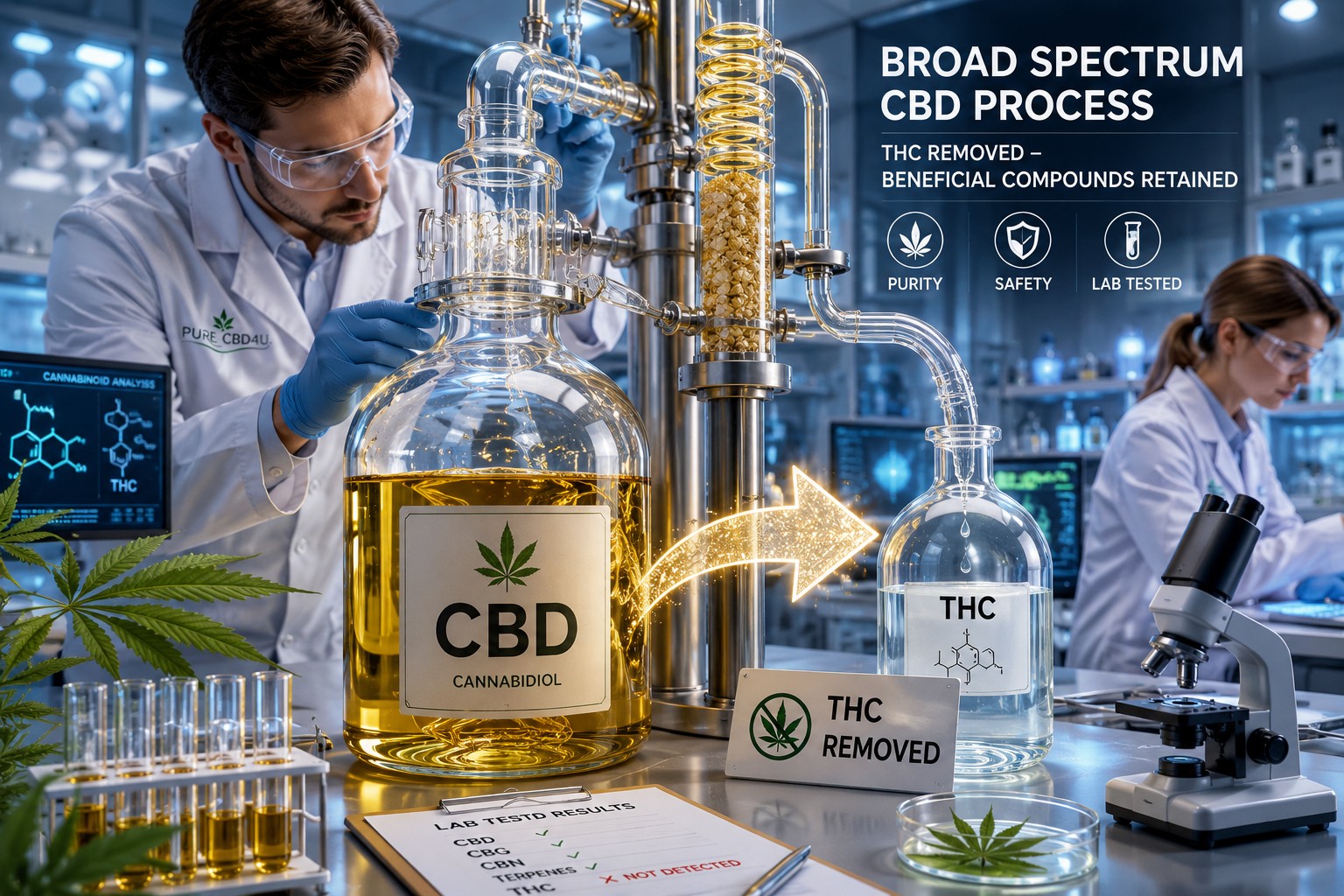
To create broad spectrum hemp extract, manufacturers apply purification steps to produce THC removed CBD while preserving as much of the remaining cannabinoid and terpene profile as possible. This is the core difference in the broad spectrum vs full spectrum THC conversation. This is technically more demanding than simply producing isolate — removing one compound selectively without stripping the rest requires more sophisticated processing.
The result is a product containing broad spectrum cannabinoids — CBD, CBG, CBN, and various terpenes — without the THC that would characterise a full spectrum product. This is why broad spectrum is often described as offering many of the benefits associated with a complete hemp extract, including the potential for some degree of the entourage effect that cannabinoids and terpenes working together may produce, without trace THC. Our dedicated article on what is the entourage effect explores this in more depth.
How THC Is Actually Removed
The removal of THC from hemp extract typically involves one or more chromatography processes — laboratory techniques that separate compounds based on their chemical properties, allowing THC to be filtered out selectively. This is significantly different from how CBD isolate is produced, where everything except CBD is stripped away. Broad spectrum production aims to keep as many non-THC compounds intact as possible while removing THC specifically.
The precision of this process matters. A well-executed chromatography process produces a clean broad spectrum extract. A poorly executed one may retain detectable THC despite being labelled THC-removed CBD. This is why no responsible discussion of is broad spectrum CBD THC-free can end at the product label.
Why “THC-Free” Depends on Testing, Not Just Claims
Here’s the key distinction most consumers don’t know: “THC-free” on a product label is a claim made by the manufacturer. “Non-detectable THC” on a Certificate of Analysis from an independent laboratory is a verified result.
These are meaningfully different. A manufacturer can print “THC-free” without having recently tested the specific batch you’re holding. A Certificate of Analysis — a third-party laboratory report specific to a given product batch — either shows non-detectable THC using the laboratory’s testing methodology, or it doesn’t.
Most accredited laboratories use testing methods sensitive to parts per million or billion. When a COA reports THC as “non-detectable” or “ND”, it means THC was not present above the laboratory’s detection threshold using those methods. This is the standard that reputable broad spectrum CBD THC-free products are verified against.
This is an important distinction because laboratory detection thresholds are extremely sensitive — far below any level associated with psychoactive effect and typically below legal limits in most jurisdictions. A result of non-detectable THC from an accredited laboratory is a meaningful, precise finding. It’s not the same as a marketing claim.
What a Certificate of Analysis Actually Shows You
Does broad spectrum CBD contain THC? A Certificate of Analysis (COA) from an independent third-party laboratory is the document that transforms the “THC-free” claim into a verifiable fact. Reading a COA for a broad spectrum product requires knowing what to look for. The cannabinoid panel should show THC as “ND” (non-detectable). The batch number on the COA should match the product — a COA from months ago doesn’t verify the batch you’re holding. The testing laboratory should be accredited and independent — internal testing has an inherent conflict of interest. Our guide on how to choose high-quality CBD oil covers COA verification in full detail.
Legal Context: THC Limits and Detection
Hemp-derived CBD must contain THC below a legal threshold — 0.3% in the US, 0.2% in parts of Europe. Full spectrum operates within those limits. Broad spectrum aims further: non-detectable THC rather than just legal compliance. The difference matters for athletes in tested sports, employees in safety-sensitive roles, or anyone who wants no measurable THC rather than simply legal THC levels.
This is also relevant to drug testing. THC free hemp oil and CBD THC free products significantly reduce drug testing risk compared to full spectrum; they don’t entirely eliminate it if THC is present at any detectable level. Our article on does full spectrum CBD show up on a drug test addresses this from the full spectrum perspective, and the full spectrum CBD vs broad spectrum CBD comparison covers the complete picture of differences.
Who Should Choose Broad Spectrum CBD
Broad spectrum appeals to a specific and entirely reasonable set of priorities: the potential benefits of a broader cannabinoid and terpene profile — more than CBD isolate offers — combined with the assurance that THC isn’t part of what you’re consuming.
People who choose CBD without THC include those with professional drug testing requirements, those who are personally sensitive to THC even at sub-intoxicating levels, those operating in regions with stricter individual policies around THC, and those who simply prefer the clarity of a THC-free product for personal reasons.
For all of these users, broad spectrum is a genuinely well-suited choice — not a compromise. Whether broad spectrum or full spectrum is “better” overall is a separate question explored in our is full spectrum CBD better article and the CBD oil for daily wellness guide. What matters here is that broad spectrum, when properly made and properly verified, delivers what it promises.
Practical Buying Advice
When evaluating any broad spectrum product, the following questions are worth asking:
Does the product have a current, batch-specific Certificate of Analysis from an independent accredited laboratory? Does that COA confirm non-detectable THC specifically? Does the batch number on the COA match the product? Is the manufacturer transparent about their extraction and purification process?
Brands that answer these questions readily are delivering genuinely verified THC free hemp oil. “THC-free” on the label begins the conversation. A COA ends it.
Frequently Asked Questions
Is broad spectrum CBD THC-free?
In well-made products, yes — to laboratory detection standards. Broad spectrum CBD is processed to remove THC while preserving other cannabinoids. Is broad spectrum CBD THC-free universally? Only when backed by a current COA, not just a label claim.
Does broad spectrum CBD contain THC or traces of it?
A poorly manufactured product could — THC removal requires a precise, well-executed chromatography process. This is exactly why third-party batch-specific testing matters. Products from reputable manufacturers showing non-detectable THC on current COAs are genuinely THC-free to laboratory standards.
How is THC removed from broad spectrum CBD?
Through chromatography — separation techniques that isolate and remove THC while leaving other cannabinoids intact. This is more demanding than producing isolate and requires well-controlled manufacturing.
Can broad spectrum CBD make you high?
No. Reputable broad spectrum products with non-detectable THC contain no THC at levels associated with psychoactive effect. THC-free CBD doesn’t produce intoxication.
Does broad spectrum show up on a drug test?
Broad spectrum products with verified non-detectable THC significantly reduce drug testing risk compared to full spectrum. However, they don’t guarantee a negative result in all circumstances — testing sensitivity and individual factors vary. Verified non-detectable THC on a current COA provides the best available assurance.
Is THC-free CBD really THC-free?
When backed by a current, batch-specific COA from an independent laboratory showing non-detectable THC, yes. Without that verification, “THC-free” is a claim rather than a confirmed fact.
Who should choose broad spectrum CBD?
People with drug testing requirements, THC sensitivity, or personal preferences around avoidance — who still want the benefits of a fuller cannabinoid and terpene profile than isolate offers.
How do I verify a broad spectrum product is THC-free?
Locate the COA for your specific batch. Confirm THC shows as non-detectable. Verify the lab is accredited and independent, and the batch number matches your product.
Written by Carmen Dos Anjos Germano, Founder of Pure CBD4U
Carmen founded Pure CBD4U after her own search for reliable, high-quality CBD oil, starting with full spectrum CBD oil 5% as part of her personal wellness routine. That experience shaped the company’s focus on transparency, quality and independent testing. Pure CBD4U works with EU-grown hemp, uses third-party laboratory testing, and makes batch results accessible through QR codes on its products. Carmen remains closely involved in product selection, quality standards and the development of the Pure CBD4U range.

Leave a Reply