
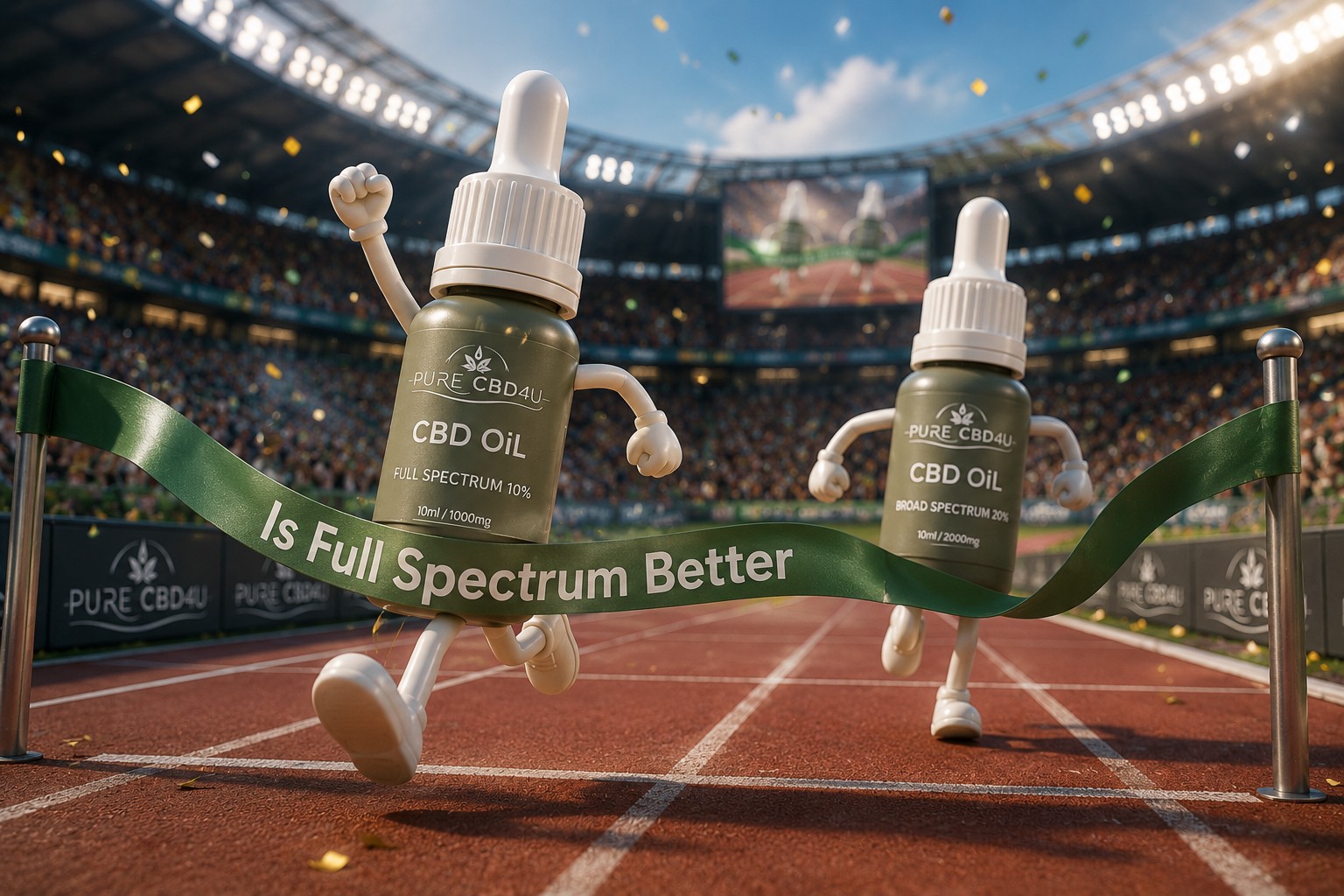
Many CBD companies simply claim that full spectrum is “the best.” The reality is considerably more nuanced — and considerably more interesting.
Is full spectrum CBD better? It almost certainly offers advantages for some people in some situations, and this full spectrum CBD vs broad spectrum comparison deserves more honesty than most brands give it. It also has real reasons to give others pause. Any honest CBD spectrum comparison finds that broad spectrum or isolate isn’t a question with a universal answer. It’s a question that only becomes meaningful when you replace “better” with “better for what, for whom, and under what circumstances?”
That’s the question this article is actually trying to answer.
What “Full Spectrum” Actually Means
Full spectrum CBD retains the hemp plant’s complete cannabinoid and terpene profile as it naturally exists — including CBD, trace amounts of THC (typically under 0.3%), CBG, CBN, and a range of terpenes and flavonoids that give different hemp cultivars their distinctive character. Nothing significant is removed during extraction and processing.
Broad spectrum CBD — and the question of is broad spectrum CBD THC-free is answered clearly in our dedicated guide — undergoes additional processing to remove THC specifically, while retaining most of the other cannabinoids and terpenes. CBD isolate goes further still — the full spectrum vs isolate comparison is significant: isolate strips everything except cannabidiol, producing a purified powder over 99% CBD.
The question of which is best turns largely on one piece of biology: whether these compounds work better together than they do alone.
The Entourage Effect: What the Evidence Actually Says
The entourage effect is the hypothesis — and at this stage it remains a hypothesis with meaningful support rather than a settled fact — that cannabinoids, terpenes, and other phytocannabinoids work synergistically, producing effects greater or more nuanced than any single compound would produce alone. The idea was first formally proposed by researchers in the late 1990s and has since accumulated a meaningful body of supporting evidence, particularly from laboratory and animal studies.
What does that evidence actually show? Studies on isolated cannabinoids versus full spectrum hemp extracts have found differences in activity — sometimes significant ones. Research suggests that terpenes may modulate how cannabinoids interact with receptors, that minor cannabinoids like CBG and CBN may contribute their own distinct effects, and that the combined cannabinoid profile of a full spectrum extract may behave differently in the body than CBD in isolation.
The honest qualification: most evidence comes from laboratory settings and animal models rather than large-scale human clinical trials. Head-to-head human research comparing full spectrum CBD directly with broad spectrum for specific wellness outcomes remains limited. The entourage effect is well-theorised and supported by early evidence — not yet as firmly established as its proponents sometimes suggest.
Where Full Spectrum CBD Tends to Shine
Full spectrum tends to show advantages in user experience — most describe a more rounded, complete feeling compared to isolate, consistent with the entourage hypothesis: more compounds engaging the endocannabinoid system together rather than one alone. Full spectrum cannabinoids and terpenes working as they exist naturally — these are the full spectrum CBD benefits users most consistently report.
Research into pain and inflammation has often used full spectrum extracts over isolate, reflecting scientific interest in the complete cannabinoid profile as the most natural form of hemp consumption. This doesn’t prove superiority, but it reflects where research attention goes.
When Broad Spectrum Is the Better Choice
Calling broad spectrum a consolation prize for people who can’t tolerate THC misrepresents what it actually offers. For a meaningful share of CBD users, broad spectrum isn’t a compromise — it’s the right choice.
People in professions with drug testing are the clearest example — even trace THC in full spectrum can accumulate to detectable levels with consistent use. Athletes in tested sports, employees in safety-sensitive roles, and others subject to regular screening reasonably choose broad spectrum. Those sensitive to THC or operating in regions with stricter THC regulations also find broad spectrum genuinely preferable rather than a compromise.
What’s worth emphasising: broad spectrum CBD retains most of the additional cannabinoids and terpenes that make full spectrum interesting. The entourage effect isn’t fully absent in broad spectrum products — it’s somewhat reduced by the absence of THC specifically. Whether that reduction matters meaningfully in practice depends on the individual and the goal.
The Role of Quality in This Comparison
Here’s where the CBD spectrum comparison often goes wrong: people focus on spectrum type while paying less attention to product quality within each category. A poorly made full spectrum product delivers a worse experience than a well-made broad spectrum one. Spectrum type is one variable in choosing CBD oil — not the most important one. The quality of the hemp extract, extraction method, labelling accuracy, and third-party verification are all likely to matter more than whether trace THC is present. Our guide on how to choose high-quality CBD oil covers what to actually look for.
How to Make the Right Decision for You
The best type of CBD isn’t the one with the most compounds — it’s the one that fits your goals and circumstances.
No THC concerns and interested in the most complete hemp profile? Full spectrum is the logical choice. Subject to drug testing or sensitive to THC? Broad spectrum offers most of the same advantages without the variable. Want precise, consistent dosing with one well-characterised compound? CBD isolate has a legitimate place. In all cases, the decision of is full spectrum CBD better matters less than choosing a reputable, independently tested product from quality hemp. For further reading, our full spectrum CBD vs broad spectrum CBD comparison, the what is the entourage effect guide, and our CBD oil for daily wellness article on building a consistent routine explore these differences in more depth.
Frequently Asked Questions
Is full spectrum CBD better than broad spectrum?
Better is the wrong frame. Full spectrum CBD offers the most complete cannabinoid and terpene profile, which may support the entourage effect. Broad spectrum is preferable for people with THC concerns. Neither is objectively superior — the right choice depends on your goals and circumstances.
Is full spectrum CBD best for most people?
For people without drug testing concerns or THC sensitivity, full spectrum represents the most complete hemp extract available. Whether it’s measurably more effective than broad spectrum for most users isn’t definitively established in clinical research. Is full spectrum CBD best? Possibly — but the evidence doesn’t yet support a categorical yes.
Is the entourage effect real?
It’s a well-supported scientific hypothesis with meaningful evidence from laboratory and early human research. The idea that cannabinoids and terpenes work synergistically is plausible and consistent with available data. High-quality head-to-head clinical evidence comparing full spectrum and isolate in humans is still limited.
Is full spectrum stronger than broad spectrum?
Not necessarily in terms of CBD concentration — strength in that sense depends on the product’s total CBD content. In terms of the breadth of cannabinoid compounds, full spectrum retains trace THC that broad spectrum removes. Whether this makes it more effective depends on the entourage effect, which remains an active area of research.
Should beginners choose full spectrum CBD?
It’s a reasonable starting choice for beginners without THC concerns. The full cannabinoid profile represents what hemp naturally offers. Beginners who want to avoid THC entirely or who are uncertain about individual compounds might prefer to start with broad spectrum and adjust from there.
Why do some people prefer broad spectrum?
Drug testing, professional requirements, THC sensitivity, personal preference, and regional regulatory considerations are all valid reasons. Broad spectrum retains most of the broader cannabinoid and terpene profile that makes full spectrum interesting — the trade-off is specifically the trace THC.
Does full spectrum CBD always work better?
No. Individual response varies, product quality varies, and the entourage effect hypothesis — while well supported — doesn’t guarantee a universally better experience from full spectrum. Many people report excellent results with broad spectrum and even isolate products.
Is full spectrum CBD right for everyone?
Not for everyone. People subject to drug testing, those sensitive to THC, and those with specific regulatory concerns may find broad spectrum a better fit. The question of is full spectrum CBD better only has meaning in the context of individual goals.
Written by Carmen Dos Anjos Germano, Founder of Pure CBD4U
Carmen founded Pure CBD4U after her own search for reliable, high-quality CBD oil, starting with full spectrum CBD oil 5% as part of her personal wellness routine. That experience shaped the company’s focus on transparency, quality and independent testing. Pure CBD4U works with EU-grown hemp, uses third-party laboratory testing, and makes batch results accessible through QR codes on its products. Carmen remains closely involved in product selection, quality standards and the development of the Pure CBD4U range.

Leave a Reply