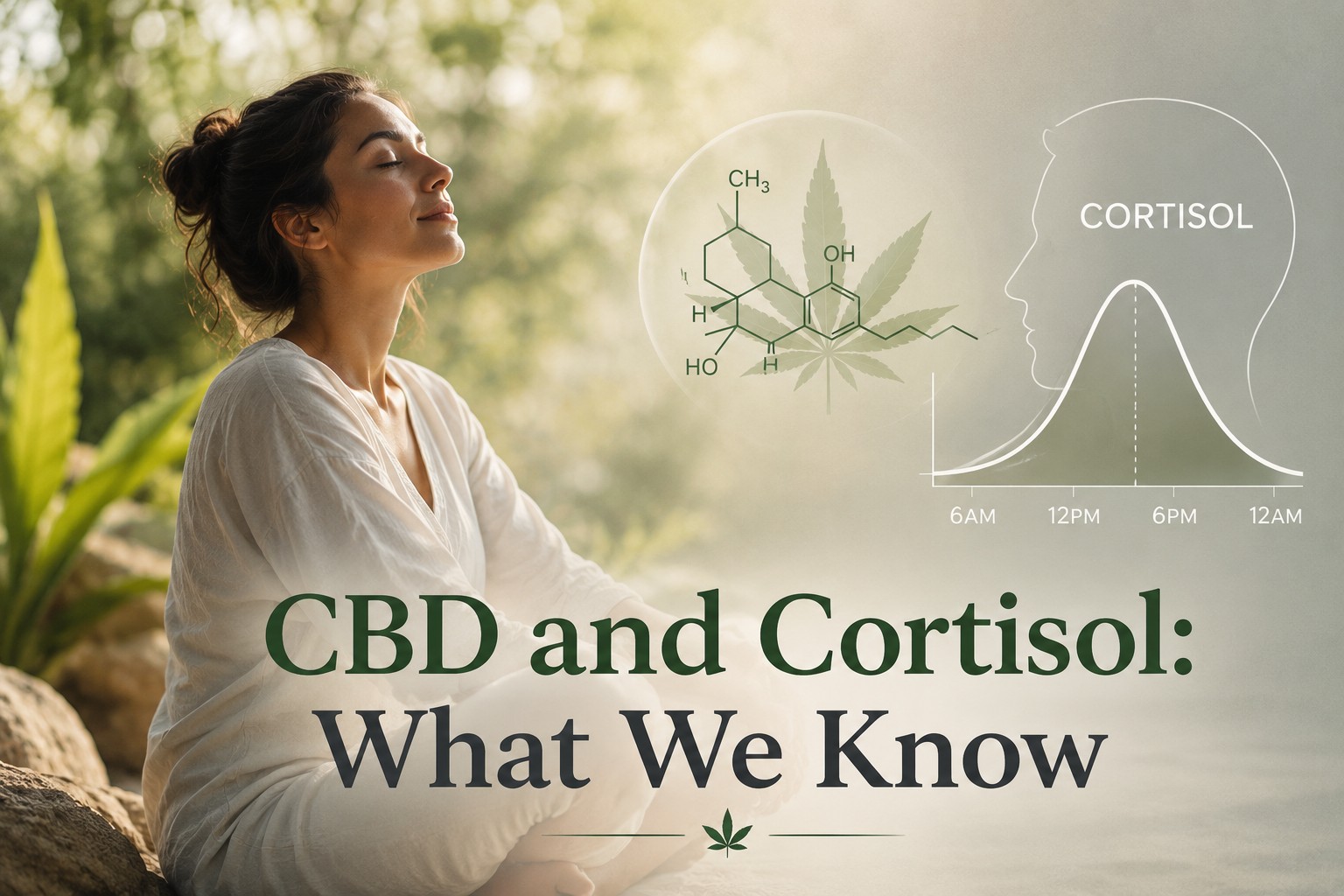
Ask almost anyone on the street what cortisol is, and you’ll get a confident, immediate answer: “the stress hormone.” It’s become one of those phrases that circulates so widely it feels self-explanatory. Ask a follow-up question, though — what does cortisol actually do, why does the body make it, what happens if it’s elevated — and the confidence tends to evaporate fairly quickly. Most people can name it. Very few can explain it.
That gap between familiarity and understanding is worth investigating properly, especially given how much online content now pairs cortisol with CBD as though the relationship between them were simple and settled. It isn’t. But working out what’s actually known requires starting with cortisol itself, not with CBD.
What Cortisol Actually Is
Cortisol is a steroid hormone produced by the adrenal glands, released as part of the hypothalamic-pituitary-adrenal axis — usually shortened to the HPA axis — a communication system linking the brain to the adrenal glands that governs the body’s stress response. Far from being a malfunction or a design flaw, cortisol is essential for survival: it regulates blood sugar, supports metabolism, influences blood pressure, helps control inflammation, and follows a natural daily rhythm, typically peaking shortly after waking and gradually declining through the day to support normal sleep.
None of that sounds much like a villain, because cortisol isn’t one. The label “stress hormone” captures only one part of its job — its role in the acute stress response, where it helps mobilize energy and sharpen alertness in the face of a genuine challenge. That response evolved for good reason and works well as designed: a short burst of cortisol during a real threat, followed by a return to baseline once the threat passes.
So Why Does Cortisol Have Such a Bad Reputation?
The problem was never cortisol’s existence — it’s poor regulation over time. When stress becomes chronic rather than occasional, the HPA axis can struggle to return cortisol to baseline as efficiently, leaving levels elevated for longer stretches than the system was built to sustain. Prolonged elevation has been associated in research with disrupted sleep, altered appetite and metabolism, weakened immune response, and mood-related effects, among other things. That’s a legitimate, well-documented concern — but it’s a story about chronic dysregulation, not about cortisol itself being harmful.
Social media has, understandably, simplified this considerably. “Cortisol” has become a shorthand for stress, fatigue, weight gain, poor sleep, and a long list of other complaints, often stripped of the nuance that it’s a normal hormone doing a necessary job, and that the actual issue lies in the regulation, timing, and duration of its release — not its presence. That popularization is part of why terms and claims about cortisol circulate so widely, and also why so many of them deserve closer scrutiny.
Where CBD Enters This Investigation
It’s against this backdrop — real biology, real popular confusion — that CBD has increasingly been marketed alongside cortisol, often with confident claims about “lowering” or “balancing” it. Given CBD’s broader association with calm and stress relief, the pairing makes intuitive sense. Whether it holds up under actual scrutiny is a separate question, and one worth investigating on its own terms.
What the Research Actually Shows
There is a genuine, established mechanistic link worth starting from: CBD interacts with the endocannabinoid system, a regulatory network that has documented connections to HPA axis function, and with serotonin 5-HT1A receptors involved in stress and anxiety regulation. That interaction is real, published pharmacology — the foundation is solid.
From there, the picture narrows considerably by evidence type. Animal studies have shown that CBD can influence cortisol response under laboratory stress conditions, including research suggesting it may blunt the cortisol spike associated with acute stress in rodent models. Human research is considerably thinner. A small number of studies have measured cortisol levels in people after CBD administration — including research using simulated public speaking tasks — with some showing modest reductions in stress-related cortisol response, though sample sizes tend to be small and results are not uniformly consistent across studies.
What doesn’t exist is strong, replicated clinical evidence that CBD reliably lowers cortisol in healthy humans under everyday conditions. The distinction between animal research, small acute-stress lab studies, and real-world, everyday cortisol regulation is significant, and it’s one that a lot of popular content collapses into a single, confident claim that the underlying science doesn’t yet fully support.
| Evaluating three common online claims “CBD lowers cortisol”: some animal and small human studies suggest a possible effect under acute lab conditions; not established for everyday use “CBD fixes adrenal fatigue”: adrenal fatigue is not a recognized medical diagnosis; this claim has no credible scientific basis “CBD resets your stress hormones”: no clinical evidence supports a hormonal “reset” effect; this is marketing language, not established science |
A Claim Worth Addressing Directly: “Adrenal Fatigue”
It’s worth pausing on one term specifically, since it appears constantly alongside cortisol content online: adrenal fatigue. Despite widespread use in wellness marketing, adrenal fatigue is not recognized as a legitimate medical diagnosis by endocrinology societies, and there is no validated clinical test or established biological mechanism confirming it as a distinct condition. Persistent fatigue, low mood, or disrupted energy can have many real causes — some hormonal, many not — and deserve proper medical evaluation rather than a label that current endocrinology research doesn’t actually support.
What Genuinely Supports Healthy Cortisol Regulation
Separate from anything involving CBD, a well-established body of research points to lifestyle factors that meaningfully support healthy HPA axis function over time. Regular, consistent sleep is arguably the single most influential factor, since cortisol’s daily rhythm depends heavily on a stable sleep-wake cycle to function as designed. Consistent exercise helps regulate the stress response over time, though intense overtraining without adequate recovery can itself elevate cortisol unhelpfully — moderation and recovery matter as much as the activity itself.
Chronic stress management — through whatever combination of habits, support, or professional help genuinely works for an individual — directly addresses the actual mechanism behind prolonged cortisol elevation, rather than treating a symptom downstream of it. Balanced nutrition, limiting excessive alcohol intake, which is well documented to disrupt cortisol rhythm and sleep architecture alike, and building in genuine recovery periods after demanding stretches all contribute to the same underlying goal. A consistent daily rhythm — regular meal times, regular sleep times, regular activity — gives the HPA axis the predictable structure it relies on to function well.
CBD, where current evidence allows any role at all, sits as one small, still-developing area of interest within this much larger and better-established picture — not a substitute for any of it.
What This Investigation Actually Concludes
Cortisol was never the problem to begin with. It’s a normal, essential hormone doing exactly what it evolved to do, and the actual concern — chronic dysregulation from prolonged, poorly recovered stress — is a considerably more precise target than the vague, often alarmist way “cortisol” gets discussed online. CBD’s relationship to that system is a genuinely interesting, still-developing area of research, grounded in real mechanistic plausibility and some encouraging early findings, but not yet supported by the kind of robust human evidence that would justify calling it a proven cortisol-lowering supplement.
“How do I lower my cortisol?” is the question a lot of online content invites, and it’s not quite the right one — cortisol isn’t an enemy to be suppressed, and chasing a lower number isn’t inherently a health goal. A more accurate version asks something broader: how can a healthy stress response be supported through sleep, movement, recovery, and daily rhythm, while paying attention to how the science around tools like CBD continues to develop? Understanding cortisol, as it turns out, tends to be more useful than trying to fight it — it was never the villain the internet made it out to be.
This article is intended for general educational purposes and is not medical advice. CBD has not been shown to reliably regulate cortisol in humans, and “adrenal fatigue” is not a recognized medical condition. Anyone concerned about hormonal health, chronic fatigue, or persistent stress should speak with a doctor or endocrinologist for proper evaluation.
Written by Carmen Dos Anjos Germano, Founder of Pure CBD4U
Carmen founded Pure CBD4U after her own search for reliable, high-quality CBD oil, starting with full spectrum CBD oil 5% as part of her personal wellness routine. That experience shaped the company’s focus on transparency, quality and independent testing. Pure CBD4U works with EU-grown hemp, uses third-party laboratory testing, and makes batch results accessible through QR codes on its products. Carmen remains closely involved in product selection, quality standards and the development of the Pure CBD4U range.

Leave a Reply