
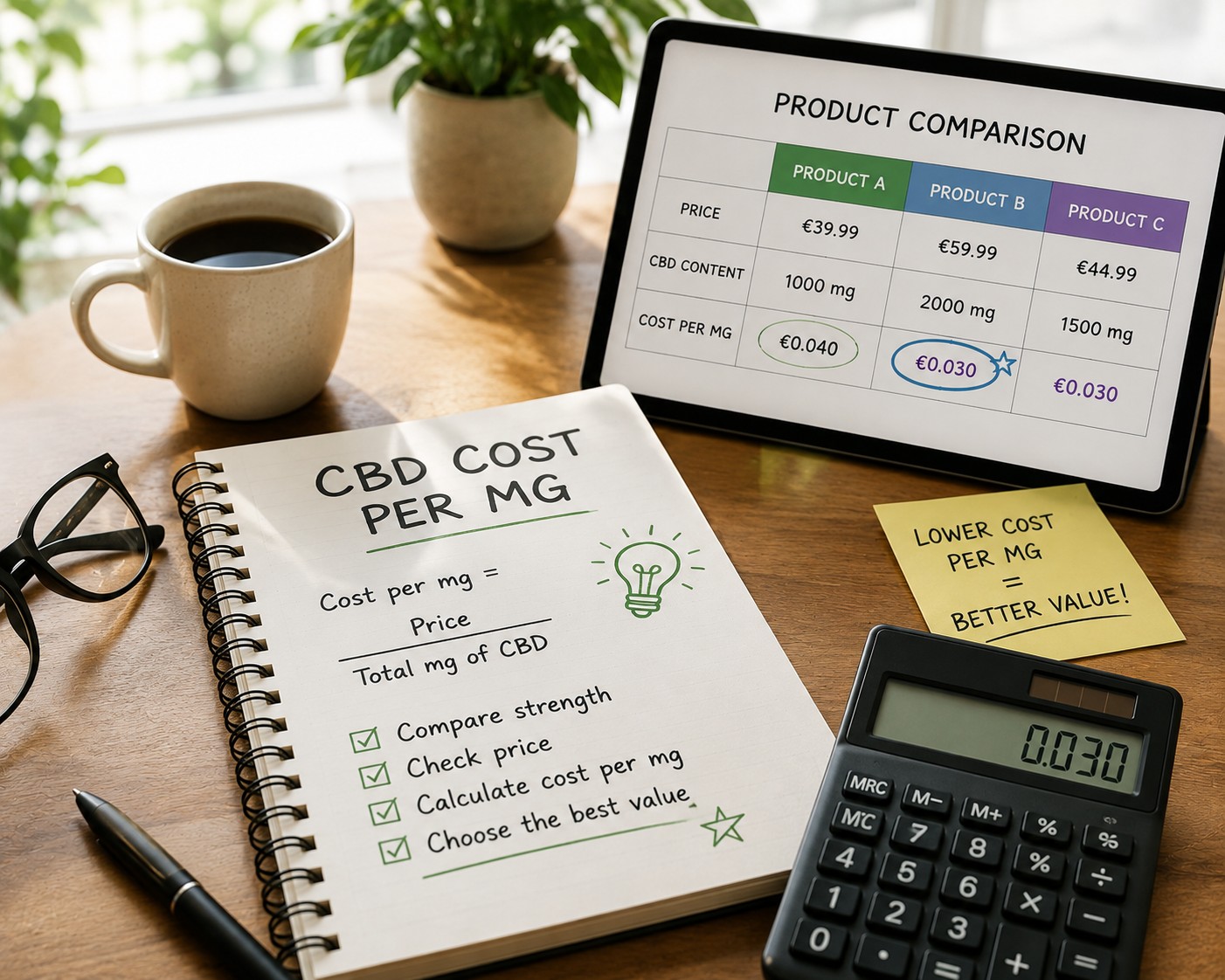
Bottle A costs €29.95. Bottle B costs €59.95, exactly double. Most shoppers would assume Bottle B is the worse deal, twice the price for what looks like the same kind of product. Look at the actual numbers below and that assumption falls apart completely.
| Product | Price | Total mg CBD | Cost per mg |
| Bottle A — 10ml, 5% | €29.95 | 500mg | €0.0599 |
| Bottle B — 10ml, 20% | €59.95 | 2000mg | €0.0300 |
| Bottle C — 30ml, 10% | €79.95 | 3000mg | €0.0267 |
Bottle B, despite costing twice as much upfront, works out to roughly half the price per milligram of actual CBD. Bottle C, priced highest of the three in absolute terms, turns out to be the best value of all once you calculate it properly. None of this is visible from sticker price alone.
Why Sticker Price Is Nearly Useless on Its Own
CBD products vary across three variables at once, bottle size, concentration percentage, and price, which means sticker price alone tells you almost nothing about actual value. A cheaper bottle can easily be the worse deal once you account for how little CBD it actually contains, and a pricier bottle can work out considerably cheaper per dose. Cost per mg is the only number that puts every product on genuinely equal footing, regardless of size or strength.
The Formula Behind the Table Above
Two steps produce every cost-per-mg figure shown above:
Step 1: Find total mg of CBD in the bottle
Multiply bottle size in ml by the percentage strength, then by 100. A 10ml bottle at 20% contains 10 × 20 × 10 = 2000mg total CBD.
Step 2: Divide price by total mg
€59.95 ÷ 2000mg = €0.03 per mg. That single number is what you compare across every product, regardless of bottle size or percentage.
Where This Actually Changes a Buying Decision
This matters most in exactly the scenario shown at the top of this page: two bottles of noticeably different upfront price where the more expensive one is quietly the smarter buy. It also matters when comparing a small, low-strength bottle to a large, high-strength one, since a 10ml 5% bottle and a 30ml 20% bottle look nothing alike on the shelf but can be compared instantly once reduced to cost per mg.
It’s a genuinely different mindset from asking “which bottle is cheaper” to asking “which bottle gives me more CBD for the same money,” and the two questions don’t always point to the same answer.
A Word of Caution: Price Isn’t the Only Thing That Matters
Cost per mg is a genuinely useful comparison tool, but it shouldn’t be the only factor in a purchase decision. Extraction method, third-party lab testing, EU-grown hemp sourcing, and whether a Certificate of Analysis is actually published all affect what you’re paying for beyond the raw milligram count. The cheapest cost-per-mg product isn’t automatically the right choice if it comes from a brand that can’t show independent lab results.
We’d frame cost per mg as the tiebreaker between products you already trust on quality, not the only number that matters.
How Strength Affects the Value Equation Beyond Just Price
There’s a practical side to this beyond pure cost per mg. A higher-strength oil that works out cheaper per milligram also means fewer drops needed to reach the same daily dose, which has its own knock-on benefits, a bottle that lasts longer between reorders, and less variation in dosing accuracy that can creep in when counting a larger number of drops each day. Two products with an identical cost per mg aren’t always equally practical day to day once you factor in how many drops each one actually requires.
Try It Without the Manual Maths
Our CBD Cost Calculator runs this exact calculation instantly for any two or more products you want to compare, breaking each one down into cost per drop, cost per serving, cost per day, and cost per mg, so you can see the full picture rather than just the final number. It is part of the free PureCBD4U Toolkit, where the drops and bottle duration calculators are also available.
Frequently Asked Questions
Is a higher percentage CBD oil always better value?
Often, but not always. It depends on price alongside concentration. Higher-strength oils frequently work out cheaper per mg, but always check the actual figures rather than assuming.
How do I calculate cost per mg myself?
Multiply bottle size in ml by the percentage, then by 100, to get total mg of CBD. Divide the price by that total mg figure to get cost per mg.
Why do two bottles with the same percentage have different costs per mg?
This usually comes down to bottle size and pricing strategy. A larger bottle at the same percentage often has a lower cost per mg, since production and packaging costs don’t scale perfectly with volume.
Should I always buy the cheapest cost-per-mg product?
Not automatically. Lab testing, hemp sourcing, and extraction quality matter alongside price. Use cost per mg to compare products you already trust, not as the only deciding factor.
Does cost per mg apply to CBD gummies and capsules too?
Yes, the same principle applies, calculated as price divided by total mg of CBD across all gummies or capsules in the package.
Written by Carmen Dos Anjos Germano, Founder of Pure CBD4U
Carmen founded Pure CBD4U after her own search for reliable, high-quality CBD oil, starting with full spectrum CBD oil 5% as part of her personal wellness routine. That experience shaped the company’s focus on transparency, quality and independent testing. Pure CBD4U works with EU-grown hemp, uses third-party laboratory testing, and makes batch results accessible through QR codes on its products. Carmen remains closely involved in product selection, quality standards and the development of the Pure CBD4U range.

Leave a Reply