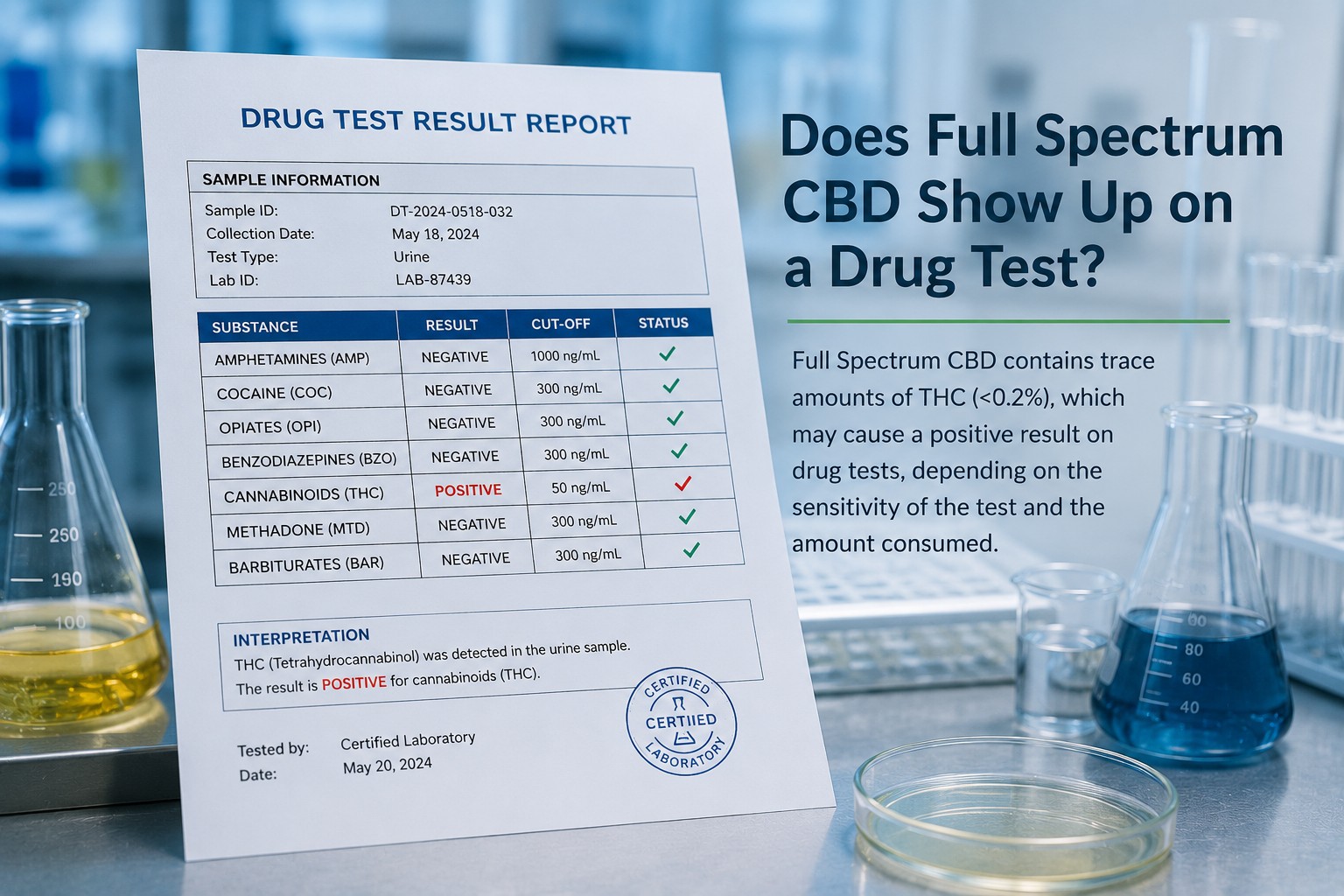
Many people believe drug tests look for CBD. In reality, they usually don’t — and that single fact changes how you should think about this entire question. Does full spectrum CBD show up on a drug test? Not the CBD itself.
Standard CBD workplace drug testing, CBD THC screening in urine, and most anti-doping panels are not designed to detect cannabidiol. Does CBD show up on a drug test? No — but what’s alongside it might. They screen for THC metabolites — specifically the compound THC-COOH, which the body produces when it processes tetrahydrocannabinol. CBD and THC are chemically distinct, metabolised differently, and only one of them is typically targeted in a CBD drug test scenario.
So the question of whether full spectrum CBD shows up on a drug test isn’t really about CBD at all. It’s about the trace THC that full spectrum products naturally contain — and whether that small amount, over time, could accumulate to detectable levels in your system.
What Drug Tests Actually Detect
Understanding the mechanics matters before assessing the risk. Most standard CBD urine tests use immunoassay technology to screen for THC-COOH above a defined cut-off threshold — typically 50 nanograms per millilitre (ng/mL) in workplace screening, though military and some competitive sports testing may use lower thresholds that increase the likelihood of detection.
A positive screening is usually confirmed by a more sensitive GC-MS test designed to verify THC exposure — not CBD use.
Hair tests can detect THC metabolites for months; saliva tests detect recent exposure; blood tests have a shorter window. None detect CBD itself — but full spectrum CBD THC content provides exactly the substrate these tests target.
Why Full Spectrum CBD Contains Trace THC
Full spectrum CBD is made from whole hemp extract, retaining the plant’s complete cannabinoid and terpene profile. Under most regulatory frameworks, hemp-derived CBD products must contain THC below a defined legal limit — typically 0.3% in the United States and 0.2% in many European jurisdictions. Full spectrum products operate within these limits, which means trace THC is intentional and legal rather than a manufacturing error.
At these concentrations, a single serving of full spectrum CBD doesn’t deliver much THC. A standard 10ml bottle of 10% full spectrum oil at 0.2% THC contains approximately 20mg of THC across the entire bottle — equivalent to less than 0.1mg per drop. This is far below any intoxicating level.
The question isn’t whether a single serving answers does full spectrum CBD show up on a drug test — it almost certainly doesn’t trigger anything. The real question is what happens with regular, sustained use over days and weeks.
How Real Is the Risk?
This is the question that actually matters, and the honest answer is: the risk is real but not uniform.
THC metabolites are fat-soluble, meaning they accumulate in fatty tissue and are released gradually over time. With consistent daily full spectrum CBD use — several servings per day, high-strength products, over an extended period — there is documented potential for THC-COOH to accumulate to detectable levels in some individuals, even from entirely legal hemp-derived products.
Research has documented positive THC drug tests following full spectrum hemp use at higher doses in frequent users — but the majority of typical-dose users don’t approach positive thresholds. Individual metabolism, body fat, frequency, dose, and product quality all determine where any given person sits on that spectrum.
What no manufacturer can honestly claim is that full spectrum CBD guarantees a negative drug test result. Risk is generally low for occasional users at typical doses. Risk is meaningfully higher for daily high-dose users, especially with slower metabolism or higher body fat. For very low threshold testing — sports anti-doping, military, some zero-tolerance workplace policies — even the lower range of risk may be unacceptable.
What Influences Your Individual Risk
Several concrete variables shape where the risk actually sits for any individual:
Daily dose and frequency: occasional users accumulate far less THC-COOH than daily high-dose users.
Product quality: a product containing more THC than labelled delivers more than the user intends — making COA verification essential.
Individual metabolism and body composition: slower metabolism and higher body fat percentage both increase accumulation risk.
Testing threshold: workplace urine tests at 50ng/mL represent a different profile than military or anti-doping testing at 15ng/mL or lower.
Athletes, Employers, and Anti-Doping
CBD employment drug test concerns are different from CBD athlete drug test concerns, which in turn differ from military screening. Understanding which category applies to you matters considerably.
For WADA-governed sports, CBD was removed from the prohibited list in 2018 — CBD itself is not banned. THC remains prohibited at 150ng/mL urinary THC-COOH. Athletes in tested sports are generally advised to use verified THC-free products rather than full spectrum to eliminate the variable entirely.
For CBD employment drug test scenarios, zero-tolerance policies treat trace THC from legal hemp the same as recreational cannabis. A CBD positive drug test carries real employment consequences even when only legal products were used. Military personnel face similar zero-tolerance contexts regardless of product legality.
The Case for Broad Spectrum in These Situations
For anyone in a situation where a positive THC result carries real consequences, the risk-benefit calculation for full spectrum CBD changes. Broad spectrum CBD products from reputable manufacturers with verified non-detectable THC on current batch COAs eliminate this specific variable — not because broad spectrum is inherently superior for other purposes, but because it removes the only mechanism through which CBD product use could contribute to a positive drug test.
Our article on is broad spectrum CBD THC-free covers what “THC-free” on a COA actually means and how to verify the claim — essential reading before assuming any product is genuinely free of detectable THC. Our full spectrum CBD vs broad spectrum CBD guide and is full spectrum CBD better article explore the broader comparison if you’re deciding between spectrum types for reasons beyond drug testing.
Before Your Next Test
THC metabolites can remain detectable in urine for days to several weeks depending on the factors above. No supplement reliably accelerates clearance. Stopping full spectrum use well before a known test date is the most reliable approach — the timeline depends on your usage pattern, body composition, and test sensitivity. Our CBD side effects guide covers broader safety context, and our guide on how to choose high-quality CBD oil covers what a COA should confirm.
Frequently Asked Questions
Does full spectrum CBD show up on a drug test?
Not directly — drug tests don’t detect CBD. They screen for THC metabolites. Full spectrum CBD drug test risk comes from the trace THC these products legally contain, which can accumulate to detectable levels with regular, sustained use in some individuals.
Will full spectrum CBD make me fail a drug test?
Not necessarily, but the risk isn’t zero. Occasional use of typical wellness doses of accurately labelled products is unlikely to produce a positive result. Daily high-dose use over extended periods carries measurably higher risk, particularly for sensitive testing programmes.
How much THC is in full spectrum CBD?
Legal hemp-derived full spectrum products typically contain under 0.3% THC. In a standard 10ml bottle of 10% CBD oil, this represents approximately 20mg of THC in the entire bottle — very small amounts per serving, but amounts that can accumulate with consistent daily use.
Is broad spectrum safer for drug testing?
Yes, significantly. Verified broad spectrum CBD with non-detectable THC on a current COA removes the primary mechanism through which CBD product use could contribute to a positive drug test.
Can athletes use full spectrum CBD?
CBD itself is not prohibited by WADA. THC remains prohibited in competition, and full spectrum products carry trace THC that could theoretically accumulate to testing thresholds. Most sports anti-doping advisors recommend verified THC-free products for athletes subject to testing.
Can CBD accumulate over time?
THC metabolites from full spectrum CBD can accumulate. CBD itself is processed and cleared more quickly. The accumulation concern for drug testing is specifically about THC-COOH building up in fatty tissue with sustained full spectrum use.
Should I avoid full spectrum CBD before a drug test?
If facing a test where a positive THC result carries consequences, stopping full spectrum use well in advance is advisable. The clearance timeline depends on your usage pattern, metabolism, and the test’s detection threshold — there is no universal “safe window.”
Which CBD products are safest for workplace testing?
Verified broad spectrum or CBD isolate products from reputable manufacturers with current, batch-specific COAs confirming non-detectable THC. The COA — not the label — is the meaningful verification.
Related reading: Is Full Spectrum CBD Better?
Written by Carmen Dos Anjos Germano, Founder of Pure CBD4U
Carmen founded Pure CBD4U after her own search for reliable, high-quality CBD oil, starting with full spectrum CBD oil 5% as part of her personal wellness routine. That experience shaped the company’s focus on transparency, quality and independent testing. Pure CBD4U works with EU-grown hemp, uses third-party laboratory testing, and makes batch results accessible through QR codes on its products. Carmen remains closely involved in product selection, quality standards and the development of the Pure CBD4U range.

Leave a Reply