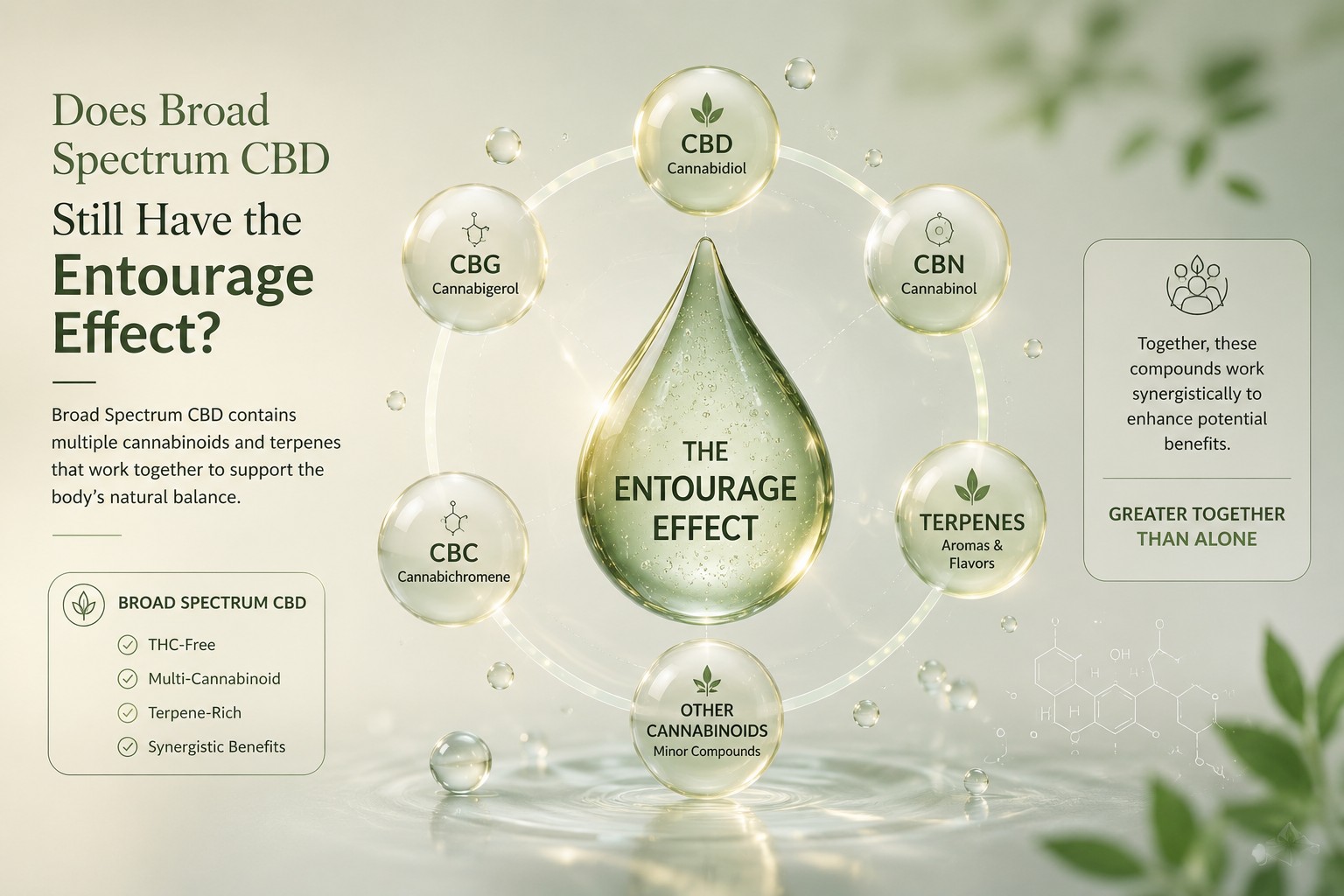
If THC is removed from broad spectrum CBD, does the entourage effect disappear along with it? Does broad spectrum CBD still have the entourage effect? And does broad spectrum work as a meaningful whole-plant extract without THC?
These are genuinely interesting questions — they challenge a widespread oversimplification: that THC is the essential ingredient that makes cannabinoid synergy work. The CBD entourage effect without THC is more than a marketing claim, as research is beginning to reveal.
The Misconception Worth Examining
The entourage effect is often discussed as though it’s primarily a THC phenomenon. This framing has a historical basis — early cannabinoid research focused heavily on THC as the dominant active compound in cannabis, and early discussions of entourage effects were coloured by that lens. But the concept has expanded considerably since its original formulation, and reducing the entourage effect to a THC-dependent mechanism misrepresents the current state of research.
What the entourage hypothesis actually proposes is that cannabinoids working together with terpenes, flavonoids, and other phytocannabinoids produce effects that none of them achieve alone. A THC free entourage effect isn’t a contradiction — it’s a question of degree. THC is one compound in that profile, not the only one.
What Broad Spectrum Actually Retains
To answer the central question, it helps to be specific about what broad spectrum CBD contains after THC removal. A well-produced broad spectrum hemp extract typically retains:
CBD as the primary cannabinoid, alongside minor cannabinoids including CBG, CBN, and often others in smaller quantities. The terpene profile — the aromatic compounds responsible for hemp’s distinctive character — is also largely preserved during a well-executed THC removal process. Flavonoids and other phytonutrients may remain depending on the extraction method.
What’s removed is specifically THC. Not the terpenes. Not the other cannabinoids. Not the flavonoids. The question becomes: do those remaining compounds still interact synergistically, even without THC in the picture?
What the Science Currently Suggests
Researchers have found evidence of synergistic interactions between CBD and other non-THC cannabinoids. Studies examining CBG alongside CBD have suggested the two cannabinoids may influence shared receptor pathways in ways that differ from either working alone. Research on CBN has pointed toward possible complementary effects with CBD, particularly in areas like sleep research, though the evidence remains early-stage.
Terpene synergy is perhaps the most actively studied aspect of the broad spectrum entourage effect without THC. Individual terpenes found in hemp — including myrcene, linalool, limonene, and beta-caryophyllene — have been found in laboratory research to interact with the endocannabinoid system and related receptor pathways. Beta-caryophyllene in particular has attracted significant interest because it binds directly to CB2 receptors, making it a cannabimimetic terpene — one that produces receptor-level interactions typically associated with cannabinoids. This is not a minor finding: it suggests the “entourage” in hemp extends beyond the cannabinoid family into the terpene profile.
Studies comparing isolated CBD with whole hemp extracts in animal models have fairly consistently found differences in activity — the extract producing effects at lower doses or producing qualitatively different responses than isolated CBD. While these studies don’t isolate THC as the variable, they do support the idea that something in the broader extract beyond CBD is contributing to its effects.
The Honest Caveat
Does broad spectrum CBD have the entourage effect identically to full spectrum? Almost certainly not. THC interacts particularly with CB1 receptors, removing one set of pharmacological interactions. Whether those interactions are essential or supplementary to overall synergy is a question current evidence doesn’t clearly resolve. What can be said: the available evidence supports meaningful cannabinoid synergy in broad spectrum products, while acknowledging full spectrum may provide a more complete version.
How Researchers Think About This
Researchers increasingly describe the entourage effect as a spectrum rather than an on/off switch — something that exists in degrees depending on how complete the cannabinoid and terpene profile is. A product with CBD, CBG, CBN, and a full terpene profile is still a complex multi-compound extract. Its cannabinoid synergy may not replicate full spectrum exactly — but calling it inert doesn’t fit the evidence either.
Our what is the entourage effect guide covers the broader mechanism in considerably more depth.
The Practical Implication
For consumers, this translates into something useful: choosing broad spectrum CBD is not choosing a product without synergy. It’s choosing a different — possibly somewhat reduced — version of cannabinoid synergy, in exchange for removing a compound that matters for some circumstances.
The broad spectrum CBD benefits here are clear: this is a sensible trade-off for many people. Those needing a verified THC-free product don’t have to choose between avoiding THC and entirely forgoing the potential of cannabinoid interaction. Does broad spectrum work? Yes — the synergy is meaningful, if somewhat different from full spectrum. The trade-off is more modest than the all-or-nothing framing sometimes suggests.
For those comparing on effectiveness grounds, does broad spectrum CBD still have the entourage effect in a way that matters? The question isn’t binary — it’s whether the reduction in synergy from removing THC produces a meaningful difference for any given individual. The answer, given the individual variation in endocannabinoid system response and the dose-dependence of cannabinoid interactions, is likely to vary between users. Our is full spectrum CBD better article approaches this from the effectiveness angle, and the full spectrum CBD vs broad spectrum CBD comparison covers the broader decision in full.
A Note on Quality
One point worth emphasising: the quality of a broad spectrum product determines how much of the non-THC cannabinoid and terpene profile actually survives extraction and processing. A poorly produced broad spectrum extract may remove THC successfully but also strip away significant portions of the terpene and minor cannabinoid content that make the synergy argument meaningful in the first place.
A well-produced broad spectrum hemp extract preserves terpene and minor cannabinoid content that makes the synergy argument meaningful. How to choose high-quality CBD oil and the CBD vs CBG vs CBN comparison are worth reading alongside this one.
Frequently Asked Questions
Does broad spectrum CBD still have the entourage effect?
Does broad spectrum CBD still have the entourage effect? Current evidence suggests yes — to a meaningful degree, though not identically to full spectrum. CBD, CBG, CBN, and terpenes retained in broad spectrum products appear to interact synergistically. THC’s absence may reduce the completeness of that synergy, but doesn’t eliminate cannabinoid synergy entirely.
Is THC necessary for the entourage effect?
Not necessarily. The entourage effect hypothesis involves multiple compounds — cannabinoids, terpenes, and flavonoids. THC is one contributor. Research suggests terpenes and minor cannabinoids can interact synergistically with CBD independently of THC. Whether THC’s contribution is essential or supplementary isn’t yet definitively resolved by clinical research.
Do terpenes contribute to the entourage effect in broad spectrum?
Yes, and this is one of the more actively studied aspects. Terpenes like beta-caryophyllene interact directly with endocannabinoid receptors. Research supports the idea that terpene synergy with cannabinoids remains meaningful in broad spectrum extracts that retain a full terpene profile.
Is broad spectrum less effective than full spectrum?
Possibly somewhat, on the entourage dimension specifically — though this depends on the individual, the dose, and the quality of both products. Many users find broad spectrum entirely effective for their goals. The difference is unlikely to be dramatic for most wellness applications.
Why do some people choose broad spectrum over full spectrum?
Drug testing requirements, professional obligations, THC sensitivity, and personal preference are the most common reasons. For these users, broad spectrum provides a meaningful cannabinoid and terpene profile without the THC variable. Our is broad spectrum CBD THC-free article covers the THC-free verification side.
Does removing THC remove all cannabinoid synergy?
No. The broad spectrum vs full spectrum entourage question isn’t binary. Multiple cannabinoids and terpenes remain active in well-produced broad spectrum extracts, and research suggests these compounds interact synergistically.
Which CBD type is best if I want no THC?
Broad spectrum CBD from a reputable manufacturer with a current, batch-specific COA confirming non-detectable THC — which provides both the THC-free profile and the broadest cannabinoid and terpene content available without THC.
Is there research directly comparing broad spectrum and full spectrum entourage effects?
High-quality human clinical trials directly comparing entourage activity between these two spectrum types remain limited. Most evidence comes from animal studies, in vitro research, and pharmacological reasoning. This is a genuine gap in the current research landscape.
Related reading: Is Full Spectrum CBD Better?
Written by Carmen Dos Anjos Germano, Founder of Pure CBD4U
Carmen founded Pure CBD4U after her own search for reliable, high-quality CBD oil, starting with full spectrum CBD oil 5% as part of her personal wellness routine. That experience shaped the company’s focus on transparency, quality and independent testing. Pure CBD4U works with EU-grown hemp, uses third-party laboratory testing, and makes batch results accessible through QR codes on its products. Carmen remains closely involved in product selection, quality standards and the development of the Pure CBD4U range.

Leave a Reply