
A practical framework for weighing the real risks, not just the headlines
You’d never give your dog a random pill from the kitchen cupboard just because it looked harmless. So it’s entirely reasonable to pause and ask the same question before giving CBD.
Is CBD actually safe for dogs?
The honest answer isn’t a simple yes or no. It depends on a handful of specific, identifiable factors — and once you understand what they are, the question becomes far easier to answer for your own dog, with your own product, in your own situation.
What CBD Actually Is, in Plain Terms
CBD is one of many cannabinoids found in hemp. It’s non-intoxicating, meaning it doesn’t produce a high, and it is not the same compound as THC.
Reputable pet products are made with Broad Spectrum CBD, or a legally compliant Full Spectrum CBD containing only trace amounts of THC. That distinction matters a great deal, and it comes up again later in this guide.
What the Research Actually Tells Us So Far
Research into CBD and dogs is still a developing field, but it is genuinely growing. Veterinary studies have looked at areas including mobility, stress, seizure activity, and general wellbeing.
Current studies generally suggest that CBD is well tolerated by many healthy dogs when quality products are used appropriately — though the research base is still developing, and it would overstate things to call CBD conclusively “proven safe.” Most reported side effects across these studies have been mild rather than severe.
The Variable That Matters Most: Product Quality
This is the section worth reading most carefully, because it’s where most real-world risk actually lives — not in CBD itself, but in what surrounds it on the shelf.
A handful of quality markers separate a genuinely safe product from a risky one:
- Independent third-party testing, not just an in-house claim
- A Certificate of Analysis (COA) that’s actually available to check
- Accurate, clearly stated CBD concentration
- No contaminants in the finished product
- No detectable pesticides
- No heavy metals
- No excessive THC beyond legal trace limits
- Proper, consistent manufacturing practices
A cheap, untested product from an unknown source is often a bigger practical risk to a dog than CBD itself ever is. The compound has a reasonable safety profile; an unregulated bottle with an inaccurate label does not.
The One Substance That Actually Causes Problems
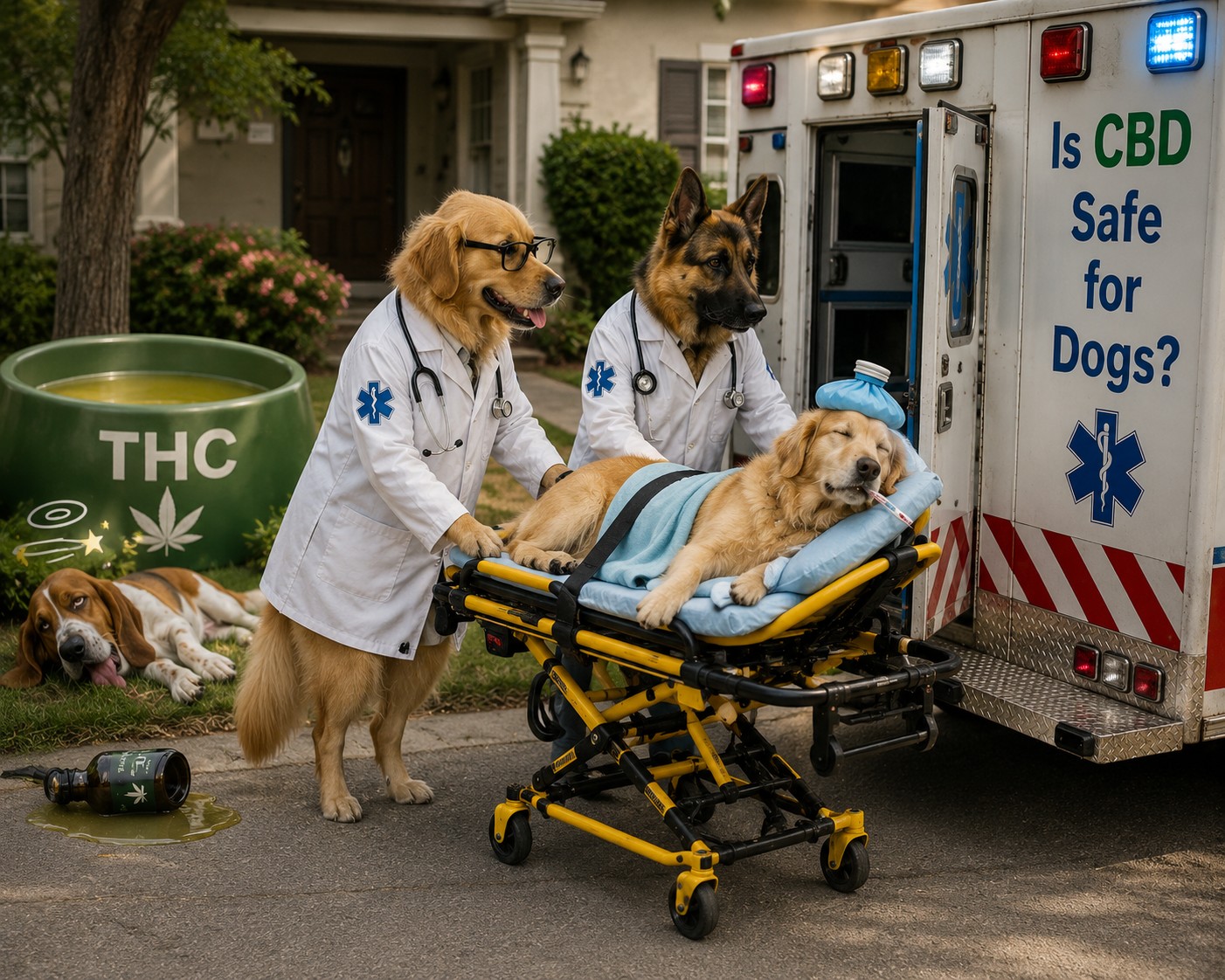
If there’s a single thing worth being genuinely cautious about, it’s THC — not CBD.
Dogs are considerably more sensitive to THC than humans are. A product containing a meaningful amount of it can cause real problems, including:
- Poor coordination
- Confusion
- Excessive sleepiness
- Urinary incontinence
- Vomiting
- Tremors
The practical rule that follows from this is simple: never intentionally give a dog anything containing significant THC, and only use CBD products specifically formulated for animals — not human products, and not anything sourced casually.
The Side Effects Worth Actually Knowing About
Separate from THC exposure, CBD itself can still produce some mild effects in certain dogs, usually related to dose:
- Temporary drowsiness
- Softer stools than usual
- General digestive upset
- Reduced appetite
- Increased thirst
These effects are typically dose-related, and often ease once the amount given is lowered. None of this is a guarantee that a given dog won’t react at all — just an honest picture of what’s commonly reported.
When It’s Worth Looping In Your Vet First
A few specific situations call for a conversation with a veterinarian before starting, rather than after:
- Very young puppies
- Pregnant dogs
- Dogs with liver disease
- Dogs currently taking prescription medication
- Dogs managing chronic illnesses
- Elderly dogs
The medication point deserves a brief explanation: CBD is processed through some of the same liver enzymes — the cytochrome P450 system — that metabolise many prescription drugs. That can, in some cases, affect how those medications behave. It’s not a reason for alarm, but it is a reason to check first if your dog is already on medication.
Mistakes That Quietly Undermine Safety
- Giving human CBD products instead of pet-specific ones
- Using products that contain meaningful amounts of THC
- Buying untested CBD with no available lab results
- Giving a large amount right away instead of starting small
- Changing the amount daily, making it hard to judge anything
- Ignoring the dog’s weight entirely
- Introducing several new supplements at the same time
- Skipping the specific product’s own dosage instructions
A Practical Checklist for Choosing a Safe Product
✓ Third-party lab tested
✓ Clear, accurate CBD content stated on the label
✓ Hemp source clearly disclosed
✓ A Certificate of Analysis you can actually access
✓ A formula made specifically for pets
✓ No unnecessary or unexplained additives
✓ An easy-to-measure dropper for accurate dosing
Myth vs Fact
| Myth | Fact |
| CBD is the same as cannabis. | CBD is non-intoxicating and is meaningfully different from THC, the compound responsible for a psychoactive effect. |
| Natural means completely risk-free. | Natural products can still cause side effects or interact with medications — “natural” isn’t the same as “risk-free.” |
| More CBD works better. | Starting low and increasing gradually is generally the safer, more effective approach than reaching for a large amount immediately. |
| Evidence Summary Established: dogs have an endocannabinoid system, CBD has been investigated in veterinary research, and mild side effects are the most commonly reported outcome.Emerging: research into mobility, stress, and general wellbeing continues, alongside longer-term safety studies.Not established: CBD curing diseases, CBD replacing veterinary treatment, or CBD being appropriate for every dog. | |
Key Takeaway
For most healthy dogs, high-quality CBD products appear to have a reasonably good safety profile when used responsibly. The biggest risks in practice usually come from poor-quality products, incorrect dosing, or THC exposure — not from carefully chosen, pet-specific CBD itself.
Choose a reputable brand, start with a low amount, observe your dog carefully, and consult a veterinarian whenever there’s genuine uncertainty. That combination, more than anything else, is what safety actually comes down to.
| Medical Disclaimer CBD is not intended to diagnose, treat, cure, or prevent disease.Always consult a veterinarian if your dog has health conditions or takes medication.Keep all CBD products out of reach of pets unless being administered correctly.Never give dogs products containing significant amounts of THC. |
Related Reading
Written by Carmen Dos Anjos Germano, Founder of Pure CBD4U
Carmen founded Pure CBD4U after her own search for reliable, high-quality CBD oil, starting with full spectrum CBD oil 5% as part of her personal wellness routine. That experience shaped the company’s focus on transparency, quality and independent testing. Pure CBD4U works with EU-grown hemp, uses third-party laboratory testing, and makes batch results accessible through QR codes on its products. Carmen remains closely involved in product selection, quality standards and the development of the Pure CBD4U range.

Leave a Reply