
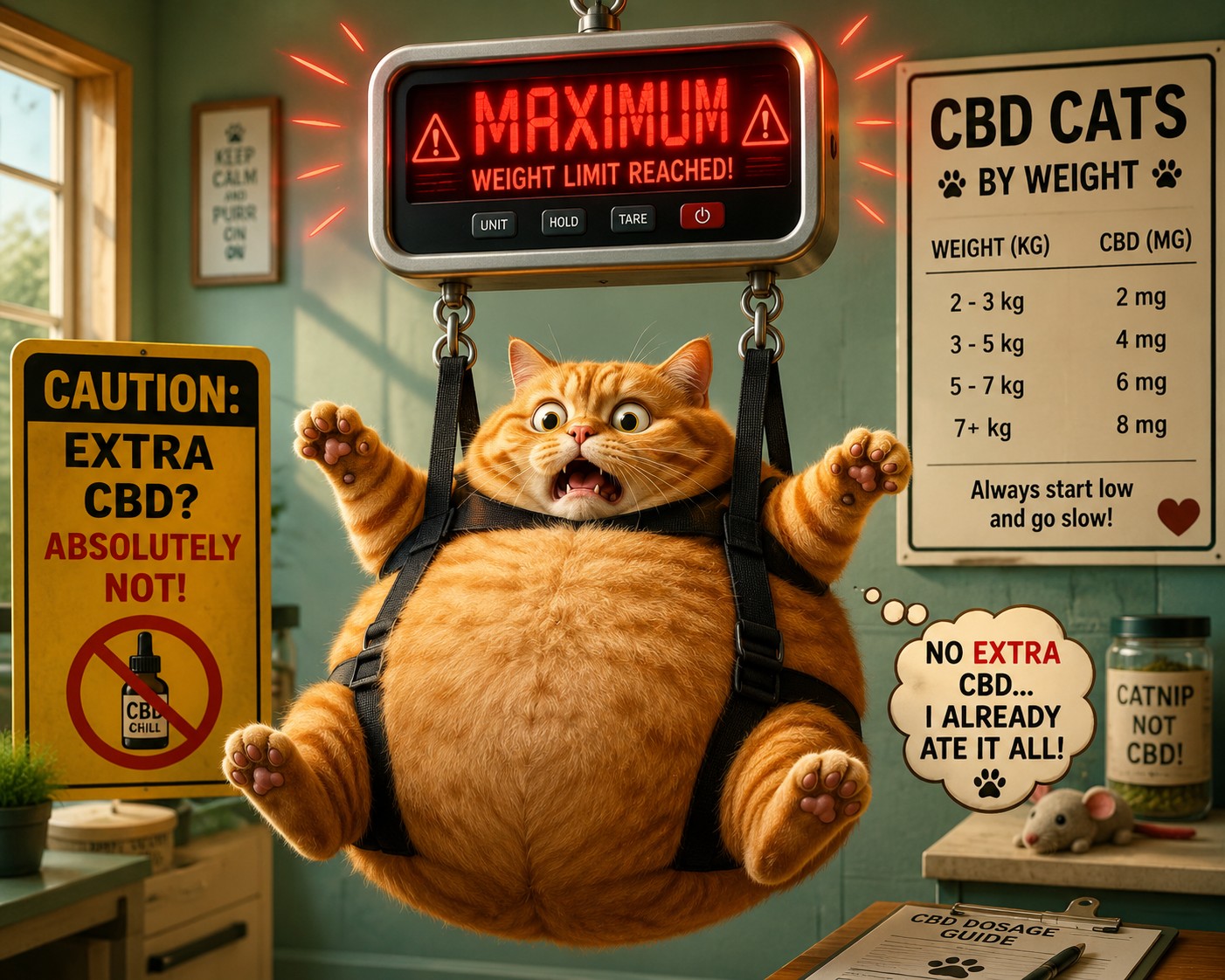
A message we received recently from a customer summed up a question we hear constantly:
“My cat is only 3.5kg, and I keep reading dosage charts made for dogs. Do I just scale it down, or is it not that simple?”
It’s not that simple, and it’s a good question to ask before guessing. Cats aren’t small dogs, and treating them like one when it comes to dosing is one of the most common mistakes we see. Here’s how to actually work out an appropriate amount, step by step. If you want the wider picture first, our complete guide to CBD for animals covers how CBD works across species before you narrow down to cats.
Step 1: Understand Why Cats Aren’t Just “Small Dogs”
Cats have a notably different liver enzyme profile than dogs, particularly when it comes to processing certain compounds. This isn’t unique to CBD, it’s the same reason a handful of medications and even some human foods are fine for dogs but risky for cats. It doesn’t mean CBD is dangerous for cats when dosed appropriately, but it does mean a dog dosing chart, scaled down by weight alone, isn’t a reliable shortcut.
Step 2: Get an Accurate Weight
This sounds obvious, but guessing is more common than you’d think, especially with cats, who are notoriously difficult to weigh on a standard bathroom scale. The most reliable method: weigh yourself holding your cat, then weigh yourself alone, and subtract the difference. A kitchen scale works for smaller or calmer cats who’ll sit still on it briefly.
Step 3: Use a Cat-Specific Starting Range
A commonly used general starting guideline for cats is approximately 0.2mg to 0.5mg of CBD per kilogram of body weight, taken once or twice daily, which is generally more conservative than typical dog dosing guidelines scaled by weight alone. For a 3.5kg cat, that works out to roughly 0.7mg to 1.75mg per dose as a starting point, not a fixed target.
- Small cat (under 4kg): start around 0.7mg to 2mg per dose
- Medium cat (4kg to 6kg): start around 1mg to 3mg per dose
- Larger cat (over 6kg): start around 1.5mg to 4mg per dose
These are conservative starting points, not maximums. The goal at this stage isn’t to find the “right” dose immediately, it’s to establish a safe baseline and observe from there.
Step 4: Convert mg to Drops Based on Your Product’s Concentration
This is where a lot of owners get tripped up, because drops aren’t a fixed unit, milligrams per drop depends entirely on the product’s strength. Our CBD oil for pets is formulated specifically at a lower concentration than our human range, precisely so the maths for small animals like cats doesn’t require awkward fractions of a drop.
Check the mg-per-drop figure on your specific product’s label rather than assuming, since this varies not just between brands but between strengths within the same brand’s range.
Step 5: Observe Before You Adjust
Give the starting dose consistently for at least five to seven days before deciding whether to increase it. Cats, more than dogs in our experience, can show delayed or subtle responses, a slightly calmer demeanour, marginally improved mobility, or simply seeming more like themselves, rather than one obvious change you can point to on day one.
Keep a simple note of appetite, litter box habits, and general demeanour during this window. Cats are also particularly good at masking discomfort, so subtle behavioural notes often tell you more than waiting for something dramatic to happen.
Step 6: Know What a Cat-Appropriate Increase Looks Like
If there’s been no noticeable change after a full week at the starting dose, a modest increase, roughly 25 to 50 percent more, given for another week, is a reasonable next step. Large jumps aren’t necessary and make it harder to judge what’s actually working.
A Note on Product Type
Oils allow for the precise, small-increment dosing that cats specifically require, far more so than treats, which are typically formulated with dogs’ larger average size in mind. If you’re using anything other than a liquid oil with a clearly labelled mg-per-drop concentration, double check that the serving size actually makes sense for a cat’s smaller bodyweight before starting.
This is also why we’d be cautious about repurposing a dog treat or chew for a cat, even one that seems like the “right” size by eye. Treats are typically formulated as a fixed mg-per-piece amount designed around average dog weights, which makes fine adjustment for a small cat almost impossible without cutting a treat into imprecise fractions.
Why Broad Spectrum Is Often the Safer Default for Cats
Cats are generally considered more sensitive to THC than dogs, even at the trace levels found in legally compliant full spectrum products. For this reason, many vets and experienced cat owners lean toward broad spectrum CBD oil, which removes THC entirely while keeping the rest of the natural hemp profile intact. It’s not a strict requirement, full spectrum products with legally compliant trace THC are used safely by many cat owners too, but if you’re looking to remove one more variable from the equation, broad spectrum is worth considering first.
When to Check With Your Vet Before Starting
- Your cat is on other medications, particularly anything processed by the liver
- Your cat has an existing liver or kidney condition
- Your cat is a kitten, elderly, or pregnant
- You’re unsure whether a behaviour change is something CBD should address at all, rather than something requiring diagnosis first
Frequently Asked Questions
Can I just use a dog dosing chart and adjust for my cat’s weight?
We wouldn’t recommend it. Cats process compounds differently to dogs due to differences in liver enzyme activity, so weight-scaling a dog chart isn’t a reliable method. Use a cat-specific starting range instead.
How many mg of CBD is safe for a small cat?
A common conservative starting range is 0.2mg to 0.5mg per kilogram of bodyweight, once or twice daily. For most small cats, that works out to roughly 1mg to 2mg per dose as a starting point.
How long before I see a change in my cat?
Give it five to seven days of consistent dosing before judging the effect. Cats often show subtle, gradual changes rather than an obvious shift on day one.
Is CBD oil better than CBD treats for cats?
Generally yes, since oils allow for more precise, small-increment dosing, which matters more for cats given their smaller average bodyweight compared to dogs.
What if my cat won’t take CBD oil directly?
Mixing the correct dose into a small amount of wet food is a common and effective alternative to giving it directly by mouth, and doesn’t affect how the CBD is absorbed.
Written by Carmen Dos Anjos Germano, Founder of Pure CBD4U
Carmen founded Pure CBD4U after her own search for reliable, high-quality CBD oil, starting with full spectrum CBD oil 5% as part of her personal wellness routine. That experience shaped the company’s focus on transparency, quality and independent testing. Pure CBD4U works with EU-grown hemp, uses third-party laboratory testing, and makes batch results accessible through QR codes on its products. Carmen remains closely involved in product selection, quality standards and the development of the Pure CBD4U range.

Leave a Reply