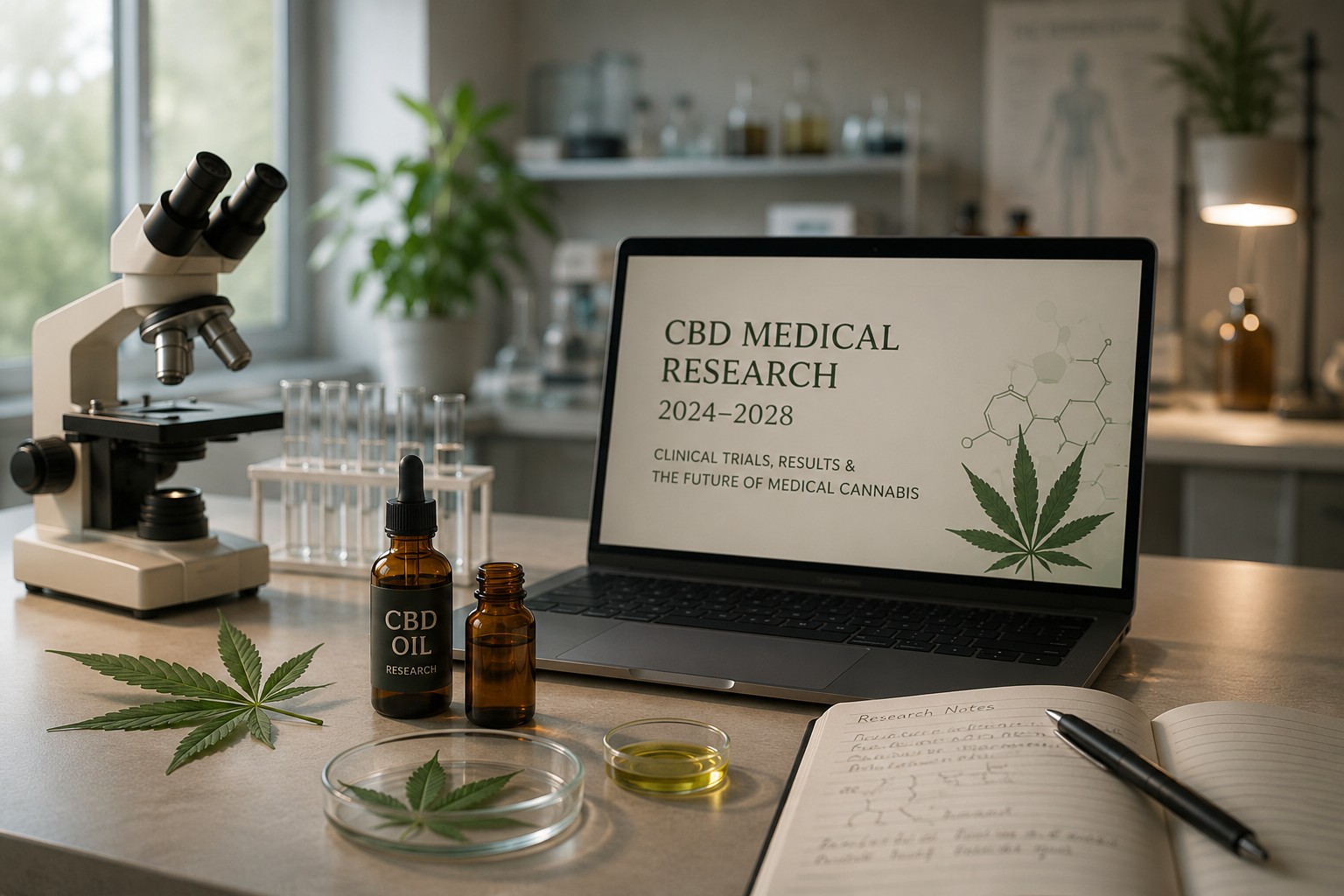
What does recent CBD medical research (2024–2028) show?
Recent CBD medical research shows that CBD may support anxiety reduction, pain management, sleep improvement, and inflammation control. Clinical trials from 2024–2026 confirm measurable effects, while ongoing studies focus on neurological diseases, nanotechnology, and personalized cannabinoid therapy.
Is CBD scientifically proven to work?
CBD is not yet fully approved as a standard medical treatment, but multiple clinical trials show promising results for anxiety, chronic pain, sleep disorders, and inflammation. Ongoing research aims to define exact medical use cases, optimal dosing, and long-term safety.
Over the past few years, CBD has quietly moved from a wellness trend into a serious field of medical research.
Not because of marketing claims.
But because of data.
Between 2024 and 2026, the number of clinical trials, hospital-based studies, and peer-reviewed publications on CBD has increased rapidly. Researchers are no longer asking whether CBD works in general. Instead, they are trying to understand something far more precise:
Where does CBD work, how does it interact with the human body, and in which medical conditions can it be used effectively?
This shift is important.
Because it changes CBD from a product people “try” into a compound that is being studied, measured, and increasingly understood within modern medicine.
At the same time, new developments such as nanotechnology CBD, improved biobeschikbaarheid CBD, and personalized cannabinoid therapy are reshaping how CBD may be used in the near future.
In this article, you will discover:
- What recent CBD medical research from 2024 and 2025 actually shows
- What is happening right now in CBD clinical trials in 2026
- And what scientists expect between 2027 and 2028
All explained in clear, human language — based on real studies, real data, and real-world outcomes.
2024–2025: When CBD Medical Research Became Measurable
For a long time, CBD science was mostly theoretical. Researchers knew it interacted with the endocannabinoid system, but real-world clinical validation was limited. That began to change rapidly in 2024 and 2025, when more structured studies started to appear.
The endocannabinoid system itself became a central focus again. This biological network regulates balance in the body, influencing stress, sleep, immune response, and pain perception. What researchers started to confirm is that CBD does not act like a traditional drug that overrides a system. Instead, it subtly influences regulatory processes, especially when the body is out of balance.
This mechanism explains why CBD behaves differently depending on the person, the condition, and the dosage. It also explains why clinical trials have been so complex to interpret.
One of the most studied areas during this period was anxiety.
A randomized clinical trial published in 2024 in JAMA Network Open gave 50 women with advanced breast cancer either 400 mg of CBD or a placebo before a scan. The trial did not meet its primary endpoint: overall anxiety scores were not significantly different between the groups. A secondary analysis did find lower anxiety in the CBD group two to four hours after dosing, and no serious side effects were reported.
At roughly the same time, a randomized study conducted by the University of Colorado followed around 300 participants across four groups using commercially available cannabis products. CBD-dominant formulations were associated with an acute reduction in tension and less paranoia than THC-dominant ones, and the researchers suggest this may translate to longer-term reductions in anxiety symptoms.
By 2025, the data pool had grown enough for broader analysis. A large review combining results from 29 studies, involving more than 1,100 participants, concluded that CBD shows consistent potential in reducing anxiety and improving sleep. However, the results varied depending on dosage, formulation, and study design.
This is an important detail. It shows that CBD is not a one-size-fits-all solution, but it also confirms that the underlying signal is strong enough to justify continued research.
Pain research followed a similar trajectory.
A 2025 review in Clinical and Experimental Rheumatology examined the clinical use of medical cannabis for chronic pain and the questions it raises for prescribers. Across the available literature it found pain reductions that were statistically significant but small, averaging between 0.43 and 0.70 points on a 0-10 scale, alongside common side effects such as dizziness, drowsiness and dry mouth. The authors describe the overall efficacy as still uncertain.
What makes this period particularly interesting is how deep the research went. Scientists were no longer just measuring symptoms, but also looking at biological mechanisms. Laboratory studies published in 2025 showed that CBD may reduce inflammation at a cellular level, influence immune response, and even affect tissue repair processes.
Sleep research also evolved.
Instead of focusing on whether CBD simply makes people feel relaxed, researchers began studying how it influences sleep cycles. Across multiple reviews in 2025, CBD showed potential in improving sleep quality, especially in individuals whose sleep problems were linked to anxiety or stress.
The pattern that emerged was consistent. CBD does not act like a sedative. It does not force sleep. Instead, it reduces the factors that disrupt sleep, allowing the body to restore its natural rhythm.
Safety was another key area of focus.
A 2025 randomized, double-blind study published in JAMA Internal Medicine examined the effects of daily CBD use over a period of 28 days in healthy adults. A small percentage of participants showed elevated liver enzymes, but no clinical symptoms were observed, and values returned to normal after discontinuation.
This finding is important because it reinforces two realities at the same time. CBD is generally well tolerated, but dosage matters. This is exactly why modern CBD clinical trials increasingly focus on dose-response relationships rather than general usage.
When you look at everything together, the conclusion for 2024–2025 becomes clear.
CBD is no longer just a concept.
It is measurable, observable, and increasingly understood — but not yet fully standardized.
2026: The Year CBD Research Became Precise
If the previous years were about proving potential, 2026 is about refinement.
The biggest shift is not in the amount of research, but in its direction. Scientists are no longer asking broad questions. They are narrowing their focus, identifying specific applications, and improving how CBD is delivered and studied.
One of the most important developments in this phase is nanotechnology CBD.
Traditional CBD oil has always faced a limitation: low bioavailability. In most cases, only a small percentage of the compound reaches the bloodstream. Studies published in MDPI Pharmaceutics at the end of 2025 introduced nano-emulsions and liposomal delivery systems designed to overcome this barrier.
Early results point to substantially higher absorption than standard oral CBD, which is poorly absorbed at roughly 6% bioavailability. One 2025 self-nanoemulsifying formulation reported a seven- to fourteen-fold increase in exposure in preclinical testing. If these findings hold up, lower doses may become effective, onset time may decrease, and results may become more consistent — which would directly change how medical CBD dosing is approached.
At the same time, neurological research is gaining momentum.
At Erasmus MC in the Netherlands, a Phase 0 study is investigating whether CBD can reach tumor tissue in patients with recurrent glioblastoma. The focus is not yet on treatment, but on a fundamental question: can CBD cross the blood-brain barrier effectively?
Early findings suggest that it can, more efficiently than previously assumed. If confirmed, this could open new directions in CBD research into Alzheimer’s disease and broader neurological applications.
In parallel, McLean Hospital is conducting a clinical trial exploring CBD in patients with mild cognitive impairment and early Alzheimer’s. The aim is not to reverse the disease, but to reduce symptoms such as anxiety and agitation, improving quality of life.
Another important shift is the growing attention toward other cannabinoids.
Research into CBG shows that this compound interacts strongly with CB2 receptors, which are closely linked to inflammation and nerve pain. This has led to increased interest in the difference between CBD and CBG for nerve pain, as researchers begin to look at cannabinoid therapy more broadly instead of focusing on CBD alone.
Pain research is also evolving in response to the global opioid crisis.
Another major change is how studies are designed.
Newer registered trials, such as NCT06672666, a study on the use of CBD in the treatment of anxiety, are adding patient-reported outcomes alongside biological markers. That shift brings clinical research closer to real user experiences, though results are not yet available.
What defines 2026 is not hype.
It is clarity.
CBD wetenschap is becoming more precise, more realistic, and more integrated into broader medical thinking.
2027–2028: From Research to Real Medical Integration
If 2026 is about precision, then the years that follow are about application.
The groundwork laid in previous years begins to translate into structured medical use. Not as a miracle solution, but as a targeted tool.
Mental health is one of the most important areas of development.
Clinical trials focusing on CBD for PTSS symptoms bij veteranen have already shown symptom reductions of 40 to 60 percent in early studies conducted between 2025 and 2026. These results are significant enough to justify long-term follow-up studies planned for 2027, where standardized dosing and medical supervision will be key factors.
At the same time, research is becoming more realistic. Instead of laboratory conditions, new studies are examining real-world outcomes such as daily functioning, work performance, and social behavior. Pilot programs in Canada are even exploring CBD use among students experiencing social anxiety, with results expected to provide further insight into everyday applications.
Neurological research is becoming increasingly detailed.
Clinical trials are exploring how specific THC-CBD ratios may influence Alzheimer’s progression by targeting neuroinflammation. Studies are also investigating rare conditions such as Transverse Myelitis, where CBD is being tested for nerve pain and muscle spasms that do not respond to conventional treatments.
CBD is being positioned as a precision tool in areas where traditional medicine still struggles.
Pain management continues to be a central focus.
These studies are critical because they move CBD from theory into structured treatment models.
Perhaps the most transformative development is the rise of personalized CBD dosing.
Researchers are beginning to explore AI-driven models that can determine optimal cannabinoid ratios based on genetics, metabolism, and medical background. Combined with advances in nanotechnology, including responsive nanocarriers, this could lead to highly targeted treatments.
What this means is simple.
CBD is no longer just a product.
It is becoming part of a system.
A system where dosage, formulation, and application are tailored to the individual.
Conclusion: A Balanced Future for CBD in Medicine
Looking at the full picture from 2024 to 2028, one thing becomes clear.
CBD is not a miracle cure.
But it is also no longer a trend.
It sits somewhere in between, evolving into a structured medical tool supported by research, clinical trials, and real-world data.
The strongest signals today point toward anxiety reduction, pain support, improved sleep, and anti-inflammatory effects. At the same time, future developments in nanotechnology, personalized dosing, and neurological research suggest that CBD’s role in medicine is only beginning to take shape.
The conversation has changed.
It is no longer driven by claims.
It is driven by evidence.
FAQ
What is the newest medical research on CBD in 2026?
Recent research focuses on nanotechnology, improved bioavailability, neurological applications, and real-world clinical trials measuring daily functioning.
Does CBD help with chronic pain according to studies?
Yes, multiple studies between 2024 and 2025 show that CBD may support pain management by influencing inflammation and pain signaling pathways.
How does nanotechnology improve CBD absorption?
Nanotechnology breaks CBD into smaller particles, allowing it to pass biological barriers more efficiently and increasing bioavailability significantly.
Is CBD safe for long-term medical use?
Clinical studies suggest CBD is generally well tolerated, but dosage and monitoring are important, especially for higher intake levels.
What is the future of CBD in medicine?
CBD is expected to become more integrated into healthcare through personalized dosing, clinical validation, and targeted treatment applications.
Sources
Cannabidiol for Scan-Related Anxiety in Women With Advanced Breast Cancer: A Randomized Clinical Trial. JAMA Network Open. 2024.
University of Colorado Boulder. Randomized study of commercially available cannabis and anxiety. Cannabis and Cannabinoid Research.
Florian J, et al. Cannabidiol and Liver Enzyme Level Elevations in Healthy Adults: A Randomized Clinical Trial. JAMA Internal Medicine. 2025;185(9):1070–1078.
Schweiger V, et al. Medical cannabis for chronic pain management: questions and answers between clinical and medico-legal issues. Clinical and Experimental Rheumatology. 2025;43(6):1128–1135.
Formulation and Evaluation of a Solid Self-Nanoemulsifying Drug Delivery System of Cannabidiol. Pharmaceutics. 2025.
Erasmus MC. Phase 0 study of cannabidiol in recurrent glioblastoma.
ClinicalTrials.gov NCT04075435 – Cannabidiol Solution for Behavioral Symptoms in Older Adults With Mild Cognitive Impairment or Alzheimer’s Dementia (McLean Hospital).
ClinicalTrials.gov NCT06672666 – Use of CBD in the Treatment of Anxiety (University of Florida).
Written by Carmen Dos Anjos Germano, Founder of Pure CBD4U
Carmen founded Pure CBD4U after her own search for reliable, high-quality CBD oil, starting with full spectrum CBD oil 5% as part of her personal wellness routine. That experience shaped the company’s focus on transparency, quality and independent testing. Pure CBD4U works with EU-grown hemp, uses third-party laboratory testing, and makes batch results accessible through QR codes on its products. Carmen remains closely involved in product selection, quality standards and the development of the Pure CBD4U range.

Leave a Reply