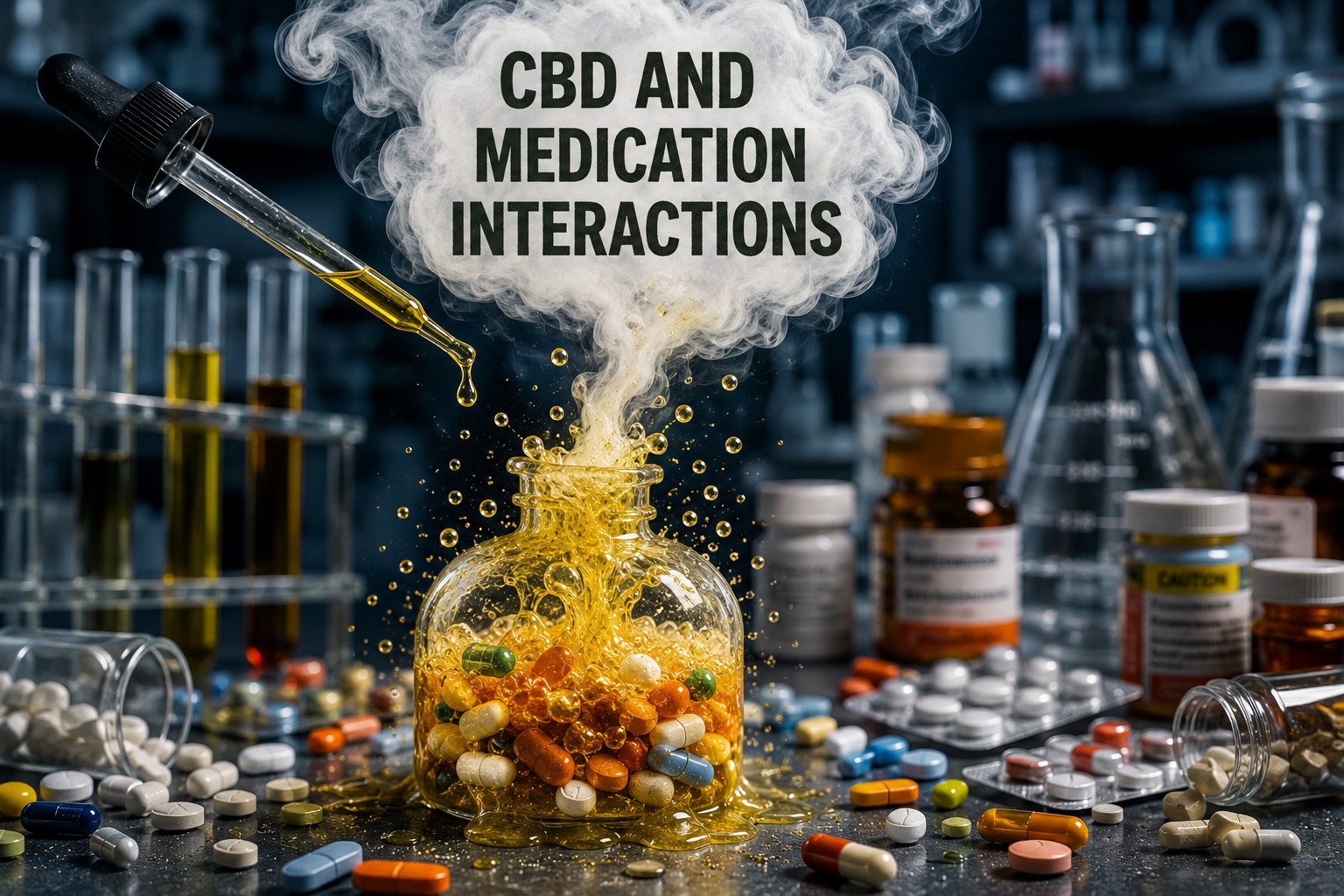
Can CBD interact with medications? If you take prescription drugs regularly and you’re considering CBD, this is the one question that genuinely matters before you start.
The answer is yes, in some cases — and being honest about that upfront, rather than burying it in a disclaimer, is more useful than the alternative. CBD medication interactions are real, reasonably well understood, and manageable with medical guidance. They’re not a reason to avoid CBD, but a reason to have a short conversation with your doctor or pharmacist first.
The Mechanism: Why CBD Can Affect How Medications Work
The interaction between CBD and prescription drugs comes down to a specific biological process: how the liver breaks things down. Most pharmaceutical drugs are metabolised through a family of liver enzymes called cytochrome P450, abbreviated CYP450. CBD drug metabolism operates through the same system — CBD CYP450 interactions are the core mechanism behind virtually every documented case of cannabidiol interactions with prescription drugs. When CBD and a medication share this metabolic pathway, they can compete for the same processing capacity.
The practical result is that CBD may slow down how quickly certain medications are cleared, causing them to build up to higher blood concentrations than intended. Less commonly, CBD may speed up the clearing of others. Either direction can have clinical significance — particularly for medications with a narrow therapeutic window, where the difference between an effective dose and a harmful one is small.
This isn’t unique to CBD. Many substances — including grapefruit juice, which famously carries warnings on certain medications — affect CYP450 enzymes in similar ways. The grapefruit warning is a useful comparison because it exists on everyday food products, helps normalise the concept of metabolic interactions, and shows that interactions of this kind are a well-understood pharmacological phenomenon rather than something alarming or unusual.
Which Medications Are Most Relevant
Not every medication is processed through the specific CYP450 enzymes most affected by CBD. But several commonly prescribed drug categories are, and these are the ones worth discussing with a healthcare professional.
CBD blood thinners concerns, particularly around warfarin, are the most frequently discussed CBD drug interactions for good reason. CBD warfarin interaction can shift blood concentration in either direction, and CBD medication safety monitoring is especially important here. Warfarin has a narrow therapeutic window — too little and clotting risk increases, too much and bleeding risk increases. CBD’s effect on the enzymes that process warfarin can shift blood concentration in either direction, making monitoring more important for anyone using both.
Certain antidepressants and antianxiety medications are metabolised through CYP450 pathways, including some SSRIs and SNRIs. The interaction risk varies between specific drugs within these categories rather than applying uniformly.
Anticonvulsants, ironically given that prescription CBD exists specifically for seizure disorders, also warrant attention. The Epidiolex trials that established CBD’s effectiveness for epilepsy also involved careful monitoring of interactions with other anticonvulsants like clobazam, where CBD was found to increase active blood concentrations.
Immunosuppressants, certain heart medications, and some cholesterol-lowering drugs also appear in the CBD interaction literature.
This is not an exhaustive list, and drug metabolism is complex enough that the absence of a category here doesn’t mean a medication is safe to combine with CBD without guidance. The useful question to ask isn’t “is my drug on the list?” but “does my specific medication have a narrow therapeutic window or a grapefruit warning?” If yes, that’s the conversation to have with your pharmacist or doctor.
The Grapefruit Test
One of the most practical shortcuts for identifying medications that may interact with CBD is checking whether the medication carries a grapefruit warning. Grapefruit inhibits some of the same CYP450 enzymes that CBD does. If your medication’s packaging or label advises avoiding grapefruit, that’s a reliable indicator that the medication’s blood concentration is sensitive to CYP450 modulation — and CBD warrants the same conversation you’d have about grapefruit.
This isn’t a perfect overlap — CBD and grapefruit affect CYP450 enzymes in somewhat different ways and to different degrees — but the grapefruit test is a useful, accessible starting point that many pharmacists and prescribing doctors already recognise.
What About CBD Topicals and Lower Doses?
Two variables worth noting that may reduce, though not eliminate, interaction concerns.
CBD applied topically — creams, balms, or lotions — is generally absorbed locally rather than entering the bloodstream in significant quantities. For most topical CBD products, systemic CYP450 interaction is unlikely, though high-absorption formulations vary.
Dose also matters. At very low doses of oral CBD, the metabolic competition with other drugs is smaller. The concern scales with the amount of CBD entering systemic circulation — which is part of why interactions are more thoroughly documented at the prescription doses used in clinical trials than at typical wellness doses. This doesn’t mean low-dose wellness CBD is completely interaction-free, but it does mean the risk gradient runs from low to higher along with the dose.
What to Actually Do Before Starting CBD
The practical guidance here is straightforward: if you take regular prescription medication, particularly anything in the categories above, speak with your doctor or pharmacist before starting CBD. This conversation doesn’t need to be complicated — a brief mention of what CBD product you’re considering and at what dose gives a healthcare professional enough to flag any specific concerns or recommend monitoring.
Some prescribers are not yet familiar with CBD interactions, in which case a pharmacist — whose specific expertise is drug-drug interactions — is often the more reliable person to ask. Pharmacists can check CBD against your current medication list quickly and flag any concerns needing review.
This conversation is especially important if any of your current medications are in the narrow therapeutic window category. Adjusting monitoring — for example, checking INR levels more frequently if you’re on warfarin — is often the practical outcome rather than stopping either medication.
Our CBD side effects guide covers the broader landscape of what people commonly notice with CBD, and our guide on how to choose high-quality CBD oil is worth reading to ensure the product you’re evaluating actually contains what it claims — which matters for any interaction assessment, since inaccurate labelling makes dose management impossible.
A Note on Stopping Medication
This article is about CBD interacting with medications — not about CBD as an alternative to medication. If you’re using CBD specifically because you’re hoping to reduce or replace prescription drugs, the right conversation is with your prescribing doctor, not a starting-point based on wellness content. That applies regardless of how promising CBD research in any given area might be.
Frequently Asked Questions
Can CBD interact with medications?
Yes. Can CBD interact with medications at wellness doses? The risk scales with dose, but the mechanism is real at any dose. CBD is metabolised through liver enzymes that also process many pharmaceutical drugs. This can cause blood concentrations to rise or fall, which matters most for medications with narrow therapeutic windows.
Which medications interact with CBD most?
The most commonly discussed categories include blood thinners like warfarin, certain antidepressants, anticonvulsants, immunosuppressants, and some heart and cholesterol medications. This isn’t exhaustive — cannabidiol interactions have been documented across a wider range of drug categories. Speaking with a pharmacist about your specific medications is the most reliable approach.
How does CBD interact with medications?
Through the CYP450 liver enzyme system. CBD may slow or speed up how quickly certain drugs are metabolised, changing how much remains active in the bloodstream. Can CBD interact with medications that use specific enzymes? Yes — which specific enzymes matter varies by drug.
Is the grapefruit warning relevant to CBD?
Yes, as a useful screening tool. Medications with grapefruit warnings are processed through CYP450 enzymes that CBD also affects. If your medication warns against grapefruit, raise CBD with your doctor or pharmacist before starting.
Are CBD topicals safer if I take medication?
Generally, yes — topical CBD is mostly absorbed locally and is less likely to reach blood concentrations that affect liver enzyme activity. However, this varies by formulation, and anyone on medication with a narrow therapeutic window should still mention CBD use to their healthcare provider.
Does the dose of CBD affect the interaction risk?
Yes. Interaction risk scales with the amount of CBD entering systemic circulation. Lower doses are less likely to produce significant metabolic competition, though they don’t eliminate the possibility entirely.
Should I stop my medication to take CBD?
Never stop or adjust prescription medication without guidance from the prescribing doctor. CBD interactions are manageable with medical guidance — they don’t require choosing one over the other in most cases.
Who should I ask about CBD and my medications?
Your pharmacist is often the best first point of contact for drug interaction questions. Pharmacists are specifically trained to assess drug-drug interactions and can review your medication list quickly. Your prescribing doctor is equally appropriate if you have an upcoming appointment.
Related reading: Is CBD Safe?
Written by Carmen Dos Anjos Germano, Founder of Pure CBD4U
Carmen founded Pure CBD4U after her own search for reliable, high-quality CBD oil, starting with full spectrum CBD oil 5% as part of her personal wellness routine. That experience shaped the company’s focus on transparency, quality and independent testing. Pure CBD4U works with EU-grown hemp, uses third-party laboratory testing, and makes batch results accessible through QR codes on its products. Carmen remains closely involved in product selection, quality standards and the development of the Pure CBD4U range.

Leave a Reply