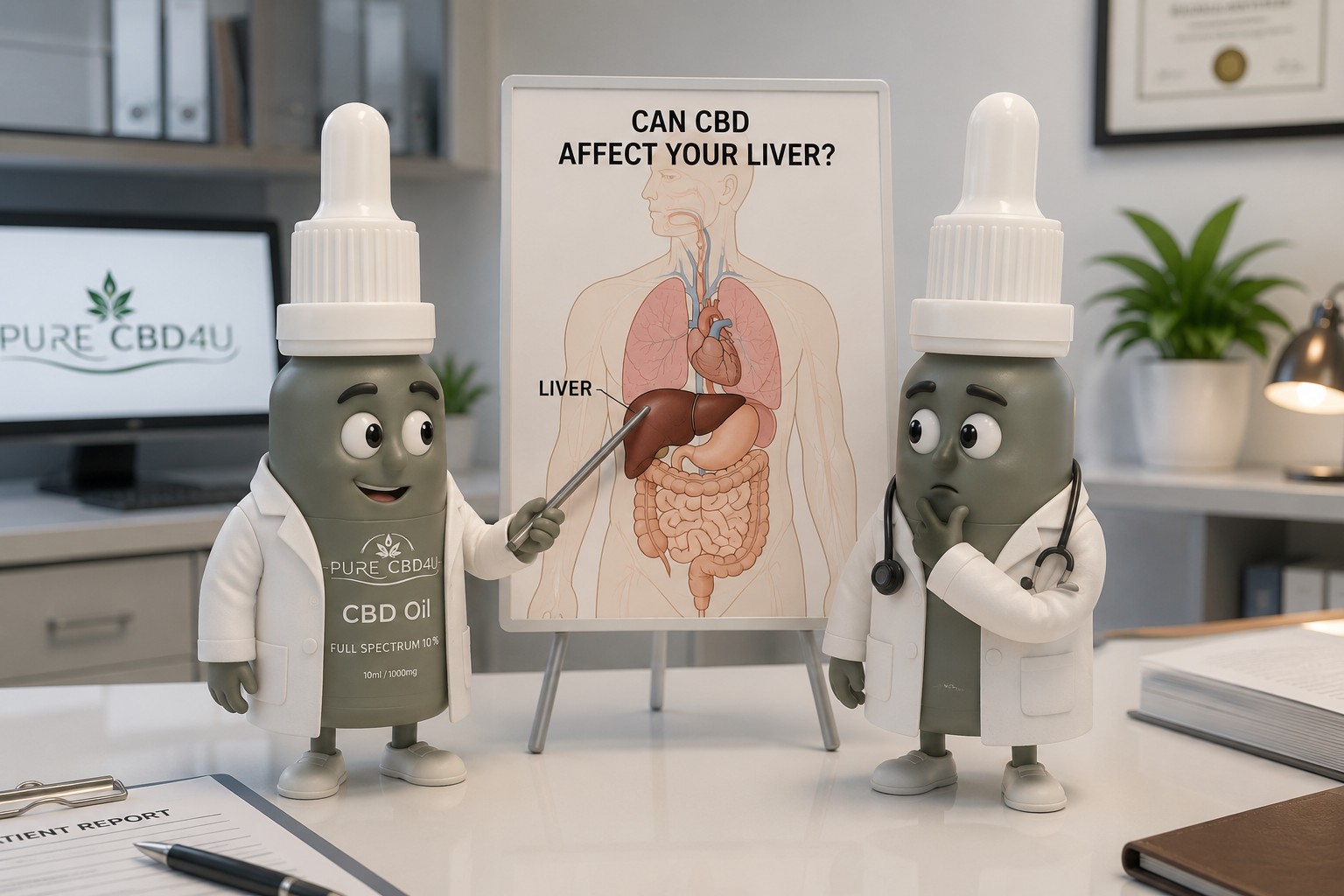
One of the most misunderstood headlines about CBD is that it “damages the liver.” Can CBD affect your liver? The claim has appeared in mainstream media and as a concern that puts people off CBD entirely. But where did it actually come from — and does it apply to someone who takes a couple of drops in their morning routine?
The answer requires tracing the evidence back to its source. And when you do, the picture looks considerably more specific, and considerably less alarming, than the headline version suggests.
Where the Claim Originated
Most concern about CBD liver health can be traced to two sources: animal research conducted using very high doses, and clinical trials of Epidiolex — the FDA-approved prescription CBD medication used for severe seizure disorders.
In the Epidiolex trials, a meaningful proportion of participants showed CBD liver damage markers — specifically elevated liver enzymes ALT and AST, the standard markers of liver stress — during treatment. CBD and liver function test results were monitored closely throughout. In some cases, these elevations were significant enough to require dose reduction or withdrawal from the study. These findings were real, documented, and appropriately reported.
What requires context is the dose. Epidiolex trials used 10, 20, or even 25mg of CBD per kilogram of body weight per day — which for an average adult translates to 700 to 1750mg of CBD daily. These are not wellness doses. They are prescription-strength amounts given to people with serious medical conditions, often alongside other medications, under close clinical supervision. The liver enzyme elevations observed in these trials are dose-dependent findings at the extreme end of the dosage spectrum.
The animal studies that generated additional concern used similarly extreme doses — in some cases producing toxic effects at amounts that would be impractical to reach through commercial CBD products. Extrapolating from these studies to everyday CBD use is a significant and often unstated leap.
What Happens When CBD Reaches the Liver
Understanding the mechanism helps explain both why the concern exists and why it may not apply to most users.
The liver is how the body processes cannabidiol. CBD is metabolised primarily through the cytochrome P450 system — the same family of CBD liver enzymes responsible for breaking down a large proportion of pharmaceutical drugs. This is why does CBD affect the liver is a pharmacologically meaningful question, not just a wellness myth. This is relevant for two reasons.
First, it means that at very high concentrations, CBD could theoretically place additional demand on liver enzymes — which is the pharmacological basis for the elevated enzyme findings in high-dose trials. Second, and more practically relevant for most people, it means CBD can interact with medications that share these metabolic pathways. If you take prescription drugs that are also processed by CYP450 enzymes — including certain blood thinners, antidepressants, and anticonvulsants — CBD can influence how quickly those drugs are metabolised, potentially raising or lowering their effective blood concentration.
For many everyday users, this drug metabolism interaction is a more relevant concern than CBD liver toxicity itself. It’s also one reason CBD side effects liver discussions so often return to medication interaction rather than direct toxicity. It’s worth discussing with a healthcare provider before starting CBD if you take regular prescription medication.
The Dose Gap Between Research and Reality
A standard 10ml bottle of 10% CBD oil contains approximately 1,000mg of CBD in total. Typical wellness use involves 5 to 40mg per day. The doses that produced liver enzyme elevations in Epidiolex trials — 700 to 1750mg daily — are between 17 and 350 times higher than most wellness users ever take.
To reach the doses used in the most concerning animal studies, an average adult would need to consume quantities no commercial CBD product is designed to deliver. This doesn’t make CBD liver safety a closed question, but it does mean that alarming research data and typical wellness use exist in genuinely different categories.
Can CBD affect your liver at wellness doses? Current evidence does not establish cannabidiol liver damage as a risk at these amounts. That statement comes with an important qualifier: long-term, systematic research at everyday doses is still limited. The absence of documented harm is not the same as confirmed safety in all populations under all conditions.
Who Should Be More Cautious
So can CBD affect your liver in practice? The evidence picture does suggest some groups deserve additional consideration.
People with pre-existing liver conditions should discuss CBD with a healthcare professional before starting it, since a liver already under stress from disease or damage may process CBD differently than a healthy one. The elevated enzyme findings in clinical trials were more pronounced in participants who also took valproate, a drug with its own hepatic effects — suggesting that combination effects deserve more attention than isolated CBD use.
People on regular prescription medication should review potential CYP450 interactions with their doctor or pharmacist, particularly if taking medications with narrow therapeutic windows where concentration changes matter significantly.
People taking CBD at unusually high doses — significantly above the 40–50mg upper range typical of wellness use — would benefit from periodic liver function monitoring, particularly if that use is sustained over a long period. This isn’t a common scenario, but it’s worth naming honestly.
For the majority of healthy adults using CBD at typical wellness doses, the current evidence does not support elevated liver concern. This is where scientific honesty requires holding two things simultaneously: the data from high-dose research is real and shouldn’t be dismissed, and it also doesn’t straightforwardly apply to someone taking 15mg of CBD oil daily.
What This Means in Practice
Before starting CBD, or if you’re already using it and have liver health questions, a conversation with a healthcare provider costs nothing and provides personalised context that general articles cannot. This is especially true if you have any pre-existing liver condition or take medication regularly.
Product quality is also directly relevant here. A CBD product with inaccurate labelling — more common than it should be in an unregulated market — could result in someone taking significantly more CBD than they intend. Third-party tested products with a verifiable Certificate of Analysis are important precisely because knowing what you’re actually consuming is the foundation of any meaningful safety assessment. Our guide on how to choose high-quality CBD oil covers this in detail.
For further context on how CBD interacts with medications more broadly, the CBD side effects guide is a useful next step. And for anyone new to CBD and trying to understand what it actually is before exploring the nuance of liver effects, the what is CBD oil article provides the necessary foundation.
Frequently Asked Questions
Can CBD damage your liver?
Can CBD affect your liver enough to cause damage? At typical wellness doses, current evidence does not establish CBD as a liver-damaging substance. The concern originates from high-dose clinical trials of prescription CBD and animal studies using extreme doses — not from everyday CBD use.
Does CBD increase liver enzymes?
In high-dose clinical settings — 700mg or more per day — elevated liver enzymes were observed in some participants. At typical wellness doses of 5–40mg daily, there is no established pattern of liver enzyme elevation in current evidence.
Is CBD hard on the liver?
At the doses used in prescription medication trials, CBD does place demands on liver metabolism. At everyday wellness doses, the same mechanism applies but at a scale that current evidence does not associate with liver harm in healthy individuals.
Can I take CBD if I have liver disease?
People with pre-existing liver conditions should discuss CBD with a healthcare professional before starting it. Their liver may process CBD differently, and individual assessment is more appropriate than general guidance.
Does CBD affect liver function tests?
In high-dose clinical trials, it did for some participants. At typical wellness doses, significant effects on liver function tests are not established in current research. If you have concerns about liver function, baseline testing before starting CBD is a reasonable step to discuss with your doctor.
Is prescription CBD the same as wellness CBD?
The same active compound, but at very different doses and in a different clinical context. Epidiolex is given at hundreds of milligrams daily to people with serious seizure disorders under medical supervision. Commercial CBD oils are typically used at 5–40mg daily. The research findings from one don’t automatically transfer to the other.
Should I worry about CBD and my liver?
If you’re a healthy adult using CBD at typical wellness doses without pre-existing liver conditions or relevant medication interactions, the current evidence does not support significant liver concern. If you have liver disease, take regular prescription medication, or use CBD at high doses, a conversation with a healthcare professional is genuinely worthwhile.
Written by Carmen Dos Anjos Germano, Founder of Pure CBD4U
Carmen founded Pure CBD4U after her own search for reliable, high-quality CBD oil, starting with full spectrum CBD oil 5% as part of her personal wellness routine. That experience shaped the company’s focus on transparency, quality and independent testing. Pure CBD4U works with EU-grown hemp, uses third-party laboratory testing, and makes batch results accessible through QR codes on its products. Carmen remains closely involved in product selection, quality standards and the development of the Pure CBD4U range.

Leave a Reply