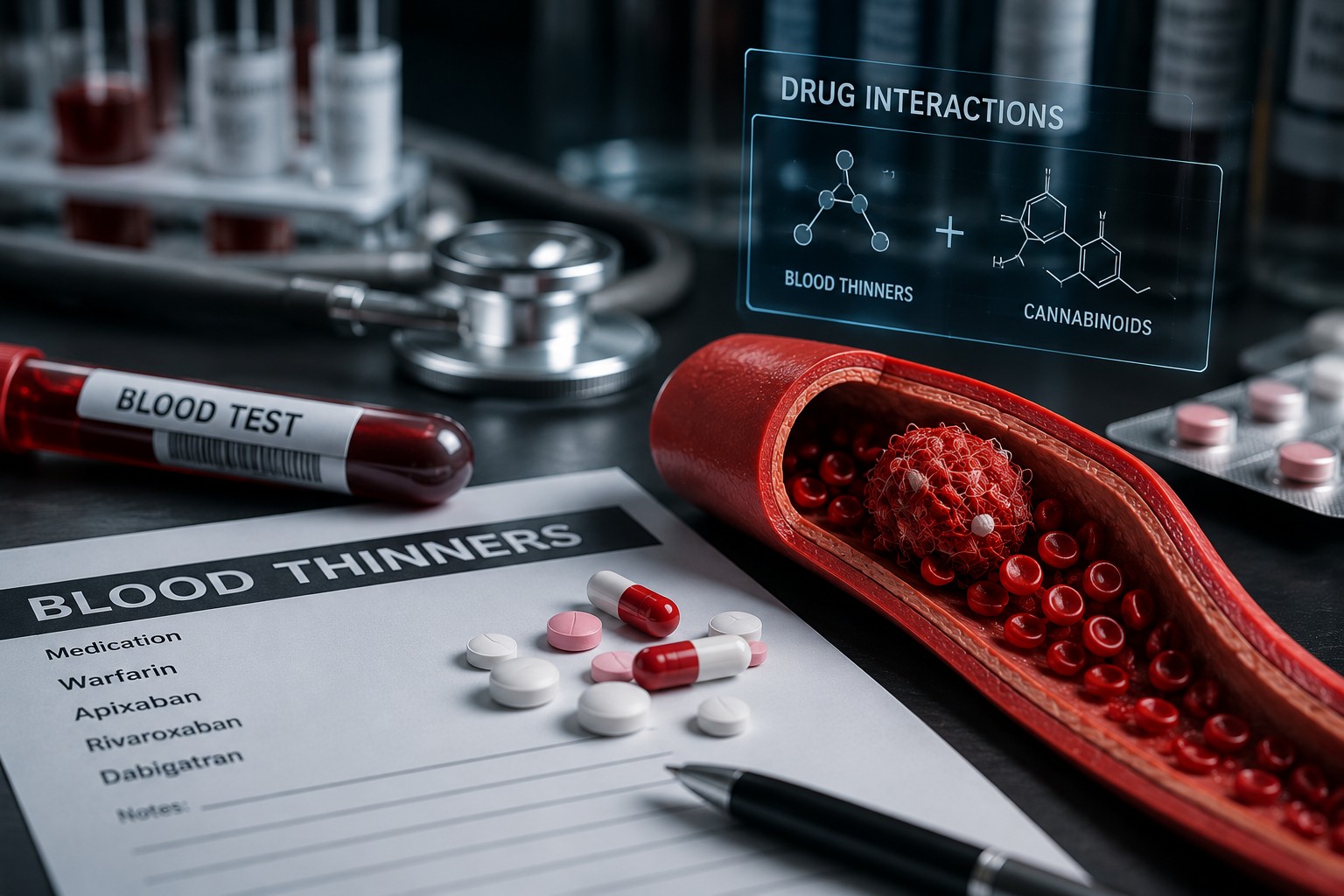
CBD oil and blood thinners is one of the most important drug interaction topics in the CBD space — and for good reason. CBD blood thinners concerns are among the most commonly cited, and the most clinically significant. CBD oil and blood thinners is a combination that isn’t inherently dangerous for everyone, but it does require informed, specific medical guidance in a way that most other CBD conversations don’t.
If you’re researching CBD oil and blood thinners, the most important thing to understand is why the interaction happens and what it means practically for your monitoring routine. This article explains both.
Why Blood Thinners Are Different
Most medications sit in one of two camps where CBD interactions are concerned: either the risk is theoretical and unlikely to matter at typical wellness doses, or there’s documented, clinically relevant potential for the interaction to shift things in ways that matter. CBD blood thinners discussions — and CBD warfarin concerns in particular — sit firmly in this second camp.
This isn’t because CBD is especially problematic. It’s because warfarin, the most commonly prescribed anticoagulant worldwide, has an unusually narrow therapeutic window. Too little, and it doesn’t protect against the blood clots it’s prescribed to prevent. Too much, and it increases the risk of bleeding — sometimes seriously. Even small shifts in warfarin blood concentration can move a patient from the therapeutic zone into a zone that requires clinical attention.
The CBD and warfarin interaction operates through the same liver enzyme pathway that metabolises most medications — the cytochrome P450 system. Specifically, CBD is thought to inhibit CYP2C9, the enzyme primarily responsible for breaking down warfarin. When CYP2C9 activity is reduced, warfarin clears from the body more slowly, causing blood concentrations to rise. This is a pharmacological interaction with real documented clinical significance, not a theoretical concern.
What the Evidence Shows
Case reports have documented elevated warfarin concentrations and elevated CBD INR levels — the measure used to monitor anticoagulation — in patients using CBD alongside warfarin. The most detailed published case involved a patient whose INR rose to a level associated with bleeding risk after starting CBD, stabilising when the warfarin dose was adjusted under medical supervision.
This is consistent with what the CYP2C9 mechanism would predict, and it’s the reason warfarin consistently appears near the top of any CBD drug interaction discussion. The evidence isn’t from massive randomised trials — it’s from case reports and pharmacokinetic reasoning — but the underlying mechanism is well understood and the clinical signal is clear enough to warrant real precaution rather than dismissal.
What isn’t established is whether lower CBD doses consistently produce clinically meaningful INR changes. Some interaction data comes from higher CBD doses, and the dose-dependence of the effect is not fully characterised in research. This uncertainty doesn’t mean low-dose CBD is safe to combine with warfarin without monitoring — it means the picture is incomplete enough that independent monitoring is essential.
Other Blood Thinners and CBD
Warfarin receives the most attention in cannabidiol blood thinners research, but it isn’t the only anticoagulant relevant to this discussion. Does CBD affect blood thinners beyond warfarin? The answer depends on the specific drug.
Direct oral anticoagulants (DOACs) — including apixaban (Eliquis), rivaroxaban (Xarelto), edoxaban, and dabigatran — are increasingly prescribed as alternatives to warfarin. Their interaction profile with CBD is less well studied than warfarin’s, partly because DOACs are newer and partly because they use different metabolic pathways. Some are metabolised through P-glycoprotein and CYP3A4 rather than CYP2C9, which may produce different interaction profiles. Current evidence is insufficient to conclude that DOACs are safe to combine with CBD without guidance — the absence of documented interaction is not the same as confirmed safety.
Aspirin, used at low doses as an antiplatelet rather than a strict anticoagulant, has a different mechanism and different interaction profile. The risk level is generally considered lower, but the same principle applies: anyone using aspirin for cardiovascular prophylaxis should mention CBD to their healthcare provider.
What Practically Happens If You Combine CBD and Warfarin
The practical concern is that CBD blood clotting effects — specifically CBD INR drift upward — meaning your blood is being thinned more than intended. CBD coagulation effects are real and worth monitoring. Symptoms of elevated INR or anticoagulation above the therapeutic range include unusual bruising, prolonged bleeding from cuts, blood in urine, or in more serious cases, internal bleeding.
This doesn’t mean these outcomes are inevitable — the degree of CBD blood clotting effect varies between individuals. But it does mean that monitoring INR more frequently during the period of introducing CBD is the appropriate clinical response, not assuming nothing will change.
The Conversation to Have With Your Doctor
If you take warfarin or another anticoagulant and want to explore CBD, the conversation with your prescribing doctor or anticoagulation clinic should cover:
- What CBD product you’re considering and at what dose
- Whether your INR monitoring schedule can be adjusted to catch any changes quickly
- Whether the potential benefit you’re seeking from CBD could be addressed another way in your specific situation
- Whether there’s a particular time to introduce CBD that makes monitoring easier
This isn’t a conversation about getting permission — it’s about having the monitoring infrastructure in place to catch any interaction before it becomes a clinical problem. Most patients on warfarin already have regular INR monitoring. Adding CBD alongside a temporarily more frequent monitoring schedule is a manageable approach for many people, not a prohibition.
Product Quality Matters More Here Than Usual
For anyone on anticoagulant therapy, product quality and accurate labelling are more than a general wellness consideration — they’re a safety necessity. If a CBD product contains more CBD than labelled, the dose you’re managing the interaction around may not be the dose you’re actually taking. Third-party tested products with a verifiable Certificate of Analysis are the only reliable way to know what you’re consuming. Our guide on how to choose high-quality CBD oil covers this in detail.
Our broader article on can CBD interact with medications explains the general CYP450 mechanism this interaction operates through, and our CBD side effects guide covers the wider context of CBD safety for anyone wanting additional background.
Frequently Asked Questions
Can I take CBD oil and blood thinners together?
CBD drug interactions with blood thinners are real — CBD blood thinners combination is possible for some people, but not without medical guidance first. CBD may increase warfarin blood concentration by inhibiting the liver enzyme that processes it. This doesn’t automatically mean CBD is off-limits, but it does mean your anticoagulation monitoring needs to account for CBD use.
Does CBD affect warfarin?
Yes, based on case reports and pharmacological evidence. CBD appears to inhibit CYP2C9, the enzyme primarily responsible for warfarin metabolism, which can cause warfarin levels to rise. The degree of effect varies between individuals.
What happens to my INR if I take CBD with warfarin?
INR may rise, indicating stronger anticoagulation than intended. In documented cases this has reached levels associated with bleeding risk, though the magnitude of effect is not the same for everyone. More frequent INR monitoring when starting CBD is the appropriate clinical response.
Is it safe to take CBD with blood thinners?
The combination is not absolutely contraindicated in all circumstances, but it requires medical supervision, dose management, and monitoring. It should not be started without discussing it with your prescribing doctor or anticoagulation clinic.
What about newer blood thinners like Eliquis or Xarelto?
Less research exists on CBD interactions with DOACs than with warfarin. Different metabolic pathways are involved, but the absence of documented interaction doesn’t confirm safety. Discuss with your prescribing doctor before combining CBD with any anticoagulant.
How much CBD is safe with blood thinners?
No established safe dose has been defined for the combination. The interaction appears dose-dependent, but current evidence is insufficient to specify an amount that reliably avoids INR impact. Medical supervision is needed regardless of dose.
Should I stop my blood thinner to take CBD?
Never stop or adjust anticoagulant medication without explicit guidance from your prescribing doctor. The risks of undertreated anticoagulation can be serious. The correct approach is medical guidance on combining both, not replacing one with the other.
Related reading: Is CBD Safe?
Written by Carmen Dos Anjos Germano, Founder of Pure CBD4U
Carmen founded Pure CBD4U after her own search for reliable, high-quality CBD oil, starting with full spectrum CBD oil 5% as part of her personal wellness routine. That experience shaped the company’s focus on transparency, quality and independent testing. Pure CBD4U works with EU-grown hemp, uses third-party laboratory testing, and makes batch results accessible through QR codes on its products. Carmen remains closely involved in product selection, quality standards and the development of the Pure CBD4U range.

Leave a Reply