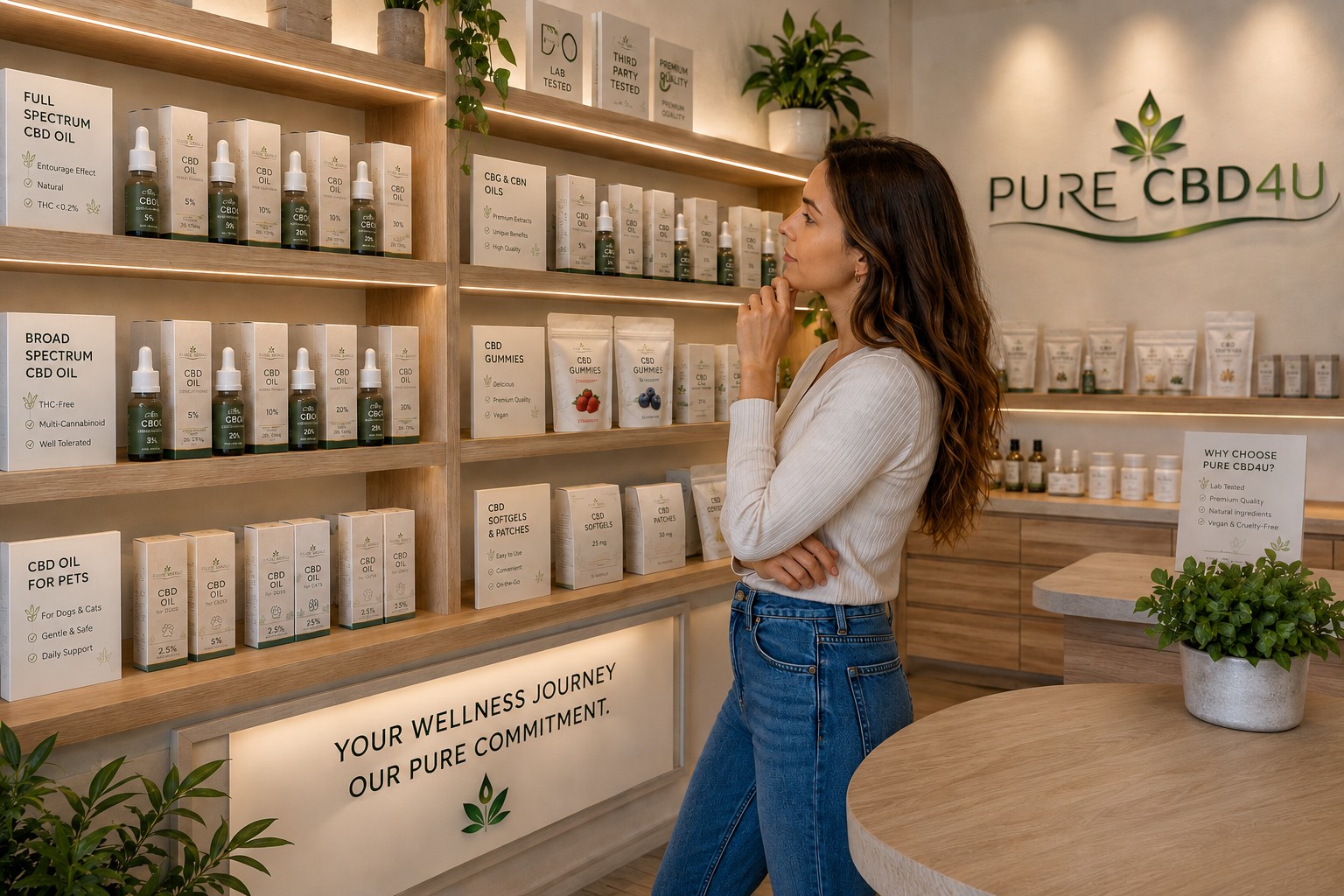
For most beginners, choosing a CBD product is actually harder than using one.
You land on a website intending to try CBD and immediately encounter Full Spectrum, Broad Spectrum, CBD Isolate, cannabinoids, terpenes, THC content, entourage effect. Before you’ve taken a single drop, you’ve already felt the pull to close the tab and come back later — which usually means not coming back.
Here’s the thing: which CBD type is best for beginners doesn’t need a complicated answer. This beginner CBD guide simplifies CBD types explained down to the two questions that actually matter: what do you want CBD to do for you, and what would make you most comfortable?
The Three CBD Types, Explained Simply
Full Spectrum CBD is the most complete version of hemp extract. It contains CBD alongside a range of other naturally occurring cannabinoids, terpenes, and a trace amount of THC — within legal limits, well below any intoxicating level. Many users and researchers believe the combination of compounds may work together more effectively than CBD alone, a concept called the entourage effect. Our what is the entourage effect guide covers that idea in more depth. Full spectrum suits beginners who are comfortable with trace THC and want the broadest hemp compound profile available.
Broad Spectrum CBD takes a very similar approach but removes the trace THC through additional processing. You still get CBD, multiple other cannabinoids, and the terpene profile — just without the THC. This makes it a natural choice for beginners who want the broader cannabinoid experience but have a preference or professional reason to avoid THC entirely. Our is broad spectrum CBD THC-free article explains what THC-free actually means in practice.
CBD Isolate is the most straightforward option: pure CBD, with everything else removed. No other cannabinoids, no terpenes, no trace THC. It’s the simplest formulation, which can feel reassuring for people who want to understand exactly what they’re taking. The trade-off is that it lacks the additional hemp compounds that make the broader spectrum products potentially more interesting.
Which Type Suits You?
The honest answer is that there’s no universally best CBD for beginners. But there is a most sensible starting point for different situations — and matching your choice to your own circumstances removes most of the confusion.
If you have drug testing concerns, professional obligations, or simply prefer to avoid THC, broad spectrum is probably your clearest starting point. You get a broader cannabinoid and terpene profile than isolate, without the THC variable. It’s the middle path that suits a significant share of first-time CBD users well.
If you’re comfortable with trace THC and want to explore what hemp naturally offers, full spectrum is a reasonable first choice. The trace THC at legal limits won’t produce any noticeable intoxicating effect, and many users describe a slightly more rounded experience from the complete hemp profile.
If you want absolute simplicity and no unknowns, CBD isolate is a legitimate choice, particularly for people who want to observe their response to CBD specifically, without any other compounds in the picture.
The full spectrum or broad spectrum for beginners question is one of the most common. For first time CBD users, broad spectrum generally serves well as a starting point — and the best CBD oil for first time users tends to be one that removes the THC variable while keeping a broad cannabinoid profile.
Why Starting Strength Matters More Than Spectrum
For a complete beginner, choosing between spectrum types is less important than one other decision: starting at an appropriate strength and dose.
Choosing CBD oil as a first-time CBD user comes down to strength and consistency as much as spectrum type. A common CBD buying guide mistake is starting with high-strength oil — assuming more means better. It doesn’t. What higher strength actually means is more CBD per drop, which is useful when you’ve established what works for you, but makes it considerably harder to start low and adjust gradually when you haven’t.
The best CBD oil for first-time users in terms of strength? For most, 5% or 10%. That’s the core CBD beginner advice that applies regardless of spectrum choice. These concentrations give you enough flexibility to begin with a small, manageable amount and increase gradually without overshooting your personal effective range. Our CBD dosage guide walks through how to translate these percentages into a practical starting amount based on your goals and body weight.
The principle: start low, stay consistent for at least a week, observe, adjust upward if needed.
Beginner Mistakes Worth Avoiding
Changing product too quickly. Many first-time users try CBD for two or three days and switch. CBD produces subtle, cumulative effects over one to two weeks — not within a single day. Our CBD oil for daily wellness guide explains why consistency matters most.
Buying from unverified sources. Not all CBD products are equal, and unfortunately the CBD market includes products that don’t contain what they claim. A Certificate of Analysis from an independent third-party laboratory is the practical baseline for knowing what’s actually in your oil. Our guide on how to choose high-quality CBD oil covers what to look for specifically.
Expecting something dramatic. Most people experience a slight easing of tension or background calm — easier to notice in retrospect than in the moment. Setting realistic expectations prevents early disappointment.
Choosing based on price alone. A very low price often means lower quality or less rigorous testing. A reasonably priced product from a brand with current lab testing beats the cheapest bottle.
A Simple Beginner Checklist
Before you buy your first CBD oil:
- ✓ Have I decided whether I need to avoid THC? (If yes, choose broad spectrum or isolate)
- ✓ Am I starting with 5% or 10% strength rather than jumping to higher concentrations?
- ✓ Does the product have a current Certificate of Analysis from an independent laboratory?
- ✓ Is the ingredients list short and transparent?
- ✓ Am I prepared to be consistent for at least two weeks before drawing conclusions?
- ✓ Do I have realistic expectations — subtle, cumulative effects rather than instant changes?
If you can tick all of these, your first CBD experience is likely to be a reasonable one.
Which CBD oil should a beginner start with?
For most beginners without drug testing concerns, a broad spectrum 10% CBD oil from a third-party tested brand is a sensible starting point. Full spectrum is perfectly reasonable if you’re comfortable with trace THC. Isolate works for those wanting maximum simplicity.
What matters most isn’t which spectrum you choose — it’s quality, appropriate starting strength, consistent time, and not judging the outcome after a single dose.
Frequently Asked Questions
Which CBD type is best for beginners?
This CBD buying guide has no single universal answer. Broad spectrum suits beginners who want multiple cannabinoids and terpenes without THC. Full spectrum suits those comfortable with trace THC and interested in the complete hemp profile. CBD isolate suits those wanting maximum simplicity. For most beginners, broad spectrum is a sensible first choice.
Is full spectrum too strong for beginners?
Not necessarily. Trace THC won’t produce intoxication. The relevant concern is CBD concentration — a 5% or 10% full spectrum oil is a reasonable start.
Should beginners avoid THC?
Not unless they have a specific reason to — drug testing, professional requirements, personal preference, or THC sensitivity. Trace THC in legal full spectrum products doesn’t produce a high. If you’re uncertain, broad spectrum removes that variable.
How much CBD should a beginner take?
Start small — a few drops of a 5% or 10% oil once daily. Our CBD dosage guide covers the process in detail.
Is CBD isolate good for beginners?
It’s a legitimate choice for people who want maximum simplicity — knowing they’re taking only CBD with nothing else. The trade-off is missing the broader cannabinoid and terpene profile that full and broad spectrum products offer.
What’s the safest way to start using CBD?
Choose a third-party tested product from a reputable brand. Start with a 5% or 10% concentration. Begin with a low daily dose. Stay consistent for at least one to two weeks. Adjust gradually. Our what is CBD oil guide is a helpful first read if you’re still building general background.
Which strength CBD oil should beginners choose?
5% or 10%. Lower strengths give more control for gradual increases. Higher strengths suit experienced users who already know what works.
Is broad spectrum better than full spectrum for first-time users?
For those with any uncertainty about THC, yes. Our full spectrum CBD vs broad spectrum CBD comparison and is full spectrum CBD better articles explore the differences for users ready to go deeper.
Written by Carmen Dos Anjos Germano, Founder of Pure CBD4U
Carmen founded Pure CBD4U after her own search for reliable, high-quality CBD oil, starting with full spectrum CBD oil 5% as part of her personal wellness routine. That experience shaped the company’s focus on transparency, quality and independent testing. Pure CBD4U works with EU-grown hemp, uses third-party laboratory testing, and makes batch results accessible through QR codes on its products. Carmen remains closely involved in product selection, quality standards and the development of the Pure CBD4U range.

Leave a Reply