
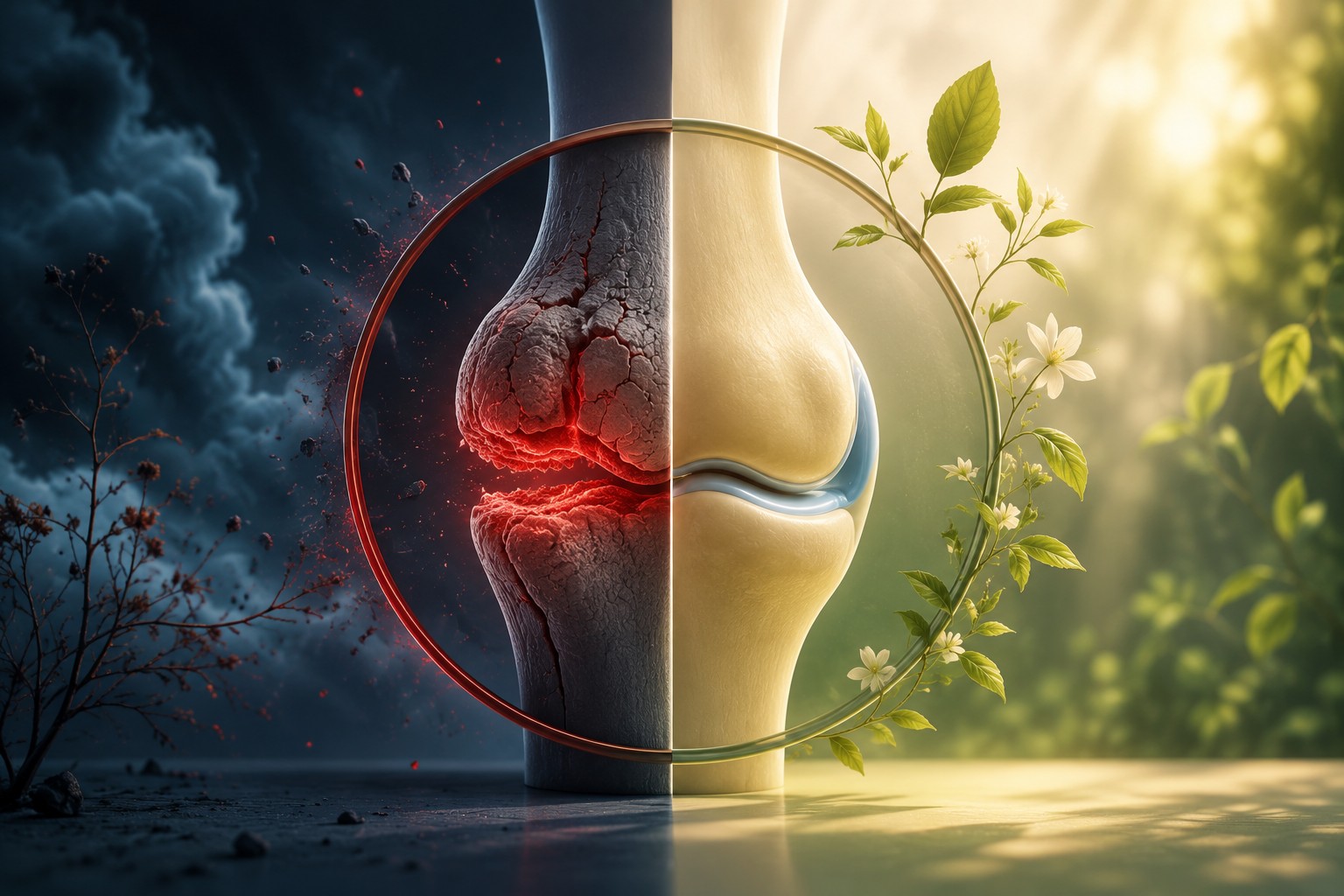
Here’s a question worth pausing on before anything else: do you actually have arthritis — or are you thinking of osteoarthritis? It’s a distinction most people have never had a reason to consider, since the two words get used almost interchangeably in everyday conversation. But they describe genuinely different conditions, with different underlying causes and different treatment approaches, and untangling that difference is where any honest, useful discussion of CBD and joint health actually needs to start.
Two Different Conditions, One Confusing Word
Arthritis is really an umbrella term, covering more than a hundred different inflammatory joint conditions rather than describing a single disease. Rheumatoid arthritis, psoriatic arthritis, and ankylosing spondylitis all fall under this umbrella, and what unites many of them is that the immune system itself is involved — in rheumatoid arthritis, for instance, the immune system mistakenly attacks the joint lining, producing inflammation, pain, and, over time, potential joint damage if left unmanaged. These are autoimmune or inflammatory conditions at their core, driven by the body’s own immune response rather than simple mechanical wear.
Osteoarthritis, despite sharing part of the name, is a genuinely different biological process — mainly related to gradual wear, ageing, and changes in cartilage over time, rather than an immune system malfunction. It’s the more common of the two, and it’s often what people picture generally when they hear the word “arthritis,” even when discussing an inflammatory, immune-driven condition entirely.
Why does this distinction actually matter here? Because confusing the two creates unrealistic expectations about what any approach, including CBD, might reasonably do. A wellness habit that might support general joint comfort in the context of ordinary wear is a very different proposition from anything intended to influence an autoimmune inflammatory process being actively managed with prescribed medication. Getting the condition right is the first step toward getting expectations right.
What Daily Life With Arthritis Often Looks Like
Beyond the clinical definitions, arthritis — particularly the inflammatory, autoimmune forms — tends to affect daily life in ways that go well beyond pain alone. Morning stiffness is one of the more universally recognized experiences, joints feeling locked or resistant for the first while after waking, sometimes for minutes, sometimes for a considerably longer stretch. Small, ordinary tasks can become genuinely difficult: opening a jar that wouldn’t have registered as an obstacle a few years earlier, buttoning a shirt with fingers that don’t cooperate the way they used to, walking downstairs with knees that need a slower, more deliberate pace, holding a coffee mug in a way that doesn’t strain an inflamed joint.
Fatigue is a significant, often underappreciated part of the picture too — inflammatory arthritis can produce a genuine, physical tiredness that has little to do with how much sleep someone got the night before, since ongoing inflammation itself is metabolically demanding on the body. And much of inflammatory arthritis follows an unpredictable rhythm of flare-ups and remission — good days where joints feel almost normal, followed by bad days that arrive with little warning. Living well with arthritis often means building a life flexible enough to accommodate that unpredictability, which is its own kind of ongoing adjustment separate from managing pain in any single moment.
Where CBD Enters the Discussion
It’s only with this fuller understanding of the condition — what it actually is, and what living with it actually involves — that CBD becomes a reasonable, well-grounded part of the conversation.
CBD’s interaction with the endocannabinoid system, which has documented involvement in pain perception and inflammatory regulation, rests on genuine, established pharmacology, and CB2 receptors specifically are present on immune cells relevant to inflammatory processes — a plausible mechanistic basis for interest in cannabinoids and inflammatory joint conditions. Laboratory research has shown CBD reducing inflammatory markers under controlled conditions, and animal studies, including some specifically modeling inflammatory arthritis, have shown reduced inflammation and pain behavior — genuinely encouraging, mechanistically grounded findings that do not automatically confirm the same effect in human patients.
Human clinical trials specifically involving people with rheumatoid arthritis or other inflammatory arthritis remain limited in number and scale. Patient surveys report that some people with arthritis use CBD and describe improved symptoms and quality of life, which is worth acknowledging honestly — but patient surveys are a meaningfully different category of evidence than a randomized controlled trial, carrying real limitations around expectation effects and lack of blinding. Topical CBD applied over affected joints has some early research interest for localized comfort, working through a different pathway than oral CBD’s broader systemic effect, though neither route currently has robust, large-scale human trial data specific to arthritis. Human evidence remains limited overall, and CBD is not an approved treatment for arthritis, rheumatoid or otherwise. Any marketing suggesting it treats or manages the underlying disease process goes beyond what current research can responsibly support.
| What’s known vs. what’s still limited Established: CB2 receptors on immune cells give a plausible mechanism for cannabinoid involvement Animal studies: encouraging reductions in inflammation in arthritis models, not yet confirmed in humans at scale Patient surveys: some report improved symptoms, though this isn’t equivalent to clinical trial evidence Not established: CBD as an approved or proven treatment for any form of arthritis |
Can CBD Replace Arthritis Medication?
No. This deserves a direct, unambiguous answer, because getting it wrong carries real consequences. Prescribed arthritis medications — particularly DMARDs (disease-modifying antirheumatic drugs) and biologic medicines used for rheumatoid and other inflammatory forms of arthritis — are specifically designed to slow or halt the underlying disease process, reducing the immune system’s attack on joint tissue and helping prevent the progressive joint damage that inflammatory arthritis can otherwise cause over time.
CBD has not been shown in any credible research to replace the disease-modifying effect of these medications. Stopping or reducing prescribed arthritis treatment without medical guidance, in favor of CBD or any other wellness product, can allow underlying joint damage to progress, potentially causing harm that may not be reversible. This is a genuinely important point, worth stating plainly rather than softening: CBD may be something some people discuss with their healthcare provider as a possible addition alongside prescribed care, but it is not a substitute for medication that’s actively managing an inflammatory disease process.
Supporting Joint Health Alongside Medical Care
Within the context of ongoing medical treatment, several evidence-based habits genuinely support joint health and overall wellbeing for people managing arthritis. Staying active, within limits appropriate to the individual and the condition’s current state, helps maintain joint mobility and muscle support, even though it may feel counterintuitive during a flare. Low-impact activities like swimming, walking, or cycling are often better tolerated than high-impact options, and even gentle, consistent movement on manageable days can help preserve range of motion over time. Physiotherapy offers tailored guidance for maintaining function and managing specific joint challenges as they arise, and can help build the kind of individualized exercise plan that generic advice can’t provide.
Maintaining a healthy weight reduces mechanical load on weight-bearing joints, which matters for both inflammatory and wear-related joint conditions alike. Balanced nutrition supports overall health and may help manage broader inflammatory load, and protecting joints during daily tasks — using larger joints for heavier tasks, adapting grips for smaller ones, using assistive tools where helpful — reduces unnecessary strain without requiring someone to avoid tasks altogether. Sleep plays a genuine role in the body’s inflammatory and recovery processes, and poor sleep has been linked to worse pain perception the following day. Stress management matters too, since stress has documented links to symptom flares in several inflammatory conditions, making practices like relaxation techniques or simply protecting downtime a genuinely relevant part of a broader management plan, not just a nice-to-have.
Some people, within this broader approach, choose to discuss CBD with their healthcare professional as one possible addition worth exploring — not as a replacement for anything already prescribed, but as a conversation worth having openly with someone who knows their full medical picture, including any other medications that might interact with it.
Back to the Original Question
Understanding the condition is very often the first real step toward managing it well — which is exactly why this article opened with a question rather than an answer. Arthritis is not one single disease, and there was never going to be one single solution that applies equally to an autoimmune condition and to gradual, wear-related joint change. Recognizing which one applies changes what a reasonable, informed approach actually looks like.
CBD may become one supportive option some people explore, ideally in open conversation with a healthcare provider, alongside prescribed medical care and the daily habits that genuinely support joint health. But informed decisions start with understanding what arthritis actually is, what it isn’t, and what current research can — and honestly cannot — tell us about where CBD might reasonably fit into that picture.
This article is intended for general educational purposes and is not medical advice. CBD is not an approved treatment for arthritis and should never replace prescribed medication without medical guidance. Anyone with arthritis or considering CBD alongside arthritis treatment should speak with a doctor or rheumatologist before making any changes to their care.
Written by Carmen Dos Anjos Germano, Founder of Pure CBD4U
Carmen founded Pure CBD4U after her own search for reliable, high-quality CBD oil, starting with full spectrum CBD oil 5% as part of her personal wellness routine. That experience shaped the company’s focus on transparency, quality and independent testing. Pure CBD4U works with EU-grown hemp, uses third-party laboratory testing, and makes batch results accessible through QR codes on its products. Carmen remains closely involved in product selection, quality standards and the development of the Pure CBD4U range.

Leave a Reply