
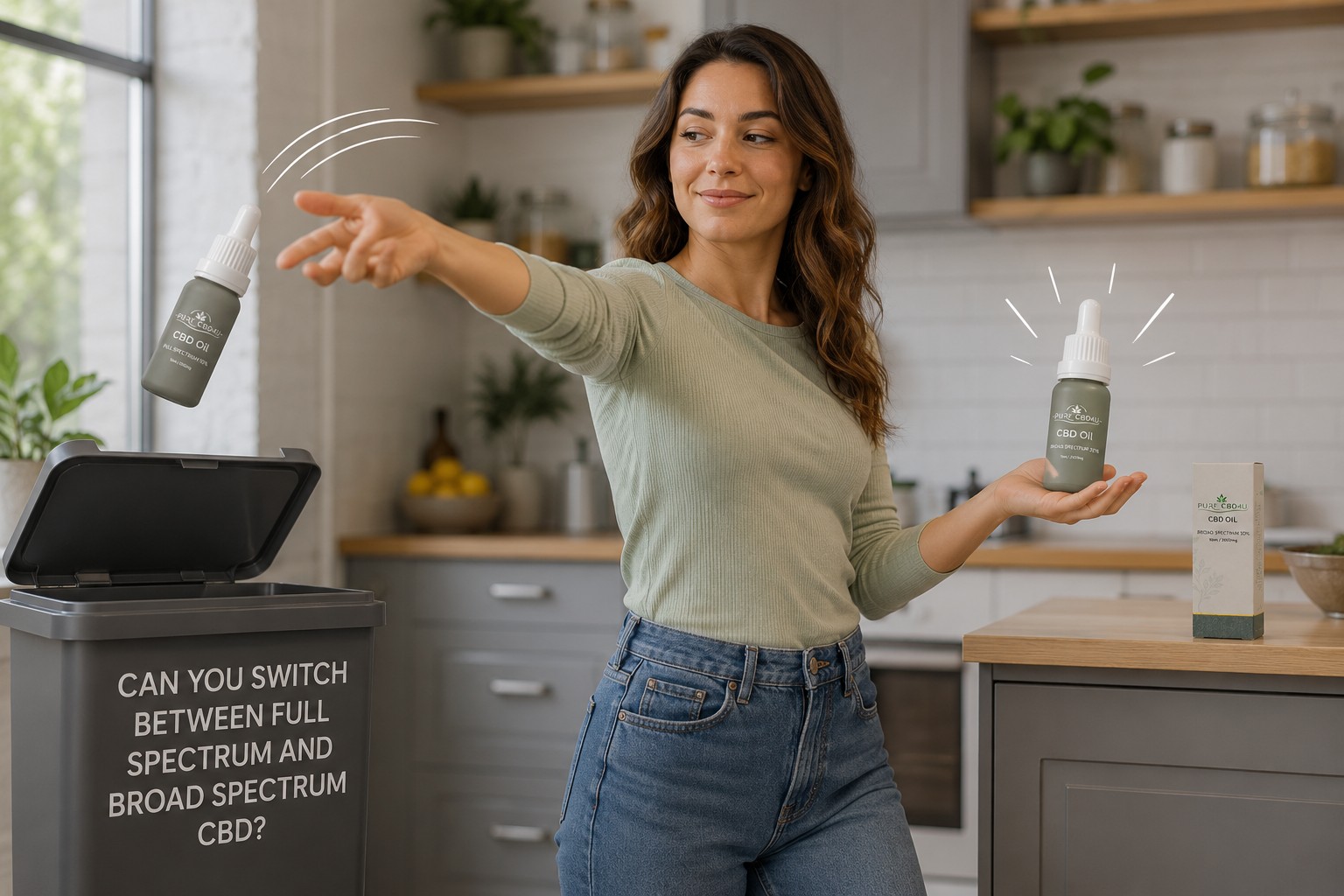
Many CBD users don’t stick to just one type of product forever. At some point — a drug test at work, a change in circumstances, or curiosity about whether a different product might suit them better — they start wondering whether switching between full spectrum and broad spectrum is possible, safe, or worth the effort.
Can you switch between full spectrum and broad spectrum CBD? Yes — it’s perfectly fine, and many people do it more than once. The more useful answer explains what actually changes when you do, what you might notice, and how to make the transition without accidentally misreading a normal adjustment period as something going wrong.
What Changes and What Stays the Same
The most important thing to understand about switching CBD products is that CBD itself doesn’t change. Cannabidiol is the same molecule whether it appears in a full spectrum, broad spectrum, or isolate product — the core compound continues working through the same endocannabinoid system pathways regardless of spectrum type.
Can I change CBD types freely? The full spectrum vs broad spectrum switching question is really about what that profile change means for you personally — here’s what shifts. Full spectrum CBD contains trace THC alongside CBD and a range of other minor cannabinoids and terpenes. Broad spectrum CBD removes that trace THC while retaining most of the rest. If you’re switching full spectrum to broad spectrum, you’re essentially removing one variable — trace THC — while keeping the broader cannabinoid and terpene environment largely intact.
If you’re going the other direction, switching broad spectrum to full spectrum, you’re adding trace THC back into the mix. For most people at typical wellness doses this is barely perceptible. For people who are particularly sensitive to THC — even at very sub-intoxicating trace levels — this addition can produce noticeable differences in how the product feels.
Why People Switch
Understanding why you’re switching matters because it shapes what a successful switch looks like for you.
Full spectrum to broad spectrum: usually driven by drug testing requirements, new professional obligations, or personal preference around THC. Some also notice broad spectrum feels slightly cleaner or more alert for daytime use.
Broad spectrum to full spectrum: often driven by curiosity about the entourage effect and whether a fuller cannabinoid profile feels different in practice.
Alternating between both is something experienced CBD users do deliberately — broad spectrum during drug testing risk periods, full spectrum otherwise. This practical cannabinoid switching approach to changing CBD products raises no safety concerns. CBD tolerance switching in this way is well within normal use patterns.
What You Might Actually Notice
Most people switching between full spectrum and broad spectrum CBD notice less than they expect. The core CBD experience — the sense of calm, the everyday wellness support, the routine — tends to carry over reasonably well.
The differences that do appear tend to be subtle. Some users describe full spectrum as feeling slightly more rounded or deeply relaxing, which is consistent with the broader cannabinoid profile and trace THC contributing to what researchers call the entourage effect. Some users describe broad spectrum as feeling slightly more clear-headed, particularly at daytime doses. Neither description applies universally — individual response is genuinely variable, and for many people no meaningful difference is perceptible at typical wellness doses.
What people sometimes mistake for a product not working is simply the CBD adjustment period — your endocannabinoid system adapting to a slightly different profile. The first week may feel subtly different before settling into a new baseline. This is normal.
How to Switch Smoothly
The most common mistake people make when switching CBD products isn’t choosing the wrong product — it’s changing too many variables at once. If you switch spectrum type, strength, format, and brand simultaneously, there’s no way to know what actually made the difference.
When you can switch between full spectrum and broad spectrum CBD smoothly, it comes down to a few practical habits:
Keep the same format. If you’ve been using sublingual CBD oil, stay with oil for the new product rather than switching to capsules or gummies at the same time.
Match the milligram amount. Use your current daily CBD total as your starting point with the new product. If you’ve been taking 20mg daily, aim for 20mg in the new product rather than guessing a new amount. The CBD dosage guide can help you work out the drops calculation if you’re switching to a different concentration.
Give it a realistic runway. Two weeks of consistent daily use is a reasonable minimum before assessing whether the new product is working differently from the old one. First impressions in the first few days of switching CBD oil are often misleading.
Watch for THC sensitivity if switching to full spectrum. If you’re moving from broad spectrum to full spectrum for the first time, some people notice trace THC sensitivity in the first few days — mild drowsiness or an unusual quality to the relaxation effect. This typically settles. If it doesn’t or it’s uncomfortable, broad spectrum is the straightforward choice.
The Dosage Question
Does switching spectrum type mean resetting your dose? Usually not. Your established effective milligram amount tends to carry over because CBD itself is the shared foundation. The experience at that dose may shift slightly — deeper relaxation with full spectrum, slightly more clarity with broad spectrum — but the starting amount that’s worked for you remains sensible.
One real exception: switching to an unverified product can change your effective dose even if the label matches. Our guide on how to choose high-quality CBD oil covers what to check.
A Note on Product Quality
Any time you switch, quality verification matters. A Certificate of Analysis from an independent laboratory confirms the product contains what it claims. More on both the THC-free side and the quality picture is in our is broad spectrum CBD THC-free and is full spectrum CBD better articles.
Frequently Asked Questions
Can you switch between full spectrum and broad spectrum CBD?
Yes, safely. Both products share CBD as the primary active compound. Switching changes the surrounding cannabinoid profile — notably adding or removing trace THC — but there are no safety concerns with making the change. What you might notice is a subtle difference in how the product feels during an adjustment period.
What happens when you switch CBD products?
The core CBD molecule stays consistent. What changes is the cannabinoid and terpene profile — particularly trace THC when moving between full and broad spectrum. Most people notice little difference. Some notice subtle changes in relaxation quality that settle after one to two weeks.
Do I need to reset my CBD dose when switching?
Not significantly. Your established effective milligram amount is generally a sensible starting point with a new product. Minor adjustments may follow from your observation of how the new product feels, but a complete dose reset from scratch is rarely necessary when switching between comparable products.
How long does it take to adjust to a new CBD product?
Allow one to two weeks before drawing conclusions. The CBD adjustment period when switching oil or changing products can make the first few days feel misleading — slight differences in how the product feels early on often smooth out as your endocannabinoid system adapts.
Can switching CBD cause side effects?
Switching itself is not associated with safety concerns. What some people notice when switching full spectrum to broad spectrum is a very slight change in relaxation quality. When switching broad spectrum to full spectrum, some people with THC sensitivity notice subtle trace THC effects in the first few days. Both typically settle within a week or two. Our CBD side effects guide covers what people commonly notice with CBD products generally. The short answer to can you switch between full spectrum and broad spectrum CBD safely: yes, always.
Is it safe to alternate between full spectrum and broad spectrum?
Yes. Many experienced CBD users deliberately alternate — using broad spectrum during periods of drug testing risk and full spectrum otherwise. There are no documented safety concerns with this approach.
Will the entourage effect be different when I switch?
Possibly slightly. Full spectrum’s trace THC contributes to a complete cannabinoid profile. Broad spectrum retains most cannabinoids and terpenes but without THC, so the entourage effect may be somewhat different. Most users switching between the two notice less difference than they expect. Our what is the entourage effect and full spectrum vs broad spectrum CBD articles explore this in more depth.
What’s the best way to compare full spectrum and broad spectrum for my own response?
Switch one variable at a time — same format, same dose, same daily timing — and give two weeks minimum before comparing. Tracking your experience in a simple log or CBD app makes the comparison considerably more informative than relying on memory.
Related reading: Is Full Spectrum CBD Better?
Written by Carmen Dos Anjos Germano, Founder of Pure CBD4U
Carmen founded Pure CBD4U after her own search for reliable, high-quality CBD oil, starting with full spectrum CBD oil 5% as part of her personal wellness routine. That experience shaped the company’s focus on transparency, quality and independent testing. Pure CBD4U works with EU-grown hemp, uses third-party laboratory testing, and makes batch results accessible through QR codes on its products. Carmen remains closely involved in product selection, quality standards and the development of the Pure CBD4U range.

Leave a Reply