
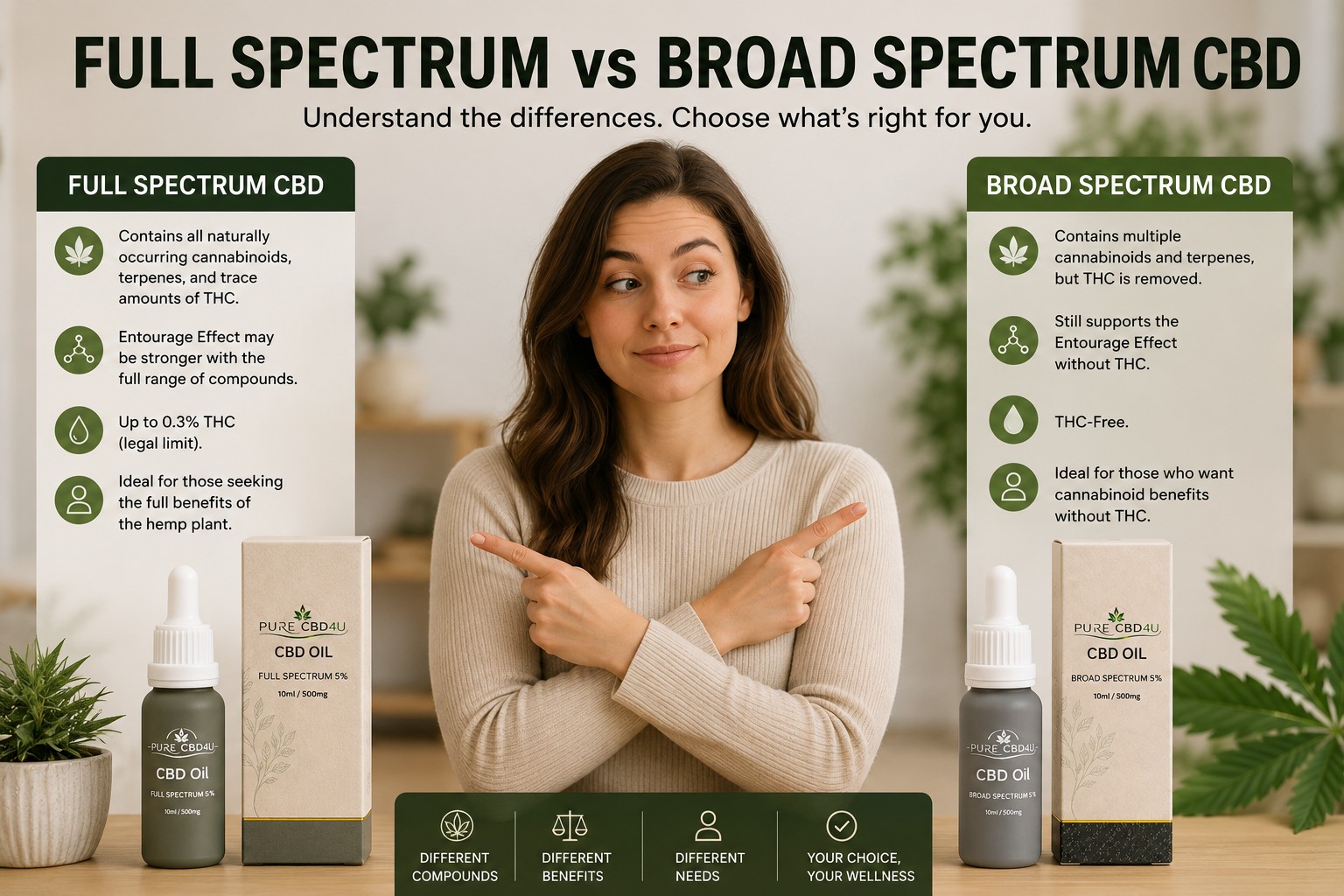
The difference between Full Spectrum and Broad Spectrum CBD comes down to one compound: THC. Full Spectrum CBD keeps the trace amount naturally found in hemp, along with the plant’s full range of cannabinoids and terpenes, while Broad Spectrum keeps that same broad cannabinoid and terpene profile but has THC removed. Neither one will get you noticeably high; the small amount in Full Spectrum CBD sits at a legal trace level, far below what’s needed for intoxication. Whether one is “better” than the other depends entirely on what you’re trying to accomplish, not on some absolute hierarchy, which is exactly why this guide exists rather than a one-line answer.
This guide is written for anyone trying to make sense of CBD oil, CBD gummies, or CBD capsules labeled “Full Spectrum” or “Broad Spectrum” and wondering which one actually fits their life. If you’re worried about drug testing, you’ll want to know which option carries more risk. If you’re chasing the synergy cannabinoids and terpenes are said to produce together, you’ll want to understand what that actually means rather than taking a label’s word for it. If you’re brand new to CBD products entirely, you’ll want a sensible starting point rather than analysis paralysis in a supplement aisle. By the end, you’ll understand exactly what separates Full Spectrum from Broad Spectrum, how each interacts with workplace screenings, which one tends to suit specific goals like anxiety, sleep, or pain, and how to judge whether any specific product is actually trustworthy regardless of which type you choose.
What Is CBD?
CBD, short for cannabidiol, is one of more than a hundred naturally occurring cannabinoids found in the cannabis plant. Unlike THC, CBD does not produce intoxication, which is the foundational fact that makes the rest of this comparison possible: both Full Spectrum and Broad Spectrum CBD are built around a non-intoxicating compound, with THC entering the conversation only as a trace, secondary ingredient in one of the two.
CBD is typically extracted from hemp, a cannabis variety legally defined by very low THC content, and sold as an oil, gummy, capsule, or topical. Current research describes CBD as generally well tolerated in healthy adults, though it isn’t risk-free, and a dedicated CBD side effects guide covers that ground in more depth than this comparison-focused article needs to.
How CBD Works
CBD interacts with the endocannabinoid system, a network of receptors throughout the brain, nervous system, and immune cells involved in regulating mood, pain, sleep, and stress response. This single system is the shared foundation behind every CBD product discussed in this guide, regardless of spectrum type.
What differs between Full Spectrum, Broad Spectrum, and isolate isn’t how CBD itself works, but which additional compounds ride alongside it and potentially influence that same system. That distinction, more than anything else, is what this entire guide is actually about.
Understanding Cannabinoids
Cannabinoids are the broad family of compounds found in the cannabis plant, of which CBD and THC are simply the two most famous members. Beyond those two, hemp naturally contains dozens of additional minor compounds, including CBG, CBN, and CBC, each interacting with the body somewhat differently and present in only small amounts compared with the dominant compound itself.
How many of these additional cannabinoids end up in your final product, and in what concentration, is precisely what separates Full Spectrum CBD from Broad Spectrum CBD from isolate. Full Spectrum keeps essentially all of them, Broad Spectrum keeps most while removing THC specifically, and isolate strips everything down to CBD alone.
Understanding Terpenes
Terpenes are the aromatic compounds responsible for cannabis’s distinctive scent, and they’re also found throughout the plant kingdom in everything from citrus fruit to lavender. In cannabis specifically, terpenes are believed to interact with cannabinoids in ways that may influence the overall effect of a product, a concept we’ll return to shortly.
Like cannabinoids, terpene content varies by spectrum type. Full Spectrum and Broad Spectrum both generally retain a meaningful terpene profile from the original hemp plant, while isolate, by definition, does not, since the purification process that creates it removes terpenes along with every cannabinoid except CBD.
What Is Full Spectrum CBD?
Quick Answer
Full Spectrum CBD contains the complete range of cannabinoids and terpenes naturally found in hemp, including a legal trace amount of THC, generally under 0.3% by dry weight. It’s considered the most “whole plant” form available, built around the idea that keeping everything together produces a more complete effect than CBD alone.
Detailed Explanation
Full Spectrum CBD starts with a hemp extract that hasn’t had any cannabinoids deliberately removed, beyond what’s required to stay under the legal THC threshold. That means alongside CBD, a Full Spectrum CBD oil typically contains small amounts of CBG, CBN, CBC, and other minor compounds, plus the original terpene profile from the hemp plant, all carried in a base like MCT oil for sublingual use. The THC content, while real, sits far below the level associated with any psychoactive effect; it’s there because removing it entirely would, by definition, make the product Broad Spectrum or isolate instead.
Premium hemp extract matters more for Full Spectrum products than for any other type, since you’re relying on the entire plant’s natural compound profile rather than a single isolated molecule. CO2 extraction has become the preferred method for producing high-quality Full Spectrum CBD, since it preserves a wider range of delicate plant compounds compared with older, harsher solvent-based extraction methods.
Key Takeaways
- Full Spectrum CBD retains all naturally occurring cannabinoids and terpenes, including trace THC.
- THC content is legally capped, generally under 0.3%, and far below an intoxicating level.
- Quality depends heavily on hemp sourcing and extraction method, especially CO2 extraction.
- It’s considered the most complete, “whole plant” form on the market.
What Is Broad Spectrum CBD?
Quick Answer
Broad Spectrum CBD keeps most of the same cannabinoid and terpene profile as Full Spectrum CBD, but THC has been removed through additional processing, ideally down to non-detectable levels. It’s often described as a middle ground between Full Spectrum and isolate.
Detailed Explanation
It’s typically made by starting with a Full Spectrum extract and then specifically targeting it for removal, while leaving the rest of the cannabinoid and terpene profile largely intact. The goal is to preserve as much of that synergy as possible while eliminating the one compound most likely to concern someone worried about workplace screening, employer policy, or simple personal preference around THC.
It’s worth being precise here, since marketing language sometimes blurs this point: “Broad Spectrum” describes an intention, not a guarantee. Some products labeled Broad Spectrum still contain a trace, technically detectable amount, even if lower than what’s found in Full Spectrum. A genuine Certificate of Analysis, the lab report covered in detail later in this guide, is the only reliable way to confirm whether a specific Broad Spectrum product is actually THC-free or simply lower in THC than its Full Spectrum counterpart.
Key Takeaways
- Broad Spectrum keeps most cannabinoids and terpenes while removing THC.
- It’s made by further processing a Full Spectrum extract specifically to eliminate THC.
- Not every “Broad Spectrum” product is guaranteed to be completely THC-free.
- A COA is the only reliable way to confirm actual THC content.
What Is CBD Isolate?
Quick Answer
CBD Isolate is cannabidiol in its purest form, typically over 99% pure CBD with every other cannabinoid, terpene, and trace of THC removed entirely. It’s the simplest, most stripped-down CBD product available.
Detailed Explanation
CBD Isolate goes a step further than Broad Spectrum CBD, removing not just THC but essentially every other cannabinoid and terpene as well, leaving a crystalline or powder form of CBD alone. This makes isolate the most precisely dosed option, since there’s nothing else to account for beyond the CBD itself, and it’s the most reliably THC-free choice for anyone who needs absolute certainty for drug testing reasons.
The tradeoff is the complete absence of that synergy, since isolate offers no additional cannabinoids or terpenes for CBD to interact with. Some users report that isolate feels less effective than Full Spectrum or Broad Spectrum at an equivalent dose, though this remains more anecdotal than firmly established in published research, and individual response varies considerably.
Key Takeaways
- CBD Isolate is over 99% pure CBD, with everything else removed.
- It offers the most precise dosing and the most reliable THC-free guarantee.
- It cannot produce an entourage effect, since no other compounds remain.
- Some users report a less pronounced effect compared with fuller-spectrum products.
Quick Comparison: Full Spectrum vs Broad Spectrum CBD
Before going deeper, here’s a side-by-side look at how Full Spectrum and Broad Spectrum CBD actually compare across the factors that matter most.
| Feature | Full Spectrum | Broad Spectrum |
| THC | Trace amount, under 0.3% | None to non-detectable |
| Cannabinoids | Full range (CBD, CBG, CBN, CBC, etc.) | Most of the same range, minus THC |
| Terpenes | Full natural profile | Largely retained |
| Entourage Effect | Strongest | Present, slightly reduced without THC |
| Drug Test Risk | Low but non-zero | Very low |
| Best For | Maximum natural compound profile | THC-free entourage effect |
| Price | Comparable | Comparable, sometimes slightly higher |
| Daily Use | Well suited | Well suited |
Key Takeaways
- The core difference is THC: present in trace amounts in Full Spectrum, removed in Broad Spectrum.
- Both retain most cannabinoids and terpenes, supporting a similar entourage effect.
- Broad Spectrum carries lower screening risk; Full Spectrum carries a small but real risk.
- Price and suitability for daily use are similar across both types.
The Entourage Effect Explained
Quick Answer
The entourage effect is the theory that cannabinoids and terpenes work synergistically, producing a combined effect greater than any single compound acting alone. It’s the central scientific concept behind why Full Spectrum and Broad Spectrum CBD exist as distinct categories from isolate.
Detailed Explanation
The idea behind the entourage effect is that CBD doesn’t act in isolation inside the body; it interacts with other cannabinoids like CBG and CBN, and with the plant’s terpenes, in ways that may enhance, moderate, or otherwise shape the overall effect compared with CBD acting completely alone. Clinical evidence indicates this is a genuinely plausible biological mechanism, supported by laboratory and animal research, though published literature on the entourage effect in humans remains considerably thinner than the confidence with which it’s often marketed.
This matters directly for the Full Spectrum versus Broad Spectrum decision. Full Spectrum CBD, by retaining THC alongside everything else, is generally considered to produce the strongest version of that synergy, since THC itself is believed to contribute alongside CBD, CBG, and the rest. Broad Spectrum still offers a meaningful version of it from its remaining cannabinoids and terpenes, just without THC’s specific contribution. CBD Isolate, lacking any additional compounds entirely, offers none of it at all. None of this should be read as a guarantee of a specific outcome; available evidence suggests a real effect exists, not that it’s been precisely quantified for any individual product or dose.
Key Takeaways
- The entourage effect describes cannabinoids and terpenes working together synergistically.
- Full Spectrum CBD is believed to offer the strongest entourage effect, due to THC’s contribution.
- Broad Spectrum still offers a meaningful, slightly reduced version of that effect.
- Human evidence for the entourage effect remains less extensive than animal and lab research.
How Cannabinoids Work Together
Beyond that broad theory, specific minor cannabinoids each appear to bring something slightly different to the table. CBG, sometimes called the “mother cannabinoid” since other cannabinoids derive from it during the plant’s growth, has drawn early research interest in its own right. CBN, often associated with sedation, shows up in both Full Spectrum and Broad Spectrum products in small amounts, typically more concentrated in older hemp plants.
None of these minor cannabinoids are present in large enough amounts in a standard bottle of CBD oil to function like a dedicated CBG oil or CBN oil product would; they’re present as supporting compounds rather than the main event. Their cumulative presence, alongside terpenes, is the practical mechanism behind that synergy rather than any single minor cannabinoid doing the heavy lifting alone.
Cannabinoids in Full Spectrum CBD
A typical Full Spectrum CBD oil contains CBD as the dominant cannabinoid, alongside smaller amounts of CBG, CBN, CBC, and trace THC, plus a range of terpenes carried over from the original hemp extract. The exact ratio varies by hemp strain, growing conditions, and extraction method, which is part of why two Full Spectrum products from different brands can feel subtly different even at the same CBD dose.
This natural variability is precisely why a COA matters so much for Full Spectrum products specifically: it’s the only way to know the actual cannabinoid breakdown of the bottle in front of you, rather than assuming every “Full Spectrum” label represents an identical compound profile.
Cannabinoids in Broad Spectrum CBD
The following picks up where the previous section left off, this time looking specifically at Broad Spectrum.
Broad Spectrum retains essentially the same minor cannabinoid lineup as Full Spectrum, CBG, CBN, CBC, and others, minus the THC that’s been specifically targeted for removal during processing. The terpene profile is generally preserved as well, since terpenes aren’t the target of that additional processing step.
The practical result is a cannabinoid profile that looks similar to Full Spectrum CBD on a lab report, with one clear difference in the THC column. This is exactly why Broad Spectrum is often described as capturing “most” of that synergy rather than “none” of it, unlike isolate.
Does Full Spectrum Contain THC?
Quick Answer
Yes. Full Spectrum CBD contains a legal trace amount of THC, generally under 0.3% by dry weight in the US, or under 0.2% in parts of the EU. This amount is far too low to cause intoxication for the vast majority of users.
Detailed Explanation
That trace THC is not an accident or a contamination issue; it’s an intentional, defining feature of what makes a product “Full Spectrum” rather than “Broad Spectrum” in the first place. Removing it entirely would, by definition, turn the product into something else. The legal threshold exists specifically to distinguish hemp-derived CBD products, which are widely legal, from marijuana-derived products, which carry meaningfully higher THC content and different legal status depending on where you live.
For most users, this trace THC has no noticeable psychoactive effect whatsoever. It can, however, accumulate with frequent, heavy use to a level that’s detectable on a sensitive drug test, which is the practical consideration that matters far more than any theoretical intoxication risk for the vast majority of Full Spectrum CBD users.
Key Takeaways
- Full Spectrum CBD legally contains trace THC, generally under 0.3% in the US.
- This THC content is intentional, not contamination, and defines the category.
- It’s far too low to cause intoxication for nearly all users.
- Frequent, heavy use could still contribute to a positive result on a sensitive screening.
Does Broad Spectrum Contain THC?
Quick Answer
Generally no. Broad Spectrum CBD is processed specifically to remove THC, ideally down to non-detectable levels. However, “Broad Spectrum” is not a strictly regulated term, and some products may still contain a trace, technically detectable amount.
Detailed Explanation
The entire point of Broad Spectrum is THC removal, but how thoroughly that removal happens varies by manufacturer and extraction quality. A genuinely well-made Broad Spectrum product should test at zero or non-detectable THC on an independent lab report. A poorly made one might still contain a small residual amount, simply less than its Full Spectrum counterpart from the same hemp source.
This is the single most important reason to never take a “Broad Spectrum” or “THC-Free” label purely at face value. Checking the actual lab-verified THC content for the specific batch you’re buying, not just the marketing claim on the front of the bottle, is the only way to know for certain what you’re actually getting.
Key Takeaways
- Broad Spectrum is processed to remove THC, ideally to non-detectable levels.
- “Broad Spectrum” isn’t strictly regulated, so actual THC content can vary by brand.
- A genuine lab report is the only reliable way to confirm THC-free status.
- Quality control during extraction directly determines how thoroughly THC is removed.
Can Full Spectrum CBD Make You High?
Quick Answer
No, not in any meaningful sense for the vast majority of users. The trace THC in Full Spectrum CBD sits far below the concentration needed to produce intoxication, and Full Spectrum CBD oil is not formulated or intended to get anyone high.
Detailed Explanation
Intoxication from THC depends heavily on dose, and the amount present in a properly formulated Full Spectrum CBD product, generally under 0.3%, is a small fraction of what’s found in products specifically intended to produce a high. Someone would need to consume an impractically large amount of Full Spectrum CBD oil, far beyond any reasonable dose, to approach anything resembling a noticeable psychoactive effect, and even then, individual sensitivity and product accuracy would play a significant role.
This doesn’t mean every Full Spectrum product is automatically safe in this regard; inaccurately labeled products with higher-than-stated THC content do exist, which circles back once again to the importance of third-party testing. For someone who has never used cannabis products before and is particularly sensitive to any THC at all, even a non-intoxicating trace amount might be worth discussing with a healthcare professional before starting, though this remains an unusual precaution rather than a typical concern.
Key Takeaways
- Full Spectrum CBD is not intended or formulated to produce intoxication.
- Trace THC levels are far too low to cause a high in typical use.
- Inaccurate labeling, not the spectrum type itself, is the main practical risk.
- Extremely THC-sensitive individuals may still want to discuss this with a doctor.
Drug Tests Explained
Quick Answer
Most standard screenings specifically detect THC metabolites, not CBD itself, which means Broad Spectrum and isolate carry very low risk, while Full Spectrum CBD carries a small but real risk with frequent, heavy use.
Detailed Explanation
Workplace screenings are generally designed to identify THC-COOH, a metabolite produced when the body processes that compound, rather than testing for cannabidiol directly. This is exactly why CBD itself is not the concern in this context; the trace amount riding alongside it in Full Spectrum products is. Can Broad Spectrum fail a drug test? In theory, if a specific product contains more residual THC than its label claims, due to poor manufacturing or testing, yes, which is precisely why verifying actual lab results matters more than trusting a “Broad Spectrum” or “THC-Free” claim alone.
Frequency and dose both matter considerably here. An occasional, modest dose of Full Spectrum CBD is unlikely to produce a positive screening result for most people, while daily, higher-dose use over an extended period raises that risk meaningfully, since trace amounts can accumulate in the body over time. Anyone facing regular workplace screening, including many athletes and people in safety-sensitive professions, should generally default to Broad Spectrum CBD or isolate rather than Full Spectrum, simply to remove this variable from the equation entirely rather than managing it.
Key Takeaways
- Standard screenings detect THC metabolites, not CBD itself.
- Full Spectrum CBD carries real, if generally low, screening risk with frequent use.
- Broad Spectrum and isolate carry very low to negligible drug test risk.
- A verified lab report is essential for anyone managing this risk seriously.
Who Should Choose Full Spectrum CBD?
Quick Answer
Full Spectrum CBD suits people who want the most complete natural compound profile and the strongest potential synergy between compounds, and who aren’t concerned about trace THC for personal, legal, or workplace reasons.
Detailed Explanation
Imagine you use CBD daily for general wellness, you’re not subject to any workplace screening, and you’ve read enough about this compound synergy to want the fullest version of it available. Full Spectrum CBD is built specifically for that scenario. You’re prioritizing the complete hemp plant profile over any concern about trace THC, and you’re comfortable knowing that a properly tested product keeps that THC content low enough to avoid any practical downside beyond the small, manageable screening consideration already covered.
Full Spectrum also tends to appeal to people who’ve tried CBD Isolate or Broad Spectrum and felt like something was missing, preferring the fuller, sometimes described as more “rounded,” experience that comes with the complete cannabinoid and terpene profile working together.
Key Takeaways
- Full Spectrum CBD suits users prioritizing the most complete compound profile.
- It’s a strong fit for daily wellness use without drug testing concerns.
- Many users choose it after finding isolate or Broad Spectrum less satisfying.
- It requires comfort with trace THC, even at a legally non-intoxicating level.
Who Should Choose Broad Spectrum CBD?
Quick Answer
Broad Spectrum CBD suits people who want most of that compound synergy and a fuller cannabinoid profile, but who specifically want to avoid THC, whether for workplace screening, employer policy, or personal preference.
Detailed Explanation
Imagine you’re an athlete worried about workplace screening, but you’ve also read about this compound synergy and don’t want to give up on it entirely by switching to plain CBD Isolate. Broad Spectrum is built specifically for that exact situation: a meaningful step up from isolate in terms of compound complexity, without the THC that makes Full Spectrum a less comfortable choice when a drug test is a real, practical concern.
Broad Spectrum also appeals to people who simply don’t want THC in their system as a matter of personal preference, separate from any testing concern, perhaps because they’re sensitive to cannabis products generally or simply prefer to avoid the compound regardless of how small the trace amount might be in a Full Spectrum alternative.
Key Takeaways
- It suits users who want a THC-free version of that synergy.
- It’s the practical choice for athletes and anyone facing regular workplace screening.
- It also fits personal preference for avoiding THC entirely, independent of testing.
- It offers more compound complexity than isolate without Full Spectrum’s THC content.
Full Spectrum vs Broad Spectrum CBD for Anxiety
Quick Answer
Both Full Spectrum and Broad Spectrum are used for anxiety, and current evidence doesn’t clearly establish one as superior. Many users prefer Full Spectrum for anxiety specifically, citing that added synergy, while Broad Spectrum remains a strong, THC-free alternative.
Detailed Explanation
Clinical evidence indicates CBD itself has reasonably strong human research behind it for anxiety, more so than for several other commonly cited uses. Whether the addition of trace THC in Full Spectrum meaningfully improves on that effect compared with Broad Spectrum remains more anecdotal than firmly established, since most rigorous anxiety research has used purified CBD rather than comparing spectrum types head-to-head. A CBD oil for anxiety guide can walk through the broader evidence in more depth than this comparison allows.
In practice, many users report that Full Spectrum feels somewhat more calming for anxiety specifically, which may relate to THC’s own, separate effect on the body at sub-intoxicating doses, layered alongside CBD’s. Broad Spectrum remains a perfectly reasonable choice for anxiety, particularly for anyone who’d rather avoid it entirely while still benefiting from a fuller cannabinoid profile than isolate offers.
Key Takeaways
- Both spectrum types are commonly used for anxiety, without one clearly outperforming the other in research.
- Some users report Full Spectrum feels more calming, possibly due to trace THC.
- Broad Spectrum remains a strong, evidence-supported, THC-free alternative for anxiety.
- Individual response varies considerably regardless of spectrum type chosen.
Full Spectrum vs Broad Spectrum CBD for Stress
Quick Answer
For everyday stress management, Broad Spectrum and Full Spectrum CBD perform similarly for most users, and the choice often comes down to THC preference rather than any meaningful difference in stress-relieving effect.
Detailed Explanation
Stress and anxiety overlap considerably in both research and everyday experience, and the same general pattern applies here: CBD’s interaction with the endocannabinoid system and certain serotonin receptors appears to support a calmer baseline regardless of spectrum type. A CBD oil for stress guide covers this mechanism in more depth, but the spectrum-specific takeaway is straightforward.
For daily, routine stress management, many users gravitate toward whichever option fits their broader lifestyle considerations, workplace screening, personal THC preference, or simply which product they’ve already found reliable, rather than choosing based on stress relief alone, since the difference between the two for this specific use tends to be modest at most.
Key Takeaways
- Full Spectrum and Broad Spectrum CBD perform similarly for everyday stress management.
- The choice often hinges on THC preference rather than differing effectiveness.
- Both interact with the same underlying stress-response pathways in the body.
- Lifestyle factors like workplace screening frequently decide the choice more than effect alone.
Full Spectrum vs Broad Spectrum CBD for Sleep
Quick Answer
Full Spectrum CBD is often preferred for sleep specifically, since trace THC and CBN, both more present in Full Spectrum extracts, are associated with mild sedating effects. Broad Spectrum CBD remains a solid, THC-free alternative for sleep support.
Detailed Explanation
Imagine you want better sleep but also drive to work every morning, which is a genuinely common, practical tension worth addressing directly. Full Spectrum CBD taken in the evening may offer a slightly more sedating effect for some users, partly attributed to trace THC and CBN working alongside CBD, but this same quality makes it less suitable for daytime use if next-day grogginess is a concern. A CBD oil for sleep guide covers timing and dosing considerations in more detail.
Broad Spectrum, while generally considered marginally less sedating without THC’s contribution, still retains CBN and other minor cannabinoids associated with sleep support, making it a reasonable choice for anyone who wants sleep-focused benefits without introducing any THC into their evening routine, particularly relevant for the early-morning driving scenario above.
Key Takeaways
- Full Spectrum CBD is often preferred for sleep due to trace THC and CBN content.
- This same quality can mean more next-day grogginess for some users.
- Broad Spectrum CBD still supports sleep through CBN and other retained cannabinoids.
- Anyone driving soon after waking should weigh this tradeoff carefully.
Full Spectrum vs Broad Spectrum CBD for Pain
Quick Answer
Full Spectrum CBD is generally favored for pain, since THC itself has documented pain-relieving properties that may combine with CBD’s own effects. Broad Spectrum CBD remains a reasonable, THC-free option for pain when that combination isn’t desired or appropriate.
Detailed Explanation
Published literature suggests cannabinoids, including both CBD and THC, may help with certain types of pain through interaction with the endocannabinoid system and the body’s inflammatory response. Because THC has its own independent research support for pain specifically, Full Spectrum CBD’s inclusion of trace THC is often considered an advantage for this particular use case, more so than for anxiety or general wellness. A CBD oil for pain guide explores this mechanism and the current evidence base in greater depth.
That said, Broad Spectrum still offers meaningful pain-related benefit through its retained cannabinoid and terpene profile, and remains the more appropriate choice for anyone managing pain while also needing to avoid THC for drug testing or personal reasons. Neither option should replace established pain management approaches discussed with a healthcare professional, particularly for chronic or severe pain.
Key Takeaways
- Full Spectrum CBD is often favored for pain due to THC’s own documented pain-relieving properties.
- Broad Spectrum CBD still offers pain-related benefit without introducing THC.
- This is one of the clearer cases where Full Spectrum may have a genuine edge.
- Neither should replace medical pain management for chronic or severe conditions.
Which Is Better for Beginners?
Quick Answer
Broad Spectrum CBD is often the more comfortable starting point for beginners, since it avoids any THC-related questions entirely while still offering a fuller compound profile than isolate. Full Spectrum CBD is equally suitable for beginners who aren’t concerned about trace THC.
Detailed Explanation
Imagine you’re a beginner purchasing CBD for the first time, unsure about dosing, unfamiliar with spectrum types, and possibly a little anxious about the whole THC question generally. Broad Spectrum removes one entire variable from that already-confusing first purchase, letting you focus on dose and product quality without needing to think about it at all. A CBD for beginners guide and a proper CBD dosage guide can help with the rest of that learning curve.
This isn’t a strict rule; plenty of beginners start with Full Spectrum CBD without any issue, particularly if they’ve already decided trace THC isn’t a concern for them personally. But for anyone who wants to eliminate decision fatigue on their very first purchase, Broad Spectrum offers one less thing to research before simply getting started.
Key Takeaways
- Broad Spectrum CBD removes THC as a variable for first-time buyers.
- Full Spectrum is equally appropriate for beginners unconcerned about trace THC.
- Starting with either is reasonable; the choice mainly simplifies decision-making.
- Dosage guidance matters more for a good first experience than spectrum choice alone.
Which Is Better for Athletes?
Quick Answer
Broad Spectrum CBD is generally the better choice for athletes, primarily due to screening considerations under organizations that prohibit THC even at trace levels. Full Spectrum CBD carries a small but real risk that most competitive athletes shouldn’t accept unnecessarily.
Detailed Explanation
Imagine you’re an athlete worried about workplace screening, training under a governing body with strict THC thresholds; this isn’t a hypothetical at all for many competitive and even recreational athletes subject to workplace or league testing policies. Broad Spectrum, verified through a genuine lab report confirming non-detectable THC, removes essentially all practical risk from this specific scenario, while still offering the recovery and pain-related benefits many athletes are actually seeking from CBD in the first place.
Full Spectrum CBD isn’t automatically disqualifying, but the math doesn’t favor it here: the potential upside, a marginally stronger compound synergy, is small compared with the downside of a failed drug test that could affect a career, a competition, or a job. For this specific population, the conservative choice is also the practical one.
Key Takeaways
- Broad Spectrum CBD is generally the safer, more practical choice for athletes.
- Screening risk, however small, outweighs marginal entourage effect gains for most athletes.
- A verified lab report showing non-detectable THC is essential here.
- Athletes still benefit from CBD’s recovery and pain-related properties either way.
Which Is Better for Everyday Wellness?
Quick Answer
For general daily wellness without specific screening concerns, Full Spectrum and Broad Spectrum CBD perform comparably, and the choice mostly comes down to personal preference around THC.
Detailed Explanation
Imagine you use CBD daily for general wellness: a steadier mood, easier relaxation, support for an active lifestyle, without one dominant symptom you’re targeting. This is the scenario where the Full Spectrum versus Broad Spectrum decision matters least in practical terms, since both offer a broad cannabinoid and terpene profile well suited to general, ongoing use.
In this context, the decision often comes down to factors outside pure effectiveness: price, availability, personal comfort with trace THC, or simply which product a trusted brand happens to offer in the strength and format you prefer. Neither choice represents a meaningfully worse option for this kind of general, lower-stakes daily use.
Key Takeaways
- Full Spectrum and Broad Spectrum perform comparably for general daily wellness.
- The decision often comes down to personal preference rather than effectiveness.
- Price, format, and brand trust matter as much as spectrum type for this use case.
- Neither option is a meaningfully worse choice for everyday, low-stakes use.
Here’s how the two compare across benefits, pros, cons, and ideal users:
| Full Spectrum CBD | Broad Spectrum CBD | |
| Key Benefit | Strongest entourage effect | THC-free entourage effect |
| Pros | Most complete compound profile; may edge out for pain and sleep | No meaningful drug test risk; still fuller than isolate |
| Cons | Small but real drug test risk with frequent use | Slightly less pronounced entourage effect than Full Spectrum |
| Ideal User | Daily wellness users unconcerned about trace THC | Athletes, beginners, and anyone prioritizing a THC-free routine |
CBD Extraction Methods
CO2 extraction has become the preferred method for producing both Full Spectrum and Broad Spectrum oils, and for CBD products generally, since it preserves a wider, cleaner range of cannabinoids and terpenes compared with older solvent-based methods, without leaving harmful residue behind. This matters for both spectrum types, but arguably more for Full Spectrum and Broad Spectrum specifically, since the entire value proposition depends on preserving as much of the plant’s natural compound profile as possible.
Lower-quality extraction methods can degrade delicate plant compounds, produce inconsistent ratios, or leave behind residual solvents that a proper lab report should catch. Premium hemp extract, grown under controlled, monitored conditions and processed using CO2 extraction, is the foundation underneath any meaningful comparison between spectrum types; a poorly extracted Full Spectrum product can easily underperform a well-extracted Broad Spectrum one, regardless of which category technically “should” offer more.
It’s worth stepping back here to talk about CBD oil as a category more broadly, since extraction quality affects every bottle regardless of spectrum type. A well-made CBD oil should list its exact CBD content on the label, disclose its extraction method, and link to lab results you can actually verify rather than simply trust. A poorly made CBD oil might skip all three, relying instead on vague marketing language about being “natural” or “premium” without anything to back that claim up. Learning to spot that difference matters more for your overall experience than the Full Spectrum vs Broad Spectrum CBD decision covered throughout the rest of this guide, since a low-quality CBD oil of either type undermines whatever benefit you were hoping to get from it in the first place.
How to Read a Certificate of Analysis
A Certificate of Analysis, or COA, is a lab report from an independent third party confirming exactly what’s in a specific product batch: actual cannabinoid content, including CBD and THC levels specifically, plus screening for contaminants like heavy metals, pesticides, and residual solvents. Reading one isn’t complicated once you know what to look for: check that the THC level matches the spectrum type claimed, confirm the CBD content matches the label, and scan the contaminant panel for a clean pass across each category tested.
The most important detail many buyers overlook is the batch number. A trustworthy brand ties its COA to a specific batch through batch verification, often via a QR code on the packaging, rather than publishing one generic report for an entire product line regardless of when it was actually manufactured. If the COA you’re looking at doesn’t correspond to the actual bottle in your hands, it’s not telling you anything reliable about what you’re about to take.
Third-Party Testing and Product Quality
Third-party testing means an independent laboratory, with no financial stake in the result, verifies a CBD oil’s actual contents rather than relying on a brand’s in-house claims alone. This single practice does more to separate trustworthy CBD products from questionable ones than spectrum type, price, or marketing language ever could, and any brand that can’t point you to current, third-party tested results for a specific bottle of CBD oil, CBD gummies, or CBD capsules should be treated with real skepticism regardless of how polished its packaging looks.
Poor-quality CBD products, regardless of whether they’re labeled Full Spectrum or Broad Spectrum, can contain heavy metals absorbed from contaminated soil, pesticide residue from poorly regulated cultivation, residual solvents left over from cheap extraction methods, cannabinoid concentrations that don’t match the label, or unexpected THC contamination beyond what’s claimed. None of these risks are inherent to CBD itself; they’re entirely a function of sourcing, extraction, and testing practices that any brand can choose to get right or wrong. Choosing transparent manufacturers who make current, batch-specific lab reports easy to find is the single highest-leverage decision a buyer can make, more impactful than the Full Spectrum vs Broad Spectrum CBD choice this entire guide has focused on.
It’s also worth being direct about regulatory context here, since it shapes why third-party testing matters as much as it does. The FDA has not approved nonprescription CBD oil, CBD gummies, or CBD capsules for treating any condition, and that lack of FDA oversight is precisely why the burden falls on individual brands, and individual buyers, to verify quality directly rather than assuming it’s been handled elsewhere. CBD drug interactions are a related consideration worth raising again here: anyone taking prescription medication should speak with a healthcare professional before starting either type of CBD oil, since the interaction risk through shared liver enzymes applies to both spectrum types equally and doesn’t depend on which one you ultimately choose.
Common Marketing Myths
A few persistent myths distort how people think about Full Spectrum and Broad Spectrum CBD, and addressing them directly is worth doing before closing out this guide, since these same myths circulate around CBD products generally, not just the two spectrum types compared here. “Broad Spectrum is always completely THC-free” isn’t reliably true, as covered earlier; it depends entirely on the specific product and its actual, lab-verified content. “Full Spectrum will get you high” is also false for properly formulated products at legal THC thresholds. “More cannabinoids always means better results” oversimplifies a genuinely complex picture, one that applies to CBD products across the board; that synergy is real but not a guarantee that more compounds automatically translates to a stronger or more reliable subjective effect for every user. Finally, “CBD Isolate doesn’t work” is an overstatement applied unfairly to an entire category of CBD products; isolate simply offers a different tradeoff, precision and reliability over breadth of compounds, not an absence of effect entirely.
One more myth worth retiring: that CBD oil is somehow a more “serious” or more effective choice than CBD gummies or CBD capsules. In reality, all three are simply different delivery methods for the same underlying cannabinoid profile, whether Full Spectrum or Broad Spectrum, and the right pick mostly comes down to how quickly you want it to act and how precisely you want each dose measured. A bottle of CBD oil offers more flexibility for fine-tuning, while CBD gummies and CBD capsules trade some of that flexibility for convenience and a fixed, repeatable amount every time.
Whichever format you land on, insist on the same baseline: a brand that’s genuinely third-party tested, not just claiming to be, with current lab results you can actually look up for the specific bottle in front of you. That single habit protects you regardless of whether you ultimately choose CBD oil, CBD gummies, or CBD capsules, and regardless of whether you land on Full Spectrum or Broad Spectrum CBD. This same third-party tested standard should apply to every one of the CBD products on your shelf, not just the one you’re currently comparing.
Which CBD Should I Choose? A Quick Recap
Before the final verdict, it’s worth pulling together the goal-specific guidance scattered throughout this guide into one place. Best CBD for beginners generally means Broad Spectrum, simply to remove THC as a variable from an already-unfamiliar first purchase. Best CBD for anxiety and best CBD for stress both point toward either type, with Full Spectrum often preferred for its added synergy and Broad Spectrum remaining a strong, evidence-backed alternative. Best CBD for sleep tends to favor Full Spectrum, given trace THC and CBN’s mild sedating contribution, while best CBD for pain similarly leans toward Full Spectrum for THC’s own independent pain-relieving research. Broad Spectrum for daily wellness and Full Spectrum for pain specifically are probably the two clearest goal-based recommendations in this entire guide, while everyday stress and general use remain close enough that either choice works well.
Full Spectrum CBD benefits and Broad Spectrum CBD benefits overlap considerably, since both rely on the same underlying cannabinoid and terpene profile; the practical difference comes down to trace THC and the small edge it may offer for the entourage effect. Does Full Spectrum CBD contain THC? Yes, always, by definition. Is there such a thing as genuinely THC-free CBD? Yes, both Broad Spectrum CBD and CBD Isolate are formulated specifically to achieve that, though always verify the actual lab result rather than trusting the claim. For CBD and drug tests specifically, defaulting to a verified Broad Spectrum or isolate product remains the simplest way to remove that risk entirely.
However you answer “which CBD should I choose,” the same closing advice applies: insist on third-party lab testing from any brand you’re considering, whether you’re buying CBD oil, CBD gummies, CBD softgels, or capsules. A CBD dosage calculator, CBD drops calculator, or CBD bottle calculator can help you settle on the right amount once you’ve picked a type, and a CBD cost calculator helps you compare price per milligram across brands rather than judging by sticker price alone. Many people now track all of this through a single CBD app rather than juggling separate notes, which makes it easier to notice patterns in how Full Spectrum versus Broad Spectrum actually affects you personally over time. If you’re managing a specific condition like anxiety, depression, chronic pain, or sleep disruption, a dedicated CBD oil for depression guide or similar goal-specific resource will go considerably deeper into the evidence than this comparison-focused article does.
Final Verdict: Full Spectrum vs Broad Spectrum CBD
There’s no universal winner in the Full Spectrum vs Broad Spectrum CBD comparison, and any guide claiming otherwise is oversimplifying a genuinely nuanced decision. Full Spectrum CBD offers the most complete compound profile and, for many users, the strongest compound synergy, particularly relevant for pain and sleep, at the cost of a small, manageable drug test consideration. Broad Spectrum offers nearly the same compound complexity without that THC-related tradeoff, making it the more practical default for athletes, beginners, and anyone who’d simply rather not think about it at all.
Whichever you choose, the factor that matters more than spectrum type alone is product quality: a verified Certificate of Analysis, genuine third-party testing, and transparent sourcing from premium hemp. Get that foundation right, and the Full Spectrum vs Broad Spectrum CBD decision becomes exactly what it should be, a matter of personal preference and specific goals, rather than a source of anxiety about what you’re actually putting in your body.
If you remember nothing else from this guide, remember this: among CBD products generally, the difference between a good experience and a disappointing one usually has less to do with Full Spectrum vs Broad Spectrum CBD and more to do with whether you bought from a brand that takes third-party tested results seriously. A mediocre CBD oil from a transparent, well-tested brand will likely serve you better than an impressive-sounding bottle from a brand that won’t show you its lab work. Keep that priority straight, take any documented CBD drug interactions seriously if you’re on other medication, and the rest of this decision becomes refreshingly simple.
Frequently Asked Questions
What is Full Spectrum CBD?
Full Spectrum CBD contains the complete range of cannabinoids and terpenes naturally found in hemp, including a legal trace amount of THC, generally under 0.3%. It’s built around the idea that keeping the plant’s full compound profile intact produces the strongest entourage effect, the theory that cannabinoids and terpenes work better together than any single compound alone. Full Spectrum CBD is typically extracted using CO2 extraction to preserve as much of that natural profile as possible, then suspended in a carrier oil for use in CBD oil, gummies, or capsules.
What is Broad Spectrum CBD?
Broad Spectrum CBD keeps most of the same cannabinoid and terpene profile as Full Spectrum CBD, but THC has been removed through additional processing, ideally to non-detectable levels. It’s often described as a middle ground between Full Spectrum and CBD Isolate, offering a fuller compound profile than isolate while avoiding the THC found in Full Spectrum products. Checking a COA is the only reliable way to confirm a specific Broad Spectrum product’s actual THC content.
Which CBD is better, Full Spectrum or Broad Spectrum?
Neither is universally better; the right choice depends on your specific goals and priorities. Full Spectrum CBD offers the most complete compound profile and potentially the strongest version of that synergy, while Broad Spectrum offers nearly the same benefits without trace THC. Athletes and beginners often prefer Broad Spectrum, while people focused on pain, sleep, or maximizing compound synergy, and unconcerned about THC, often prefer Full Spectrum. Product quality matters more than spectrum type for overall safety and effectiveness across CBD products generally.
Does Full Spectrum CBD get you high?
No, not in any meaningful sense for the vast majority of users. Full Spectrum CBD contains only a legal trace amount of THC, generally under 0.3%, far below the concentration needed to produce intoxication. A person would need to consume an impractically large amount, well beyond any typical dose, to approach a noticeable psychoactive effect. Properly formulated and accurately labeled Full Spectrum CBD products are not intended or expected to get anyone high under normal use.
Does Broad Spectrum CBD contain THC?
Generally no, since Broad Spectrum is specifically processed to remove THC, ideally to non-detectable levels. However, “Broad Spectrum” isn’t a strictly regulated term, and some products may still contain a trace, technically detectable amount depending on manufacturing quality. The only reliable way to confirm whether a specific Broad Spectrum product is genuinely THC-free is to check its independent, batch-specific lab report rather than relying on the label or marketing claims alone.
Can Broad Spectrum CBD fail a drug test?
In theory, yes, if a specific product contains more residual THC than its label claims due to poor manufacturing or inadequate testing. In practice, a well-made Broad Spectrum product verified through a genuine Certificate of Analysis carries very low screening risk, since standard tests detect those metabolites rather than CBD itself. Anyone with serious screening concerns should choose a Broad Spectrum or isolate product with verified, non-detectable THC content rather than assuming the spectrum label alone guarantees safety.
Is Broad Spectrum CBD THC-free?
Often, but not always guaranteed. A properly manufactured Broad Spectrum product should test at zero or non-detectable THC, but actual results vary by brand and extraction quality. The term “THC-free” describes an intention behind Broad Spectrum processing rather than a regulated guarantee that applies automatically to every product carrying that label. Checking the specific batch’s COA is the only way to confirm true THC-free status rather than trusting marketing language at face value.
What is the entourage effect?
The entourage effect is the theory that cannabinoids and terpenes in cannabis work synergistically, producing a combined effect greater than any single compound acting alone. It’s the central concept behind why Full Spectrum and Broad Spectrum CBD exist as categories distinct from isolate. Clinical evidence supports this as a plausible mechanism based on laboratory and animal research, though human studies specifically isolating and confirming the effect remain more limited than the confidence with which it’s often marketed.
Is Full Spectrum CBD stronger than Broad Spectrum?
Not necessarily in terms of CBD content itself, since both are dosed based on actual CBD milligrams regardless of spectrum type. Full Spectrum may produce a subjectively stronger or fuller effect for some users due to trace THC and the complete cannabinoid profile contributing to that synergy. This isn’t the same as Full Spectrum being a higher potency product; a 10% Full Spectrum and 10% Broad Spectrum oil contain the same amount of CBD, just with a different supporting cast of compounds alongside it.
Can I switch between Full Spectrum and Broad Spectrum CBD?
Yes, switching between the two is generally safe and straightforward, since both are dosed the same way based on CBD content. Some users notice a subtly different experience after switching, often attributed to the presence or absence of trace THC and its contribution to that overall effect, but there’s no special tapering or adjustment period required. It’s reasonable to try both over time to determine which one personally suits your goals and preferences better.
Can I use Full Spectrum and Broad Spectrum CBD together?
Yes, some users combine both, for example using Broad Spectrum during the day when avoiding THC matters more and Full Spectrum in the evening for its potentially stronger compound synergy. There’s no documented safety concern with combining the two, since both are simply different formulations of the same underlying compound. If you do combine them, track your total daily CBD intake across both products to stay within your intended overall dosage range.
Which CBD is best for beginners?
Broad Spectrum is often the more comfortable starting point for beginners, since it removes any THC-related questions from an already-unfamiliar first purchase, while still offering more compound complexity than isolate. Full Spectrum CBD is equally appropriate for beginners who aren’t concerned about trace THC. A dedicated CBD for beginners guide and a CBD dosage guide can help with the broader basics of getting started regardless of which spectrum type you choose first.
Which CBD is best for pain?
Full Spectrum CBD is often favored for pain specifically, since THC has its own independent research support for pain relief that may combine with CBD’s effects through that same synergy. Broad Spectrum still offers meaningful pain-related benefit through its retained cannabinoid and terpene profile, and remains the appropriate choice for anyone managing pain while needing to avoid THC. Neither should replace established pain management approaches discussed with a healthcare professional for chronic or severe pain.
Which CBD is best for stress?
Full Spectrum and Broad Spectrum perform similarly for everyday stress management, and the choice often comes down to THC preference rather than meaningfully different effectiveness. Both interact with the same underlying endocannabinoid system pathways involved in stress response. Many users choose based on broader lifestyle factors, like drug testing or personal preference, rather than selecting specifically for stress relief, since the practical difference between the two for this use tends to be modest.
Which CBD is best for anxiety?
Both are commonly used for anxiety, and current evidence doesn’t clearly establish one as superior. Some users report Full Spectrum feels more calming, possibly due to trace THC’s own effect layered alongside CBD’s, while Broad Spectrum remains a strong, THC-free alternative backed by reasonably solid anxiety research specific to CBD itself. A CBD oil for anxiety guide covers the broader evidence base in more depth than spectrum type alone.
Which CBD is best for sleep?
Full Spectrum CBD is often preferred for sleep, since trace THC and CBN, both more present in Full Spectrum extracts, are associated with mild sedating effects. Broad Spectrum remains a solid alternative, still offering CBN and other sleep-supportive cannabinoids without introducing THC. Anyone needing to drive or function early the next morning should weigh Full Spectrum’s potentially stronger sedating quality against that practical consideration before choosing.
What is CBD Isolate?
CBD Isolate is cannabidiol in its purest form, typically over 99% pure, with every other cannabinoid, terpene, and trace of THC removed entirely. It offers the most precise dosing and the most reliable THC-free guarantee of any CBD product type, making it a popular choice for drug-testing-sensitive situations. The tradeoff is the complete absence of any entourage effect, since no other compounds remain for CBD to interact with.
CBD Isolate vs Full Spectrum: what’s the real difference?
CBD Isolate contains only CBD, with everything else removed, while Full Spectrum CBD retains the complete cannabinoid and terpene profile, including trace THC. This means Full Spectrum offers a potential compound synergy that isolate cannot provide, while isolate offers more precise dosing and a guaranteed absence of THC. Many users find Full Spectrum subjectively more effective, though this remains more anecdotal than rigorously confirmed in head-to-head human research.
CBD Isolate vs Broad Spectrum: what’s the real difference?
Broad Spectrum keeps most cannabinoids and terpenes from the original hemp extract, minus THC, while CBD Isolate strips everything down to CBD alone. This makes Broad Spectrum the better choice for anyone wanting that meaningful synergy without THC, while isolate suits anyone prioritizing absolute simplicity and precise, predictable dosing above all else. Both are considered very low risk for screening purposes when properly verified.
How do I choose the right CBD for me?
Start by identifying your priorities: if avoiding THC entirely matters for workplace screening or personal preference, choose Broad Spectrum CBD or CBD Isolate. If you want the most complete compound profile and aren’t concerned about trace THC, choose Full Spectrum. From there, focus on product quality regardless of spectrum type, checking for a verified Certificate of Analysis, confirming the product is genuinely third-party tested, and verifying transparent sourcing. A CBD dosage calculator can help you settle on an appropriate starting amount once you’ve chosen a type.
How do I verify CBD product quality?
Check for a Certificate of Analysis from an independent third-party laboratory, confirming actual cannabinoid content and screening for heavy metals, pesticides, and residual solvents. Verify that this report corresponds to the specific batch of the product in your hands, typically through a QR code or batch verification number on the packaging, rather than a generic report for the product line as a whole. Transparent brands make this information easy to find without requiring you to request it separately.
What is a Certificate of Analysis?
A Certificate of Analysis, or COA, is a lab report from an independent third party confirming exactly what’s in a specific CBD product batch: actual CBD and THC content, plus screening for contaminants including heavy metals, pesticides, and residual solvents. It’s the single most important tool for verifying that a product’s label accurately reflects its contents. Trustworthy brands make current, batch-specific COAs easy to access, often through a QR code tied directly to the bottle you’re holding.
Why does CO2 extraction matter for Full Spectrum and Broad Spectrum CBD?
CO2 extraction preserves a wider, cleaner range of cannabinoids and terpenes compared with older solvent-based extraction methods, without leaving harmful residue behind. Since both Full Spectrum and Broad Spectrum products depend on retaining as much of the plant’s natural profile as possible, extraction quality directly affects how well either product can actually deliver on that promised synergy. Premium hemp extract processed with CO2 extraction generally represents the higher-quality standard across both spectrum types.
Are Full Spectrum and Broad Spectrum CBD gummies different from CBD oil?
The core spectrum-related differences, THC content and that compound synergy, remain the same regardless of delivery method. CBD gummies and CBD capsules must be digested before taking effect, generally taking longer than CBD oil taken sublingually, but the underlying Full Spectrum versus Broad Spectrum considerations covered throughout this guide apply equally across oil, gummies, capsules, and softgels.
Do CBD products contain other cannabinoids like CBG or CBN?
Full Spectrum and Broad Spectrum products typically contain small amounts of additional cannabinoids like CBG and CBN as part of their broader compound profile, though usually not in concentrations high enough to function like a dedicated CBG oil or CBN oil product would. CBD Isolate contains none of these additional cannabinoids, since the purification process removes everything except CBD itself.
Is one spectrum type more expensive than the other?
Pricing is generally comparable between Full Spectrum and Broad Spectrum CBD, since the additional processing step required to remove THC from Broad Spectrum doesn’t typically add dramatic cost compared with the base extraction process shared by both. Price differences across products usually relate more to hemp quality, extraction method, and brand positioning than to spectrum type specifically. Comparing cost per milligram of CBD, rather than sticker price alone, remains the more useful comparison regardless of spectrum type.
Can pets use Full Spectrum or Broad Spectrum CBD?
Many pet-specific CBD products use Broad Spectrum or isolate formulations specifically to avoid any THC exposure in animals, who can be more sensitive to THC than humans. Always use a product formulated and dosed specifically for pets rather than a human Full Spectrum or Broad Spectrum product, and consult a veterinarian before introducing CBD to an animal’s routine, particularly given how differently animal bodies can process cannabinoids compared with humans.
Does the FDA regulate Full Spectrum or Broad Spectrum CBD?
The FDA has not approved nonprescription CBD products of either spectrum type for treating any condition, and has raised direct concerns about inconsistent labeling across the broader CBD market. The only FDA-approved CBD medication is a specific prescription drug for severe seizure disorders, unrelated to commercial Full Spectrum or Broad Spectrum wellness products. This regulatory gap is exactly why third-party testing and a verified COA matter so much for any product you choose.
What does the World Health Organization say about CBD safety?
The World Health Organization’s formal review concluded that CBD is generally well tolerated and does not appear to carry abuse or dependence potential. This conclusion addressed pure CBD specifically rather than every commercial product sold under that label, and applies similarly to Full Spectrum, Broad Spectrum, and isolate products, since the underlying CBD safety profile doesn’t change based on which other compounds happen to accompany it.
Should I talk to a doctor before choosing Full Spectrum or Broad Spectrum CBD?
It’s worth speaking with a healthcare professional if you’re taking prescription medications, managing a health condition, or are pregnant or breastfeeding, regardless of which spectrum type you’re considering, since CBD’s drug interactions and safety considerations apply to both. A CBD side effects guide covers these broader safety topics in more depth than this comparison-focused article. For healthy adults without complicating factors, the spectrum decision itself rarely requires medical consultation on its own.
Written by Carmen Dos Anjos Germano, Founder of Pure CBD4U
Carmen founded Pure CBD4U after her own search for reliable, high-quality CBD oil, starting with full spectrum CBD oil 5% as part of her personal wellness routine. That experience shaped the company’s focus on transparency, quality and independent testing. Pure CBD4U works with EU-grown hemp, uses third-party laboratory testing, and makes batch results accessible through QR codes on its products. Carmen remains closely involved in product selection, quality standards and the development of the Pure CBD4U range.

Leave a Reply