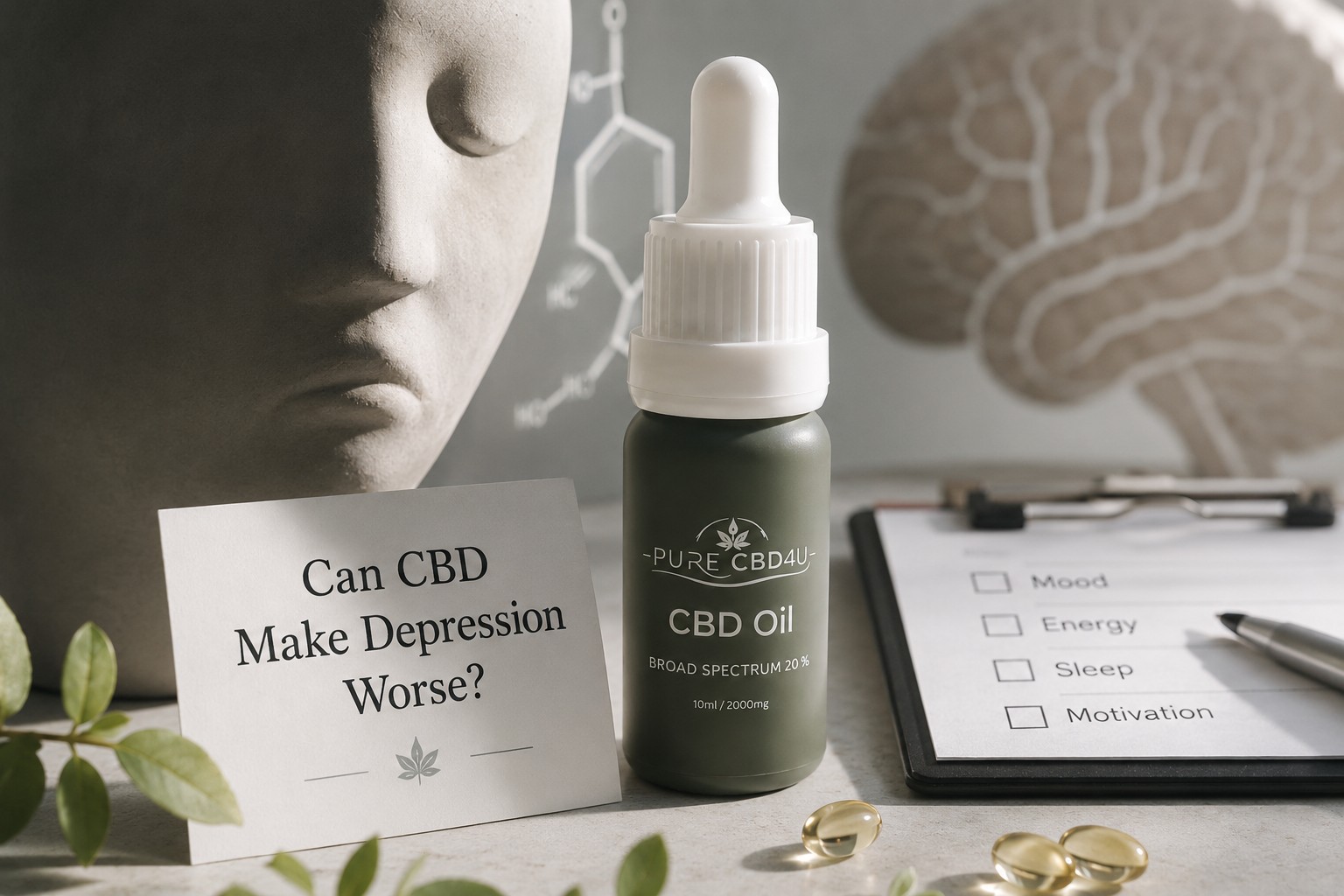
An investigation into one specific, difficult question
Some people report feeling calmer within an hour of taking CBD. Others notice nothing at all. And a smaller group — vocal enough to fill comment sections and forum threads — say it made them feel worse.
Three groups, three completely different experiences, from what is ostensibly the same product.
So the question worth asking directly is this: can CBD actually make depression worse?
Anecdotes alone won’t answer that. A single person’s account of feeling low after taking CBD is not scientific evidence — but it isn’t nothing either. It’s a data point worth examining, alongside the clinical research, before reaching any conclusion. That’s what this piece sets out to do.
Why This Question Keeps Coming Up
Search a handful of CBD forums and you’ll find the same pattern: two people take what is nominally the same product, and walk away with opposite reports. That alone explains why the question persists.
A few structural reasons help explain the spread of outcomes:
- Biology varies. Body weight, metabolism, and endocannabinoid system sensitivity differ from person to person.
- Expectations differ. Someone expecting a dramatic mood lift may interpret a neutral result as a negative one.
- The underlying condition differs. Depression is not a single, uniform experience — its causes and severity vary widely.
- Medication differs. Some people are on antidepressants or other prescriptions; others are not.
- Timing differs. CBD taken during a period of natural symptom fluctuation may get credited — or blamed — for something unrelated.
- Dose differs. Products range enormously in strength and quality, and so do the amounts people take.
None of this proves CBD is harmless, or harmful. It simply explains why the anecdotal picture is so inconsistent — and why it needs to be checked against actual research rather than accepted at face value.
What the Research Actually Says
Human clinical research on CBD and mood remains limited, and it’s worth being upfront about that rather than glossing over it.
Existing trials and safety data have not shown CBD to cause or worsen depression. Reviews of CBD’s safety profile generally describe it as well-tolerated at typical consumer doses, with side effects — when present — tending to be mild, such as fatigue or changes in appetite.
At the same time, the reverse claim doesn’t hold up either. Current evidence does not prove that CBD improves depression. Mood-related studies to date have mostly examined stress, anxiety, and sleep rather than clinical depression specifically, and much of the deeper mechanistic work remains in early or preclinical stages.
So the honest position, drawn directly from what the research supports, sits in the middle: no evidence of CBD causing depression, but no solid evidence of it treating depression either. Anyone claiming certainty in either direction is going further than the data allows.
Where Someone Might Genuinely Feel Worse — And Why That’s Not the Same as Cause
Some people do report feeling worse after starting CBD. That’s a real, reported experience — but reported and caused are two different things, and it’s worth separating them carefully.
A number of plausible explanations exist that have nothing to do with CBD itself:
- Simple fatigue, sometimes mistaken for low mood
- Poor product quality — mislabelled potency, contamination, or inconsistent extraction
- Mismatched expectations, where a lack of dramatic change reads as a negative outcome
- The natural progression of an underlying depressive episode, unrelated to CBD
- Interactions with other medications, including antidepressants
- Stopping antidepressants — intentionally or not — around the same time CBD use began
- Incorrect dosing, either too little to notice or too much to feel comfortable
- Coincidental timing — a stressful life event overlapping with new CBD use
- Disrupted sleep, which independently affects mood regardless of CBD
- Individual sensitivity, which varies as much with CBD as with any other compound
The point isn’t to dismiss anyone’s experience. It’s to say that feeling worse after taking CBD does not automatically mean CBD caused it. Correlation is not causation — and in a condition as multi-layered as depression, there are usually several candidate explanations before CBD itself becomes the most likely one.
When CBD Is Probably Not the Real Story
In many of the cases behind these anecdotes, CBD is unlikely to be the central factor at all. More often, the underlying picture involves one or more of the following, running in the background:
- Untreated or undiagnosed depression
- Burnout
- Unresolved trauma
- An anxiety disorder running alongside low mood
- An unaddressed medical condition
- Lifestyle factors — overwork, poor nutrition, lack of movement
- Ongoing chronic stress
- Social isolation
- Persistent poor sleep
CBD cannot resolve any of these on its own. Expecting it to is where the disappointment — and sometimes the sense of things “getting worse” — often actually originates.
Questions Worth Sitting With, Before Blaming the Product
Rather than jumping to a verdict, it’s worth working through a few honest questions first:
- How long have these symptoms actually existed?
- Have they been getting progressively worse, independent of anything else?
- Am I sleeping properly?
- Has there been a recent change in medication?
- Did the symptoms begin before I started using CBD, or after?
- Am I using a reputable, third-party-tested product?
- Am I expecting a result that CBD was never shown to deliver?
These questions won’t produce an instant answer. But they usually narrow down the likely explanation far more usefully than a snap judgment about the product itself.
If You Genuinely Feel Worse: What to Do Next
If mood has declined since starting CBD, the right response is not to keep adjusting the dose alone, and it isn’t to simply stop and say nothing to anyone either. A few concrete steps matter more:
- Stop experimenting alone — pause and take stock rather than trying another dose or product
- Talk with your physician, particularly if you’re on any other medication
- Review your medications together, including timing and any recent changes
- Review the dosage you’ve actually been taking, and the product’s quality and labelling
- Review what you were expecting CBD to do, honestly
- Seek help early — especially if depressive symptoms are increasing rather than staying level
Three Claims Worth Correcting
- “CBD causes depression.” Current evidence doesn’t support this — the research simply doesn’t show it.
- “If CBD doesn’t help immediately, it never will.” Timelines vary by person and use case; an immediate lack of effect isn’t proof of anything either way.
- “Natural products can’t affect mood.” Plant-derived compounds absolutely can interact with mood and biology — being natural doesn’t mean being inert.
The Honest Answer
Current evidence does not show CBD causes depression.
Current evidence also does not support CBD as a treatment for depression.
If someone feels worse while using it, that experience deserves proper investigation — sleep, medication, dosage, product quality, expectations, and the underlying condition itself — rather than a quick assumption that CBD is to blame. The honest answer sits between two extremes, and that middle ground is where the real picture actually lives.
| Medical Disclaimer CBD is not approved as a treatment for depression.Persistent depressive symptoms should always be evaluated by a healthcare professional.Anyone experiencing hopelessness or thoughts of self-harm should seek immediate medical assistance. |
Related Reading
- CBD and Serotonin
- CBD for Low Mood
- CBD for Stress-Related Depression
- CBD and Medication Interactions
Written by Carmen Dos Anjos Germano, Founder of Pure CBD4U
Carmen founded Pure CBD4U after her own search for reliable, high-quality CBD oil, starting with full spectrum CBD oil 5% as part of her personal wellness routine. That experience shaped the company’s focus on transparency, quality and independent testing. Pure CBD4U works with EU-grown hemp, uses third-party laboratory testing, and makes batch results accessible through QR codes on its products. Carmen remains closely involved in product selection, quality standards and the development of the Pure CBD4U range.

Leave a Reply