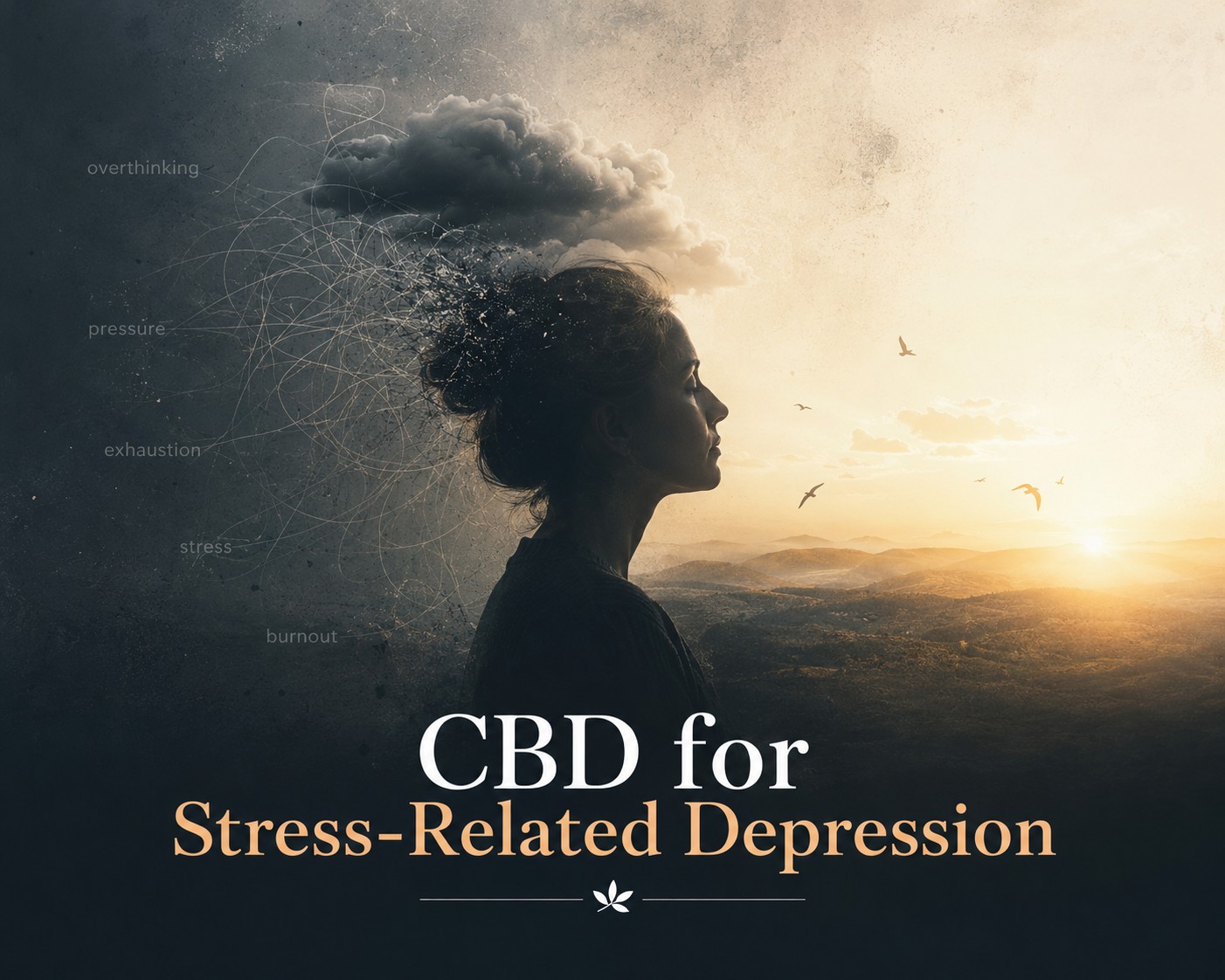
Understanding the line between chronic stress and depression — and where CBD honestly fits in
It didn’t happen overnight.
The long workdays became normal. Weekends stopped feeling like recovery. Sleep got lighter, then shorter, then unreliable. The small things that once helped you unwind — a walk, a film, a quiet evening — slowly stopped working the way they used to.
And then, somewhere along the way, you noticed something had shifted. Not a single bad day, but a low hum underneath every day. A tiredness that sleep didn’t fix. A flatness where motivation used to be.
You’re no longer simply stressed. You’re emotionally exhausted.
Can prolonged stress eventually affect your mood this deeply? It’s a fair question, and an increasingly common one. This article looks honestly at what we know about chronic stress, where it can overlap with depressive symptoms, and where CBD may — and may not — have a reasonable place in a broader recovery routine.
Stress, Burnout, and Depression Are Not the Same Thing
These words get used almost interchangeably in everyday conversation, but they describe different experiences, and the difference matters.
- Stress is a short-term response to pressure. It usually eases once the pressure lifts.
- Chronic stress is stress that doesn’t get the chance to resolve — it becomes the background state rather than the exception.
- Burnout is a specific kind of exhaustion tied to prolonged, often work-related, overload. It tends to include cynicism and a drop in a sense of effectiveness.
- Stress-related low mood describes a flatness or heaviness that develops alongside chronic stress, without necessarily meeting the criteria for depression.
- Clinical depression is a diagnosable mental health condition with its own criteria, duration, and severity, and it requires professional assessment.
It’s worth being clear about the overlap. Not everyone who experiences chronic stress develops depression. Not everyone with depression has been through a period of chronic stress. There is a real relationship between the two, but they are not the same condition, and one does not automatically lead to the other.
How Chronic Stress Changes the Body
Stress is, at its core, a survival mechanism. The body prepares to respond to a threat, then stands down once the threat passes. Chronic stress is what happens when that stand-down never quite arrives.
When the stress response stays switched on for weeks or months, a few things tend to happen. Cortisol, the body’s primary stress hormone, stays elevated for longer than it’s designed to. The fight-or-flight response, useful in short bursts, becomes a constant background setting rather than an occasional one.
Sleep is often one of the first things affected — it becomes lighter, more fragmented, or harder to fall into in the first place. Over time, this can contribute to low-grade inflammation, ongoing mental fatigue, and a kind of emotional exhaustion that doesn’t lift with a weekend off.
People in this state often notice reduced motivation, a pull toward social withdrawal, and difficulty concentrating on things that used to feel manageable. None of this happens overnight, and none of it means something has gone permanently wrong — but it does suggest the body needs a genuine chance to recover, not just a pause.
Where CBD Enters the Picture
This is the part of the conversation that deserves the most care, because it’s easy to overstate.
CBD interacts with the endocannabinoid system, a network involved in regulating processes such as mood, sleep, and the stress response. It also appears to interact with stress-response pathways more broadly, and with the 5-HT1A receptor, which is linked to serotonin signalling.
Here’s the honest distinction worth making: the research base around CBD and stress is meaningfully further along than the research base around CBD and depression. Some studies suggest CBD may support a subjective feeling of calm in stressful situations. That is a genuinely different claim from CBD treating depression, and the evidence does not support the latter.
This article won’t blur that line. CBD is not positioned here as a treatment for depression, and it shouldn’t be positioned that way anywhere.
| What the Evidence Actually Shows Established: CBD interacts with the endocannabinoid system and with 5-HT1A receptors.Emerging: some early research on stress-related outcomes, anxiety, and stress resilience, much of it from animal studies.Not established: CBD treating depression, reversing burnout, replacing therapy, or replacing antidepressant medication. |
Recovery Is Built on Lifestyle, Not Supplements
If chronic stress is the underlying issue, then recovery generally means addressing the source of that stress — not adding something on top of an otherwise unsustainable routine.
The elements that tend to matter most are ordinary, and that’s precisely the point:
- Consistent, sufficient sleep
- Clear boundaries around work and rest
- Regular movement or exercise
- Time spent outdoors or in nature
- A genuine reduction in workload, where possible
- Social connection, rather than isolation
- Mindfulness or other forms of deliberate mental rest
- Professional support, when needed
- A steady, nourishing diet
- A predictable daily routine
- Real time away from work, not just time off email
CBD cannot compensate for an unhealthy lifestyle, and it isn’t designed to. For some people, it may sit alongside these habits as one small, supportive part of a wellness routine. It is not a substitute for the changes that actually address chronic stress at its source.
Common Misunderstandings Worth Clearing Up
- “Stress always becomes depression.” It doesn’t. Many people experience prolonged stress without developing depression.
- “CBD fixes burnout.” There is no evidence for this. Burnout recovery is behavioural and structural, not chemical.
- “If I relax more, I’ll cure my depression.” Relaxation can help general wellbeing, but depression is a clinical condition that needs proper assessment and care.
- “One supplement solves chronic stress.” Chronic stress is usually the result of several compounding factors, and it tends to need several coordinated changes in response.
Coming Back to Where We Started
The goal was never simply to feel less stressed for an afternoon. The goal is creating enough genuine recovery that your body no longer believes it’s living through an emergency every single day.
For some people, CBD may become one small, supportive tool within that wider picture — nothing more dramatic than that, and nothing less honest either. But lasting recovery comes from addressing the chronic stress itself: the workload, the sleep, the boundaries, the support. That’s where the real work happens.
| Medical Disclaimer CBD is not a treatment for depression or burnout.Persistent depressive symptoms should always be evaluated by a doctor or qualified mental health professional.Anyone experiencing hopelessness or thoughts of self-harm should seek immediate professional help. |
Related Reading
- CBD for Mood Support
- CBD for Everyday Stress
- CBD for Work Stress
- CBD for Stress and Sleep
- CBD and Cortisol: What We Know
Written by Carmen Dos Anjos Germano, Founder of Pure CBD4U
Carmen founded Pure CBD4U after her own search for reliable, high-quality CBD oil, starting with full spectrum CBD oil 5% as part of her personal wellness routine. That experience shaped the company’s focus on transparency, quality and independent testing. Pure CBD4U works with EU-grown hemp, uses third-party laboratory testing, and makes batch results accessible through QR codes on its products. Carmen remains closely involved in product selection, quality standards and the development of the Pure CBD4U range.

Leave a Reply